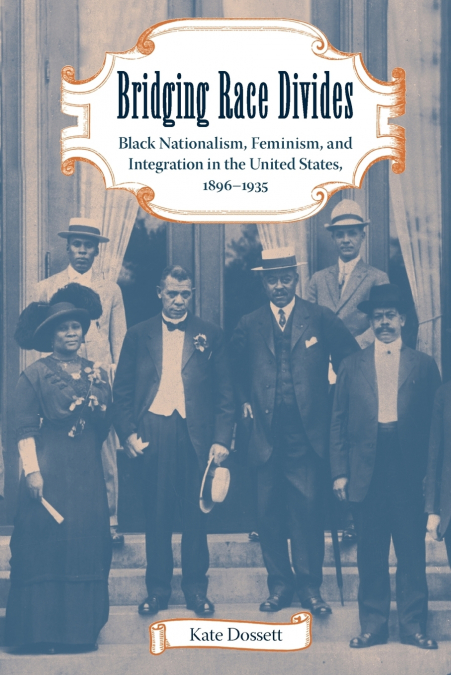

Bridging Race Divides

Bridging Race Divides

Kate Dossett

42,61 €
IVA incluido
Disponible
Editorial:
Longleaf Services on behalf of U of Florida Press
Año de edición:
2008
Materia
Historia de América
ISBN:
9780813034959
42,61 €
IVA incluido
Disponible

Selecciona una librería:

  • Librería Samer Atenea

  • Kálamo Books
  • Librería Elías (Asturias)
  • Librería Kolima (Madrid)
  • Librería Proteo (Málaga)

High-profile rivalries between black male leaders in the early twentieth century have contributed to the view that integrationism and black nationalism were diametrically opposed philosophies shaped primarily by men. Bridging Race Divides challenges this conceptualization by examining prominent 'race women' (including Amy Jacques Garvey, Mary McLeod Bethune, Madame C. J. Walker) as well as other participants in the Harlem Renaissance, Garveyism and the clubwomen’s movement to reveal the depth and complexity of women’s contributions to both black feminist and black nationalist traditions of activism in the early twentieth century. Ideas of authenticity and respectability were central to the construction of black identities within black cultural and political resistance movements of the early twentieth century. Unfortunately both concepts have also been used to demonize black middle-class women whose endeavors towards racial uplift are too frequently dismissed as assimilationist and whose class status has apparently disqualified them from performing 'authentic' blackness and exhibiting race pride.Kate Dossett challenges these conceptualizations in a thorough examination of prominent black women leaders’ political thought and cultural production in the years between the founding of the National Association of Colored Women in 1896 and the National Council of Negro Women in 1935. Through an analysis of black women’s political activism, entrepreneurship and literary endeavor, Dossett argues that black women made significant contributions toward the development of a black feminist tradition which enabled them to challenge the apparent dichotomy between black nationalism and integrationism.By exploring the connections between women like the pioneering black hairdresser Madam C. J. Walker and her daughter, A’Lelia, as well as clubwoman Mary McLeod Bethune and United Negro Improvement Association activist Amy Jacques Garvey, Dossett also makes a distinctive contribution to the field of women’s history by positioning black women at the forefront of both intellectual and practical endeavors in the struggle for black autonomy.
Artículos relacionados

  • Pan-Africanism and Education
    Kenneth J. King / Kenneth JKing
    This is an analysis of the complex links between Black America and Africa in the period of 1880 to 1945. It examines an extended white attempt to pattern politics and education in colonial Africa upon the example of the U.S. South. This export of United States race relations to Africa was resisted by Black intellectuals in the United States and many of the early nationalists in...
    Disponible

    24,60 €

  • The Native American Cookbook Recipes From Native American Tribes
    G.W. Mullins
    Light Of The Moon Publishing along with Author G.W. Mullins and Illustrator / Artist C.L. Hause have joined together to explore Native American Indian Cooking.  More than just a cookbook, this Native American recipe collection offers a look into a forgotten past.  'The Native American Cookbook Recipes From Native American Tribes,' offers a large collection of recipes from and i...
  • A Public Spirit
    George H. Atkinson
    George Henry Atkinson (1819-89) was a son of New England who arrived in the Oregon Territory in 1848, sent by the American Home Missionary Society. Although his commission from the Society specified that his work was to be ecclesiastical and educational, he took an approach to that assignment which went well beyond his mandate. Well-informed and energetic, he made an impact on ...
    Disponible

    10,45 €

  • North Carolina Women of the Confederacy
    Lucy London Anderson
    Long out of print, this volume of recollections, stories, and verse provides a glimpse of women's lives on the home front-and sometimes in the thick of battle-during the War between the States. Nearly fifty years after the American Civil War, Lucy Worth London Anderson (Mrs. John Huske Anderson) of Fayetteville, N.C., compiled one of the first memorial collections honoring the...
    Disponible

    17,20 €

  • Freedom by a Thread
    Freedom by a Thread: The History of Quilombos in Brazil brings together some of the best scholars in the world working on the history of quilombos (maroon societies) in Brazil from a variety of perspectives and approaches. Over 40 percent of the total volume of captive Africans arrived in Brazil during a 400-year period of legal and contraband transatlantic slaving. If slavery ...
    Disponible

    36,71 €

  • Nashville Baseball History
    Bill Traughber
    Nashville is a Big League city despite never having been home to a major league team. From the Civil War era, to star-studded exhibitions, to outstanding Negro Leagues teams, to some of the great minor league franchises of all time, few cities have as rich a baseball tradition as Nashville, Tennessee.Nashville sports historian Bill Traughber, who has been writing about baseball...
    Disponible

    13,15 €

Otros libros del autor

  • Radical Black Theatre in the New Deal
    Kate Dossett
    Between 1935 and 1939, the United States government paid out-of-work artists to write, act, and stage theatre as part of the Federal Theatre Project (FTP), a New Deal job relief program. In segregated “Negro Units” set up under the FTP, African American artists took on theatre work usually reserved for whites, staged black versions of “white” classics, and developed radical new...
    Disponible

    50,78 €

  • Radical Black Theatre in the New Deal
    Kate Dossett
    Between 1935 and 1939, the United States government paid out-of-work artists to write, act, and stage theatre as part of the Federal Theatre Project (FTP), a New Deal job relief program. In segregated “Negro Units” set up under the FTP, African American artists took on theatre work usually reserved for whites, staged black versions of “white” classics, and developed radical new...