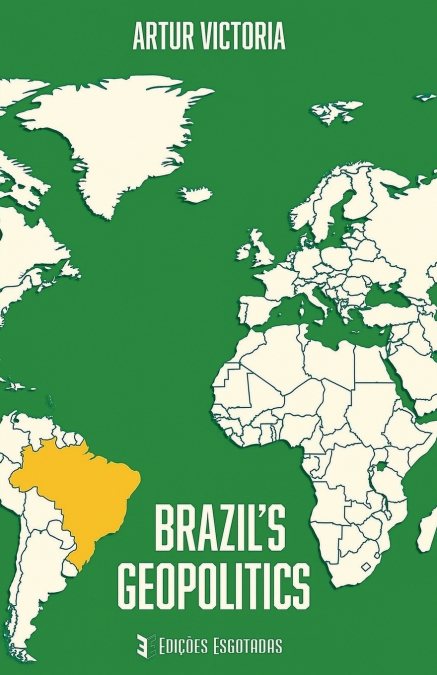

Brazil ´s Geopolitics

Brazil ´s Geopolitics

Artur Victoria

28,24 €
IVA incluido
Disponible
Editorial:
Edições Esgotadas
Año de edición:
2025
Materia
Política y gobierno
ISBN:
9798232852399
28,24 €
IVA incluido
Disponible

Selecciona una librería:

  • Librería Samer Atenea
  • Kálamo Books
  • Librería Elías (Asturias)
  • Librería Kolima (Madrid)
  • Librería Proteo (Málaga)

Brazil’s geopolitics is about a continental nation seeking to define its place in an ever-changing world. Positioned between the vast Atlantic and the intricate dynamics of South America, Brazil has long combined its territorial scale, abundant resources, and diplomatic tradition to pursue influence both regionally and globally. This book explores how geography, history, and strategic thought have shaped Brazil’s political trajectory and its aspirations for leadership and autonomy.Part I examines the historical and strategic foundations of Brazilian geopolitics, tracing the intellectual lineage from the Baron of Rio Branco to key military and civilian thinkers such as Golbery do Couto e Silva, Admiral Mário César Flores, General Carlos de Meira Mattos, and Therezinha de Castro. It analyses Brazil’s oscillation between development and non-alignment during the Cold War and the enduring role of soft power in its international identity.Part II focuses on territory, resources, and internal sovereignty, investigating how geography defines Brazil’s strategic posture. From the Amazon Basin and the Andes to the Atlantic coast, and through its great rivers-the Amazon, São Francisco, Paraná and River Plate-the nation’s vast natural systems underpin its economic and political integration.Part III explores Brazil as a regional power in South America, assessing its relations with neighbours, the factors shaping its foreign policy, and the opportunities and tensions that accompany regional leadership.Part IV addresses global geopolitics and strategic partnerships, analysing Brazil’s role in the international system, its participation in BRICS, and its complex interactions with the United States, the European Union, and the Portuguese-speaking world (CPLP).Part V turns to Brazil’s maritime domain, presenting a geostrategic vision of the South Atlantic, national defence, naval modernisation, and the emerging concept of the 'Blue Amazonia,' where maritime security and sustainability converge.Finally, Part VI introduces the concept of the Atlantic Triangle-a proposal positioning Brazil as a pivotal power linking South America, Africa, and Europe. It argues that this framework represents both a strategic vision and a call to action for Brazil’s future role in a multipolar world.Together, these parts offer a comprehensive understanding of Brazil’s geopolitical identity-rooted in history, defined by geography, and projected towards a global horizon.


Artículos relacionados

  • How Great a Crime - to tell the truth
    Neil Kay / Steven Kay
    Joseph Gales was one of the all-time great Sheffielders – forget Joe Cocker, Jessica Ennis-Hill, Sean Bean or Michael Palin. These are all minnows compared to Joseph Gales – and their stories are boring besides that of the Galeses. The Galeses story has been forgotten and has not been brought together in one place before – it is not just something dredged up from history – an i...
    Disponible

    10,33 €

  • Fearful Majesty
    Benson Bobrick
    Ivan the Terrible - the name evokes the legend of a cruel and dangerously insane tyrant. Fearful Majesty explores that legend and exposes the man, his nature, and his time.This acclaimed biography of one of Russia’s most important and tyrannical rulers is not only a rich, readable biography, it is also surprisingly timely, revealing how many of the issues Russia faces today hav...
    Disponible

    19,27 €

  • Economic Optimization of Innovation & Risk
    Robert Shuler
    A Theory of Crash Rate for Private & Public Projects with Critical or non-Critical systems.Analyzing & managing risk has been a quest for 5000 years, and is essential to everything from water supplies, finance, and agriculture to computers and space travel. At last there is a quantitative theory and a simple equation that allows you to: - choose your failure rate - get there...
    Disponible

    13,02 €

  • The System
    Lincoln Steffens
    The 'muckraker' Lincoln Steffens dug deep into business criminality and political corruption in a powerful series of articles written for McClure's magazine. Establishment newspapers and 'System' politicians dismissed his work as just another example of the decrepit modern journalism that could never pass for genuine writing. But Steffens' dogged quest for truth and justice set...
    Disponible

    23,66 €

  • Digital Activism in Asia Reader
    The digital turn might as well be marked as an Asian turn. From flash-mobs in Taiwan to feminist mobilisations in India, from hybrid media strategies of Syrian activists to cultural protests in Thailand, we see the emergence of political acts that transform the citizen from being a beneficiary of change to becoming an agent of change. In co-shaping these changes, what the digit...
    Disponible

    22,19 €

  • The New Freedom
    Woodrow Wilson
    In 1912, Woodrow Wilson was the Democratic nominee for President of the United States. He campaigned against the Republican incumbent, William Howard Taft, and Taft’s predecessor, Theodore Roosevelt, who had split off from the Republican Party to form his own Progressive, or Bull Moose, Party. Much of the campaign focused on the US economy, particularly the candidates’ views of...
    Disponible

    8,67 €

Otros libros del autor

  • Global Maritime Chokepoints
    Artur Victoria
    Global Maritime Chokepoints: Oceans, Trade and the Geopolitics of Power in the Twenty-First Century, written under supervision of the geopolitical expert Artur Victoria for the Ocean Geopolitics Centre, examines the narrow maritime passages upon which an extraordinary proportion of global trade, energy security and strategic mobility depends.Moving across the world’s principal ...
    Disponible

    32,74 €

  • Geopolitics of Institutional Asymmetry
    Artur Victoria
    The Geopolitics of Institutional Asymmetry develops a theoretical framework for understanding power in the twenty-first century. While classical geopolitics emphasises geography, military strength, economic resources and technology, the book argues that these assets alone cannot explain why states with comparable capabilities often achieve markedly different strategic outcomes....
    Disponible

    28,60 €

  • Evolution of a Thought
    Artur Victoria
    Evolution of a Thought reconstructs the intellectual journey through which professional legal enquiry gradually expanded into the study of ethics, institutions, National Defence, geopolitics and strategic power. Rather than presenting this development as predetermined, the book examines how experience, research and writing progressively generated new questions and conceptual fr...
    Disponible

    32,77 €

  • The Pragmatics of Virtue
    Artur Victoria
    The Pragmatics of Virtue provides a compelling investigation into how invisible moral principles shape the physical and administrative reality of our societies. Moving beyond traditional genealogy, Artur Victoria uses a prominent Portuguese lineage across three centuries as a rigorous sociological case study. The volume explores the moment abstract ideals encounter budgets, inf...
    Disponible

    15,34 €

  • Institutions, Civic Leadership and a Portuguese Family Across Three Centuries
    Artur Victoria
    History is often written through wars, revolutions, monarchs and political leaders. Yet the continuity of nations depends less upon exceptional events than upon the institutions that quietly preserve justice, education, charity, public administration and civic responsibility across generations. This book explores that hidden dimension of history through an extensive documentary...
    Disponible

    14,24 €

  • Adaptive Power
    Artur Victoria
    This book argues that the twenty-first century is witnessing a profound transformation in the nature of power. Traditional explanations of national strength-territory, military capability, industrial capacity and economic wealth-remain important but are no longer sufficient to explain why some states and institutions consistently outperform others under conditions of accelera...
    Disponible

    22,50 €