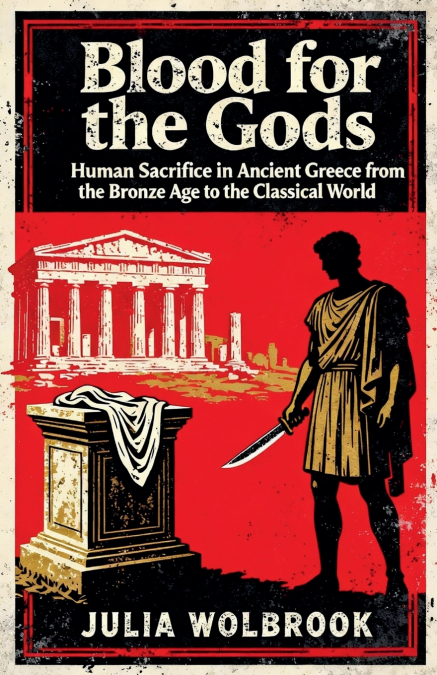

Inicio > Humanidades > Filosofía > Historia de la filosofía occidental > Filosofía occidental: antigua, hasta c. 500 > Blood for the Gods Human Sacrifice in Ancient Greece from the Bronze Age to the Classical World
Blood for the Gods Human Sacrifice in Ancient Greece from the Bronze Age to the Classical World

Blood for the Gods Human Sacrifice in Ancient Greece from the Bronze Age to the Classical World

Julia Wolbrook

14,74 €
IVA incluido
Disponible
Editorial:
Serena Capuozzo
Año de edición:
2026
Materia
Filosofía occidental: antigua, hasta c. 500
ISBN:
9798233613449
14,74 €
IVA incluido
Disponible

Selecciona una librería:

  • Librería Samer Atenea

  • Kálamo Books
  • Librería Elías (Asturias)
  • Librería Kolima (Madrid)
  • Librería Proteo (Málaga)

Did the ancient Greeks-celebrated as the founders of Western rational thought-once offer human lives to their gods?For centuries, the idea of human sacrifice in ancient Greece has been dismissed as myth, metaphor, or foreign slander. Blood for the Gods challenges this long-held assumption with a bold, evidence-driven reexamination of one of the most unsettling aspects of Greek religious history.Drawing on literary sources, comparative anthropology, and newly emerging archaeological data, this book traces the development of human sacrifice in Greek cultures from the Late Bronze Age through the end of the Classical Period. It explores not only whether such rituals occurred, but how the Greeks themselves understood and justified them-from heroic myths and ritualized violence to moments of moral tension and cultural unease.Moving beyond sensationalism, Blood for the Gods situates Greek practices within a wider eastern Mediterranean and Aegean context, revealing the complex web of cultural exchange, migration, and religious influence that shaped ritual behavior across the ancient world. By examining potential origins and transmission routes, the book offers a compelling explanation for how and why these rites emerged-and why they ultimately faded.Provocative, meticulously researched, and deeply engaging, Blood for the Gods invites readers to confront the darker edges of Greek antiquity and reconsider what 'civilization' meant in the ancient world.Perfect for readers interested in:· Ancient Greek religion and ritual· Human sacrifice and ritual violence· Bronze Age and Classical history· Myth, archaeology, and cultural exchange· The darker foundations of Western civilizationThis is not the Greece of marble statues and philosophical ideals-but the Greece where blood, belief, and the divine were sometimes inseparable.

Artículos relacionados

  • The Nature of Things
    Lucretius Lucretius
    De rerum natura (On the Nature of Things) is a 1st century BC didactic poem by the Roman poet and philosopher Lucretius with the goal of explaining Epicurean philosophy to a Roman audience. Lucretius presents the principles of atomism; the nature of the mind and soul; explanations of sensation and thought; the development of the world and its phenomena; and explains a variety o...
  • Pompeii
    Fergus Mason
    Pompeii was one of most advanced cities of its time; it had a complex water system, gymnasium, and an amphitheater. Despite it's advancements, there was one thing it wasn't ready for: Mount Vesuvius—the volcano that led to its ultimate doom.  The 79 AD eruption of Mount Vesuvius was one of the worst disasters in all of European history. In a near instant, over 15,000 p...
    Disponible

    12,45 €

  • Middle Platonism and Neoplatonism, Volume 1
    Stephen Gersh
    'It is generally agreed that those types of philosophy that are loosely called ’Platonic’ and ’Neoplatonic’ played a crucial role in the history of European culture during the centuries between antiquity and the Renaissance. However, until now no scholar has attempted to describe the evolution of these forms of thought in a single comprehensive academic study.' So writes Stephe...
  • Middle Platonism and Neoplatonism, Volume 2
    Stephen Gersh
    It is generally agreed that those types of philosophy that are loosely called 'Platonic' and 'Neoplatonic' played a crucial role in the history of European culture during the centuries between antiquity and the Middle Ages. However, until now no scholar has attempted to describe the evolution of these forms of thought in a single comprehensive academic study. Middle Platonism a...
  • Porphyry’s Commentary on Ptolemy’s Harmonics
    Andrew Barker
    ...
    Disponible

    91,02 €

  • The Roots of Platonism
    John Dillon
    ...
    Disponible

    29,89 €

Otros libros del autor

  • Beautiful Mind, Invisible Genius Hedy Lamarr, Frequency Hopping, and the Feminist Politics of Who Gets Credit in STEM
    Julia Wolbrook
    People called her the most beautiful woman in the world. No one thought to ask what she was thinking.In 1942, while MGM sold her face to millions, Hedy Lamarr quietly patented an idea that would one day help power Wi-Fi, Bluetooth, and GPS. The Navy told her to sell war bonds instead. The press made her the punchline. Her invention vanished into a classified vault, and her name...
    Disponible

    17,16 €

  • Haunted by Freedom Motherhood, Trauma, and Resistance from Harriet Jacobs to Toni Morrison and Harriet Tubman
    Julia Wolbrook
    Freedom was the dream. Survival was the battle. Motherhood was the sacrifice.What does freedom mean when the wounds of slavery refuse to disappear?From the harrowing testimony of Harriet Jacobs to the haunting literary imagination of Toni Morrison and the extraordinary courage of Harriet Tubman, Haunted by Freedom explores the hidden human cost of slavery and its enduring legac...
    Disponible

    17,00 €

  • Witch City How a Massacre of the Innocent Became New England’s Biggest Attraction
    Julia Wolbrook
    In 1692, Salem hanged nineteen people and crushed a twentieth beneath stones. Three centuries later, it sells them as souvenirs.How does a town turn its worst year into its best business?Witch City follows Salem from the gallows of Gallows Hill to the broomsticks on its fire trucks, tracing the strange journey of a community that first buried its shame, then slowly rediscovered...
    Disponible

    14,85 €

  • The Kim Throne How North Korea Turned a Family into a God
    Julia Wolbrook
    Every dictatorship is supposed to die with its dictator. North Korea did not.When Kim Il-sung died in 1994, the world waited for collapse. When Kim Jong-il followed in 2011, it waited again. Each time, the regime did the unthinkable: it handed power to the next Kim, and grew stronger.How?The Kim Throne takes you from the myth of a god who descended on Mount Paektu to the glass ...
    Disponible

    15,96 €

  • The Forgotten Corps Commander Lieutenant General Richard H. Anderson and the Tactical Genius of the Army of Northern Virginia
    Julia Wolbrook
    He fought in nearly every major battle of Lee’s army. He rose to command a corps. And almost no one remembers his name.Richard Heron Anderson never wrote the reports. He never claimed the credit. At Williamsburg, Seven Pines, Gaines’s Mill, Chancellorsville, Spotsylvania, and Cold Harbor, he was in the thick of the fight while others collected the praise, and he let them. His o...
    Disponible

    15,91 €

  • Gentlemen of Fortune The Forgotten Aristocrats of the Golden Age of Piracy and the War That Erased Them
    Julia Wolbrook
    Everything you know about pirates was written by the people who destroyed them.Blackbeard was no ragged outcast. Born into a Jamaican planter’s family, a Royal Navy veteran with land, enslaved workers, and a name in the parish registers, Edward Thache was one of the gentlemen of fortune: wealthy privateers, merchants, and planters who ruled the Atlantic’s treasure trade long be...
    Disponible

    15,98 €