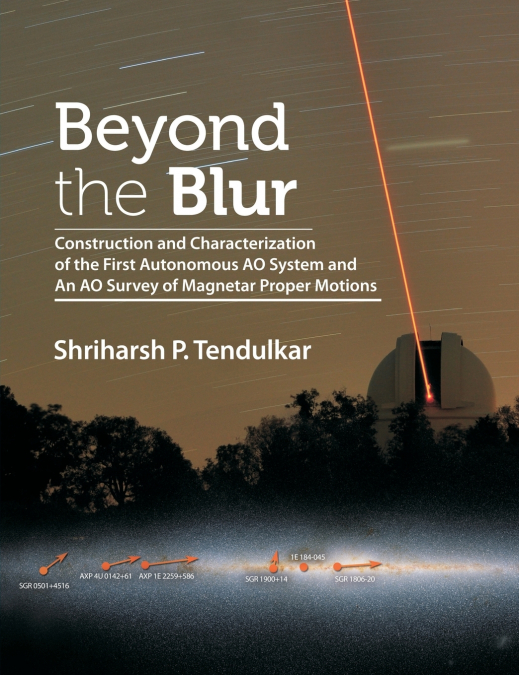

Beyond the Blur

Beyond the Blur

Beyond the Blur

Shriharsh Tendulkar

36,39 €
IVA incluido
Disponible
Editorial:
Universal-Publishers.com
Año de edición:
2014
Materia
Astrofísica
ISBN:
9781612334240
36,39 €
IVA incluido
Disponible

Selecciona una librería:

  • Librería Samer Atenea
  • Librería Aciertas (Toledo)
  • Kálamo Books
  • Librería Perelló (Valencia)
  • Librería Elías (Asturias)
  • Donde los libros
  • Librería Kolima (Madrid)
  • Librería Proteo (Málaga)

Adaptive optics (AO) corrects distortions created by atmospheric turbulence and delivers diffraction-limited images on ground-based telescopes. The vastly improved spatial resolution and sensitivity has been utilized for studying everything from the magnetic fields of sunspots upto the internal dynamics of high-redshift galaxies. This thesis about AO science from small and large telescopes is divided into two parts: Robo-AO and magnetar kinematics.In the first part, I discuss the construction and performance of the world’s first fully autonomous visible light AO system, Robo-AO, at the Palomar 60-inch telescope. Robo-AO operates extremely efficiently with an overhead < 50s, typically observing about 22 targets every hour. We have performed large AO programs observing a total of over 7,500 targets since May 2012. In the visible band, the images have a Strehl ratio of about 10% and achieve a contrast of upto 6 magnitudes at a separation of 1??. The full-width at half maximum achieved is 110-130 milli-arcsecond. I describe how Robo-AO is used to constrain the evolutionary models of low-mass pre-main-sequence stars by measuring resolved spectral energy distributions of stellar multiples in the visible band, more than doubling the current sample. I conclude this part with a discussion of possible future improvements to the Robo-AO system.In the second part, I describe a study of magnetar kinematics using high-resolution near-infrared (NIR) AO imaging from the 10-meter Keck II telescope. Measuring the proper motions of five magnetars with a precision of upto 0.7 milli-arcsecond/yr, we have more than tripled the previously known sample of magnetar proper motions and proved that magnetar kinematics are equivalent to those of radio pulsars. We conclusively showed that SGR 1900+14 and SGR 1806-20 were ejected from the stellar clusters with which they were traditionally associated. The inferred kinematic ages of these two magnetars are 6±1.8 kyr and 650±300 yr respectively. These ages are a factor of three to four times greater than their respective characteristic ages. The calculated braking index is close to unity as compared to three for the vacuum dipole model and 2.5-2.8 as measured for young pulsars. I conclude this section by describing a search for NIR counterparts of new magnetars and a future promise of polarimetric investigation of a magnetars’ NIR emission mechanism.

Artículos relacionados

  • Mars Colonization
    Randy Jones
    Life as we know it has always been confined to our single blue planet called earth. But will it always be that way? Discover just how close we are to changing life as we know it forever, and what it will take to push humanity into a new era of exploration and discovery. Find out how the next steps for our future will be unlike anything civilization as we know it has experienced...
    Disponible

    16,03 €

  • Predicting the Eclipse
    Stephen Wolfram
    Total eclipses of the Sun are rare and dramatic--and on April 8, 2024, one will cross the US. But when exactly will it happen? In this short but richly illustrated book, prominent scientist and computation pioneer Stephen Wolfram tells the triumphant and hard-won story--spanning more than two thousand years--of how science, mathematics and computation have brought us to the poi...
    Disponible

    13,52 €

  • High Energy Astrophysics
    Malcolm S. Longair
    Providing students with an in-depth account of the astrophysics of high energy phenomena in the Universe, the third edition of this well-established textbook is ideal for advanced undergraduate and beginning graduate courses in high energy astrophysics. Building on the concepts and techniques taught in standard undergraduate courses, this textbook provides the astronomical and ...
  • Strange New Worlds
    Ray Jayawardhana
    An insider’s look at the cutting-edge science of today’s planet huntersIn Strange New Worlds, renowned astronomer Ray Jayawardhana brings news from the front lines of the epic quest to find planets-and alien life-beyond our solar system. Only in the past two decades, after millennia of speculation, have astronomers begun to discover planets around other stars-thousands in fact....
    Disponible

    29,12 €

  • Galactic Astronomy
    James Binney / Michael Merrifield
    This is the definitive treatment of the phenomenology of galaxies--a clear and comprehensive volume that takes full account of the extraordinary recent advances in the field. The book supersedes the classic text Galactic Astronomy that James Binney wrote with Dimitri Mihalas, and complements Galactic Dynamics by Binney and Scott Tremaine. It will be invaluable to researchers an...
    Disponible

    155,26 €

  • Welcome to the Universe
    J. Richard Gott / Michael A. Strauss / Neil deGrasse Tyson
    An essential companion to the New York Times bestseller Welcome to the UniverseHere is the essential companion to Welcome to the Universe, a New York Times bestseller that was inspired by the enormously popular introductory astronomy course for non science majors that Neil deGrasse Tyson, Michael A. Strauss, and J. Richard Gott taught together at Princeton. This problem book fe...