
Beyond Labor’s Veil

Beyond Labor’s Veil

Robert E. Weir / Robert EWeir

68,58 €
IVA incluido
Disponible
Editorial:
Penn State University Press
Año de edición:
1996
Materia
Sociedad y cultura: general
ISBN:
9780271029269
68,58 €
IVA incluido
Disponible

Selecciona una librería:

  • Librería Samer Atenea
  • Kálamo Books
  • Librería Elías (Asturias)
  • Librería Kolima (Madrid)
  • Librería Proteo (Málaga)

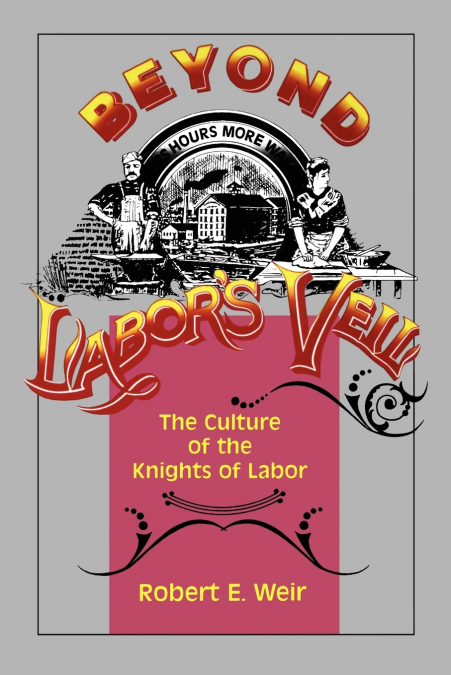
The Noble and Holy Order of the Knights of Labor was founded in 1869 as a secret fraternal order committed to the goal of uniting American labor. At its height in 1886, the Knights claimed the allegiance of perhaps a million workers. Despite a host of local studies by the new labor historians of the 1970s and 1980s, there has been no general study of the Knights since Norman Ware’s 1929 book, and no one has ever attempted a comprehensive study of the culture of the organization. In Beyond Labor’s Veil, Robert E. Weir presents a fascinating cultural portrait of the Knights across regions, covering the years 1869 to 1893.From the start, the Knights of Labor was an unusual organization, equal parts fraternal order and labor union. It was the only nineteenth-century labor organization to organize African Americans, women, and unskilled workers on an equal basis with white craftsmen. Weir goes beyond the rhetoric of public pronouncements and union politics to consider the real influence of the Knights—in communities and homes as well as in the workplace. Weir explores the many cultural expressions of the Knights—ritual, religion, poetry, music, literature, material objects, graphics, and leisure. Although the Knights barely survived into the twentieth century, Weir concludes that the creative cultural expressions of the Knights enabled it to do as well as it did in the face of powerful oppositional forces. What emerges in Beyond Labor’s Veil is a rich, detailed description of the Knights as its members adapted to the confusion and contradiction of America’s Gilded Age. 6


Artículos relacionados

  • The Gandhian Iceberg
    Chris D Moore-Backman
    The Gandhian Iceberg presents a bold, new interpretation of Gandhian nonviolence from the rare perspective of an author who is equal parts writer, scholar, and frontlines practitioner. The book faces the current crisis of climate change and the intensification of social unrest around the world, and calls for a new convergence of serious, spiritually-rooted US nonviolence activi...
    Disponible

    11,52 €

  • Contemporary Developments in Child Protection
    Nigel Parton
    Volume 1 "Policy Changes and Challenges" takes as its central theme the ongoing and challenging issues which child protection agencies have to address and the policy and practice initiatives that are developed to try and address these. The volume includes papers on: the relationship between the decline in the rate of ‘unnatural’ deaths and the growth of concern about child abus...
  • Diversity in Information Technology Education
    Goran Trajkovski
    ...
  • Model-Driven Software Development
    Model-driven software development (MDSD) drastically alters the software development process, characterized by a high degree of innovation and productivity. However, quality assurance application in the domain of software models and model-driven software development is still in an emergent phase. Model-Driven Software Development: Integrating Quality Assurance provides in-depth...
  • Evidence-Based Practice in Nursing Informatics
    Andrew Chasin
    Because of the constant advances and dynamics within the nascent field of nursing informatics, many nurses struggle in practice as they continue to try and apply habitual communication practices in the new environment without any critical reflection on, and adaptation of, those practices. Evidence-Based Practice in Nursing Informatics: Concepts and Applications serves as a valu...
  • Actor-Network Theory and Technology Innovation
    Arthur Tatnall
    About 25 years ago, the first developments of ANT (Actor-Network Theory) took place, but it wasn’t until much later that researchers began to take it seriously. In the late 1990s, ANT began to take hold in the scientific community as a new and exciting approach to socio-technical research and social theory. Actor-Network Theory and Technology Innovation: Advancements and New Co...