
BERRU Predictive Modeling

BERRU Predictive Modeling

Dan Gabriel Cacuci

221,57 €
IVA incluido
Consulta disponibilidad
Editorial:
Springer Nature B.V.
Año de edición:
2019
Materia
Ingeniería: general
ISBN:
9783662583937

Selecciona una librería:

  • Librería Samer Atenea
  • Librería Aciertas (Toledo)
  • Kálamo Books
  • Librería Perelló (Valencia)
  • Librería Elías (Asturias)
  • Donde los libros
  • Librería Kolima (Madrid)
  • Librería Proteo (Málaga)

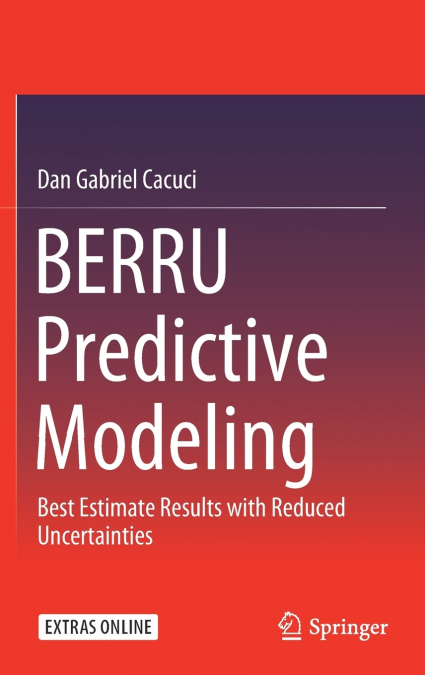
This book addresses the experimental calibration of best-estimate numerical simulation models. The results of measurements and computations are never exact. Therefore, knowing only the nominal values of experimentally measured or computed quantities is insufficient for applications, particularly since the respective experimental and computed nominal values seldom coincide. In the author’s view, the objective of predictive modeling is to extract 'best estimate' values for model parameters and predicted results, together with 'best estimate' uncertainties for these parameters and results. To achieve this goal, predictive modeling combines imprecisely known experimental and computational data, which calls for reasoning on the basis of incomplete, error-rich, and occasionally discrepant information. The customary methods used for data assimilation combine experimental and computational information by minimizing an a priori, user-chosen, 'cost functional' (usually a quadratic functional that represents the weighted errors between measured and computed responses). In contrast to these user-influenced methods, the BERRU (Best Estimate Results with Reduced Uncertainties) Predictive Modeling methodology developed by the author relies on the thermodynamics-based maximum entropy principle to eliminate the need for relying on minimizing user-chosen functionals, thus generalizing the 'data adjustment' and/or the '4D-VAR' data assimilation procedures used in the geophysical sciences. The BERRU predictive modeling methodology also provides a 'model validation metric' which quantifies the consistency (agreement/disagreement) between measurements and computations. This 'model validation metric' (or 'consistency indicator') is constructed from parameter covariance matrices, response covariance matrices (measured and computed), and response sensitivities to model parameters. Traditional methods for computing response sensitivities are hampered by the 'curse of dimensionality,' which makes them impractical for applications to large-scale systems that involve many imprecisely known parameters. Reducing the computational effort required for precisely calculating the response sensitivities is paramount, and the comprehensive adjoint sensitivity analysis methodology developed by the author shows great promise in this regard, as shown in this book. After discarding inconsistent data (if any) using the consistency indicator, the BERRU predictive modeling methodology provides best-estimate values for predicted parameters and responses along with best-estimate reduced uncertainties (i.e., smaller predicted standard deviations) for the predicted quantities. Applying the BERRU methodology yields optimal, experimentally validated, 'best estimate' predictive modeling tools for designing new technologies and facilities, while also improving on existing ones.  

Artículos relacionados

  • Modeling and Simulation Techniques in Structural Engineering
    The development of new and effective analytical and numerical models is essential to understanding the performance of a variety of structures. As computational methods continue to advance, so too do their applications in structural performance modeling and analysis. Modeling and Simulation Techniques in Structural Engineering presents emerging research on computational techniqu...
  • Arduino Programming
    Ryan roffe
    New to programming and seeking an open-source electronic interface? Look no further than Arduino!With various Arduino models available and a plethora of online and offline projects utilizing Arduino technology, its versatility and user-friendliness have drawn both beginners and experts alike.Introducing 'Arduino Programming: A Comprehensive Beginner’s Tutorial to Master Arduin...
    Disponible

    23,50 €

  • Modeling and Simulation of Functional Nanomaterials for Forensic Investigation
    Nanotechnology continues to contribute to the progress of innovations in the area of forensic science ranging from sensing, DNA monitoring, and counterfeiting to fingerprinting. In recent years, functional nanomaterials are widely applied in nanoscience and forensic investigation. They can be used in future interdisciplinary research by scientists, engineers, and biotechnologis...
    Disponible

    249,04 €

  • Transformers for Natural Language Processing and Computer Vision - Third Edition
    Denis Rothman
    The definitive guide to LLMs, from architectures, pretraining, and fine-tuning to Retrieval Augmented Generation (RAG), multimodal AI, risk mitigation, and practical implementations with ChatGPT, Hugging Face, and Vertex AIGet With Your Book: PDF Copy, AI Assistant, and Next-Gen Reader FreeKey Features:- Compare and contrast 20+ models (including GPT, BERT, and Llama) and multi...
    Disponible

    79,99 €

  • Cisco Packet Tracer Implementation
    S. R. Jena
    Welcome to the World of Cisco Packet Tracer! This book 'Cisco Packet Tracer Implementation: Building and Configuring Networks' serves as a comprehensive guide for network engineers, students, and enthusiasts who want to master the art of building and configuring networks using Cisco Packet Tracer. In today’s digital age, networks play a critical role in connecting people, devic...
  • Matlab
    De Dr. A. M. Oliveira
    O objetivo deste trabalho é apresentar a aplicação da metodologia de aprendizagem baseada em problemas (PBL) paraaulas da disciplinas de Algoritmos e Cálculo Numérico em Matlab para cursos de Engenharia, com intuito de comprometer os alunos com a resolução de problemas reais de engenharia através do uso da PBL de tal forma que os mesmos sintam-se inspirados a participar das aul...
    Disponible

    15,08 €

Otros libros del autor

  • Advances in High-Order Predictive Modeling
    Dan Gabriel Cacuci
    Continuing the author’s previous work on modeling, this book presents the most recent advances in high-order predictive modeling. ...
  • The nth-Order Comprehensive Adjoint Sensitivity Analysis Methodology, Volume I
    Dan Gabriel Cacuci
    The computational models of physical systems comprise parameters, independent and dependent variables. Since the physical processes themselves are seldom known precisely and since most of the model parameters stem from experimental procedures which are also subject to imprecisions, the results predicted by these models are also imprecise, being affected by the uncertainties und...
    Disponible

    207,28 €

  • The nth-Order Comprehensive Adjoint Sensitivity Analysis Methodology, Volume III
    Dan Gabriel Cacuci
    This text describes a comprehensive adjoint sensitivity analysis methodology (C-ASAM), developed by the author, enabling the efficient and exact computation of arbitrarily high-order functional derivatives of model responses to model parameters in large-scale systems. The model’s responses can be either scalar-valued functionals of the model’s parameters and state variables (as...
    Disponible

    47,40 €

  • The nth-Order Comprehensive Adjoint Sensitivity Analysis Methodology, Volume III
    Dan Gabriel Cacuci
    This text describes a comprehensive adjoint sensitivity analysis methodology (C-ASAM), developed by the author, enabling the efficient and exact computation of arbitrarily high-order functional derivatives of model responses to model parameters in large-scale systems. The model’s responses can be either scalar-valued functionals of the model’s parameters and state variables (as...
  • The nth-Order Comprehensive Adjoint Sensitivity Analysis Methodology, Volume I
    Dan Gabriel Cacuci
    The computational models of physical systems comprise parameters, independent and dependent variables. Since the physical processes themselves are seldom known precisely and since most of the model parameters stem from experimental procedures which are also subject to imprecisions, the results predicted by these models are also imprecise, being affected by the uncertainties und...