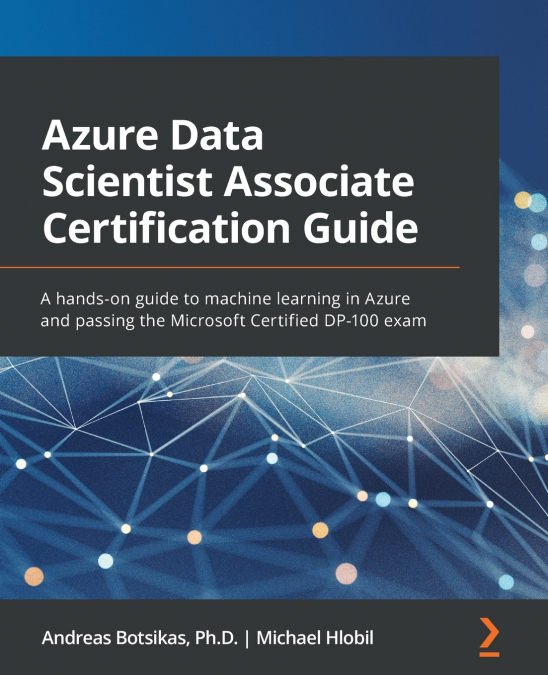
Andreas Botsikas / Michael Hlobil
 Librería Samer Atenea
 Kálamo Books
 Librería Elías (Asturias)
 Librería Kolima (Madrid)
 Librería Proteo (Málaga)
Develop the skills you need to run machine learning workloads in Azure and pass the DP-100 exam with easeKey Features:Create end-to-end machine learning training pipelines, with or without codeTrack experiment progress using the cloud-based MLflow-compatible process of Azure ML servicesOperationalize your machine learning models by creating batch and real-time endpoints Book Description:The Azure Data Scientist Associate Certification Guide helps you acquire practical knowledge for machine learning experimentation on Azure. It covers everything you need to pass the DP-100 exam and become a certified Azure Data Scientist Associate.Starting with an introduction to data science, you’ll learn the terminology that will be used throughout the book and then move on to the Azure Machine Learning (Azure ML) workspace. You’ll discover the studio interface and manage various components, such as data stores and compute clusters.Next, the book focuses on no-code and low-code experimentation, and shows you how to use the Automated ML wizard to locate and deploy optimal models for your dataset. You’ll also learn how to run end-to-end data science experiments using the designer provided in Azure ML Studio.You’ll then explore the Azure ML Software Development Kit (SDK) for Python and advance to creating experiments and publishing models using code. The book also guides you in optimizing your model’s hyperparameters using Hyperdrive before demonstrating how to use responsible AI tools to interpret and debug your models. Once you have a trained model, you’ll learn to operationalize it for batch or real-time inferences and monitor it in production.By the end of this Azure certification study guide, you’ll have gained the knowledge and the practical skills required to pass the DP-100 exam.What You Will Learn:Create a working environment for data science workloads on AzureRun data experiments using Azure Machine Learning servicesCreate training and inference pipelines using the designer or codeDiscover the best model for your dataset using Automated MLUse hyperparameter tuning to optimize trained modelsDeploy, use, and monitor models in productionInterpret the predictions of a trained modelWho this book is for:This book is for developers who want to infuse their applications with AI capabilities and data scientists looking to scale their machine learning experiments in the Azure cloud. Basic knowledge of Python is needed to follow the code samples used in the book. Some experience in training machine learning models in Python using common frameworks like scikit-learn will help you understand the content more easily.