
Auctioning Intelligence

Auctioning Intelligence

Toshihiro Tsuchihashi

57,19 €
IVA incluido
Disponible
Editorial:
Eliva Press
Año de edición:
2025
Materia
Sociedad y cultura: general
ISBN:
9789999328067
57,19 €
IVA incluido
Disponible

Selecciona una librería:

  • Librería Samer Atenea
  • Librería Aciertas (Toledo)
  • Kálamo Books
  • Librería Perelló (Valencia)
  • Librería Elías (Asturias)
  • Donde los libros
  • Librería Kolima (Madrid)
  • Librería Proteo (Málaga)

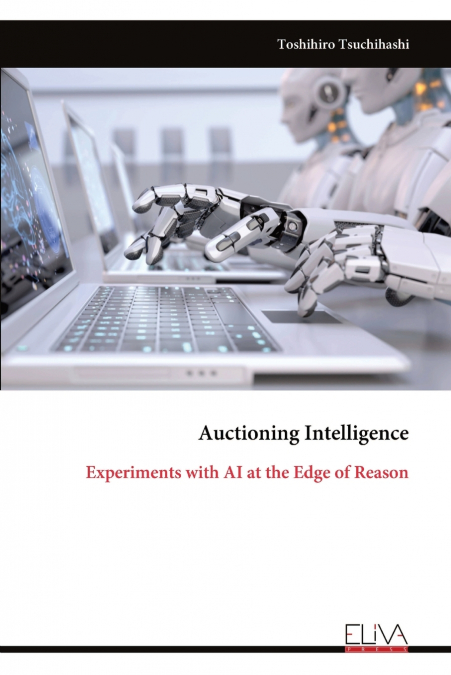
Auctioning Intelligence: Experiments with AI at the Edge of Reason explores a fundamental question: When placed in strategic, incentive-driven settings like auctions, can large language models such as ChatGPT behave like humans?While LLMs have demonstrated impressive performance across language tasks and professional exams, their behavior in competitive decision-making environments reveals striking differences from human participants. Through a series of carefully designed auction experiments, this book shows that even the latest versions of ChatGPT, despite their linguistic fluency, consistently diverge from human strategies when real stakes are involved.The findings highlight a key reality: LLMs are optimized to produce coherent language, not to maximize rewards. Without emotional heuristics like risk aversion or the instinct to win, and drawing on vast but imperfect human-generated data, ChatGPT’s actions remain fundamentally different from ours in strategic settings. These results challenge the assumption that more training or broader knowledge alone can bridge the gap between AI and human decision-making.While the experiments may evoke comparisons to a Turing test, the core focus here is not whether AI can ''appear human,'' but whether it can act human when true incentives and strategic reasoning are required. In doing so, Auctioning Intelligence invites readers to rethink what human-like intelligence really means-and whether AI can ever truly replicate it.Drawing inspiration from science fiction visions, including Philip K. Dick’s Do Androids Dream of Electric Sheep?, this book offers a timely and thought-provoking investigation into the evolving frontier between artificial and human minds.


Artículos relacionados

  • The Gandhian Iceberg
    Chris D Moore-Backman
    The Gandhian Iceberg presents a bold, new interpretation of Gandhian nonviolence from the rare perspective of an author who is equal parts writer, scholar, and frontlines practitioner. The book faces the current crisis of climate change and the intensification of social unrest around the world, and calls for a new convergence of serious, spiritually-rooted US nonviolence activi...
    Disponible

    11,52 €

  • Contemporary Developments in Child Protection
    Nigel Parton
    Volume 1 "Policy Changes and Challenges" takes as its central theme the ongoing and challenging issues which child protection agencies have to address and the policy and practice initiatives that are developed to try and address these. The volume includes papers on: the relationship between the decline in the rate of ‘unnatural’ deaths and the growth of concern about child abus...
  • Diversity in Information Technology Education
    Goran Trajkovski
    ...
  • Model-Driven Software Development
    Model-driven software development (MDSD) drastically alters the software development process, characterized by a high degree of innovation and productivity. However, quality assurance application in the domain of software models and model-driven software development is still in an emergent phase. Model-Driven Software Development: Integrating Quality Assurance provides in-depth...
  • Evidence-Based Practice in Nursing Informatics
    Andrew Chasin
    Because of the constant advances and dynamics within the nascent field of nursing informatics, many nurses struggle in practice as they continue to try and apply habitual communication practices in the new environment without any critical reflection on, and adaptation of, those practices. Evidence-Based Practice in Nursing Informatics: Concepts and Applications serves as a valu...
  • Actor-Network Theory and Technology Innovation
    Arthur Tatnall
    About 25 years ago, the first developments of ANT (Actor-Network Theory) took place, but it wasn’t until much later that researchers began to take it seriously. In the late 1990s, ANT began to take hold in the scientific community as a new and exciting approach to socio-technical research and social theory. Actor-Network Theory and Technology Innovation: Advancements and New Co...