
Athenian Democracy

Athenian Democracy

Arlene W. Saxonhouse

42,93 €
IVA incluido
Disponible
Editorial:
University of Notre Dame Press
Año de edición:
2026
Materia
Filosofía occidental: antigua, hasta c. 500
ISBN:
9780268210717
42,93 €
IVA incluido
Disponible

Selecciona una librería:

  • Librería Samer Atenea
  • Kálamo Books
  • Librería Elías (Asturias)
  • Librería Kolima (Madrid)
  • Librería Proteo (Málaga)

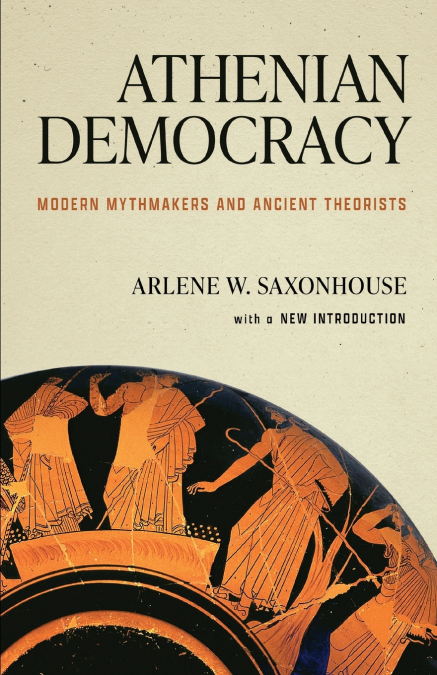
Athenian Democracy provides innovative readings of ancient theorists to reveal both the complexity of democracy’s achievements and its limits.In this classic work, noted political scientist Arlene W. Saxonhouse offers fresh and provocative explorations of ancient political theorists, lending new insights about democracy’s foundations and principles. These insights are more relevant than ever in a moment when the viability of democratic regimes is under scrutiny. Saxonhouse provides an in-depth discussion of the modern mythmakers (Hobbes, Paine, Hamilton, Mill, and Arendt, among others) who, in praising or excoriating Athenian democracy, have in fact distorted it to support their own assessments of democracy. She then offers detailed reinterpretations of the writings on democracy of four ancient theorists who had directly experienced life in the first democratic regime: Herodotus, Thucydides, Plato, and Aristotle.Saxonhouse argues that the mythmaking that often attends our views of Athenian democracy-whether as a flawed, slaveholding regime that fostered factions and oppressed women or as an ideal regime of egalitarian and participatory democracy-blinds us to the deeper understanding of democracies that these ancient theorists can offer.


Artículos relacionados

  • The Nature of Things
    Lucretius Lucretius
    De rerum natura (On the Nature of Things) is a 1st century BC didactic poem by the Roman poet and philosopher Lucretius with the goal of explaining Epicurean philosophy to a Roman audience. Lucretius presents the principles of atomism; the nature of the mind and soul; explanations of sensation and thought; the development of the world and its phenomena; and explains a variety o...
  • Pompeii
    Fergus Mason
    Pompeii was one of most advanced cities of its time; it had a complex water system, gymnasium, and an amphitheater. Despite it's advancements, there was one thing it wasn't ready for: Mount Vesuvius—the volcano that led to its ultimate doom.  The 79 AD eruption of Mount Vesuvius was one of the worst disasters in all of European history. In a near instant, over 15,000 p...
    Disponible

    10,36 €

  • Middle Platonism and Neoplatonism, Volume 1
    Stephen Gersh
    'It is generally agreed that those types of philosophy that are loosely called ’Platonic’ and ’Neoplatonic’ played a crucial role in the history of European culture during the centuries between antiquity and the Renaissance. However, until now no scholar has attempted to describe the evolution of these forms of thought in a single comprehensive academic study.' So writes Stephe...
  • Middle Platonism and Neoplatonism, Volume 2
    Stephen Gersh
    It is generally agreed that those types of philosophy that are loosely called 'Platonic' and 'Neoplatonic' played a crucial role in the history of European culture during the centuries between antiquity and the Middle Ages. However, until now no scholar has attempted to describe the evolution of these forms of thought in a single comprehensive academic study. Middle Platonism a...
  • Porphyry’s Commentary on Ptolemy’s Harmonics
    Andrew Barker
    ...
    Disponible

    80,87 €

  • The Roots of Platonism
    John Dillon
    ...
    Disponible

    26,54 €