Assyrian and biblical chronologies are they reliable?

Assyrian and biblical chronologies are they reliable?

GERARD GERTOUX

15,13 €
IVA incluido
Disponible
Editorial:
Lulu Press
Año de edición:
2021
ISBN:
9781326521219
15,13 €
IVA incluido
Disponible

Selecciona una librería:

  • Librería Samer Atenea
  • Librería Aciertas (Toledo)
  • Kálamo Books
  • Librería Perelló (Valencia)
  • Librería Elías (Asturias)
  • Donde los libros
  • Librería Kolima (Madrid)
  • Librería Proteo (Málaga)

The Assyrian chronology of the first millennium BCE is well established, especially for the period 912-609 BCE, but it is difficult to determine whether there were overlapping reigns due to possible co-regencies. Assyriologists have assumed that there were no co-regencies among the Assyrian reigns. Based on this assumption, Edwin R. Thiele, in his thesis published in 1951, established a chronology of the Hebrew kings, relying on the numerous synchronisms with the Assyrian kings, but several of the required synchronisms exhibited gaps ranging from 10 to 45 years. He solved this problem by assuming the existence of nine co-regencies among the Hebrew reigns. Despite this choice, which destroys the chronological coherence of the Hebrew reigns, Thiele’s chronology still serves as a reference for scholars. However, a careful examination of these synchronisms shows that there were several co-regencies among the Assyrian reigns, which they have been correctly dated in the biblical chronology, such as those of Sennacherib and Tiglath-Pileser III. These kings played a crucial role in Israel’s history during their co-regencies, such as Sennacherib’s campaign in Judah (his 3rd) with the siege of Lachish and Jerusalem, which took place in 712 BCE during the 10th campaign of Sargon II (722-705) with whom he was co-regent (715-705). This agrees exactly with the biblical account stating that all these events occurred during the 14th year of Judean King Hezekiah (726-697) also dated 712 BCE. Similarly, the Israelite king Menahem (771-760) had to pay a tribute (in 765 BCE) to an Assyrian king Pul (2Ki 15:19-20). The Assyrian word pulu, from apil/aplu, means 'the heir (i.e., crown prince)'. King Pul(as) reigned 36 years, according to Josephus (Jewish Antiquities IX: 283-287), which corresponds exactly to the Assyrian king Pulu (co-regent) known by his Aramaic name Bar-Ga’yah 'Son of the Majesty' who reigned from 782 to 746 BCE.

Artículos relacionados

  • Key to Countering Islamic Fundamentalism
    Maryam Rajavi
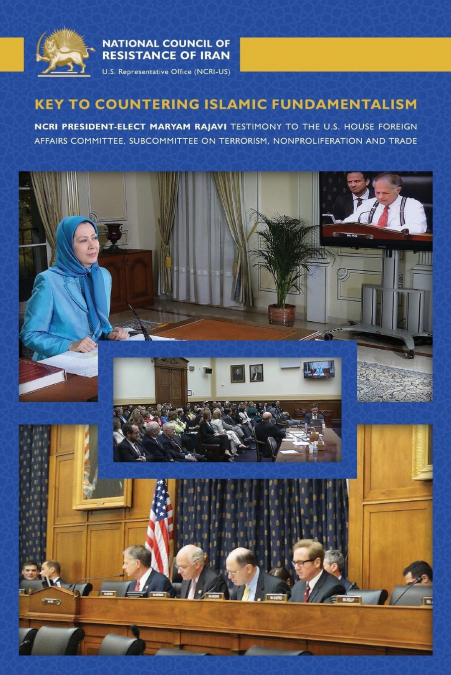
    Testimony before U.S. House Foreign Affairs Committee's subcommittee on Terrorism, non-Proliferation, and Trade discussing ISIS and Islamic fundamentalism. The book contains Maryam Rajavi's full testimony as well as the question and answer by representatives. During the hearing, Maryam Rajavi who is the president-elect of Iran's parliament-in-exile, the National Council of Resi...
    Disponible

    13,94 €

  • IRAN-A Writ of Deception and Cover-up
    NCRI- U.S. Representative Office / NCRI- U.SRepresentative Office
    Based on reliable information obtained by the Mujahedin-e Khalq (MEK) network inside Iran, a top-secret committee is in charge of drafting the answers to the International Atomic Energy Agency (IAEA) regarding the Possible Military Dimensions (PMD) of Tehran's nuclear program. Top officials from the Islamic Revolutionary Guards Corps (IRGC) and the Ministry of Defense Armed...
    Disponible

    5,44 €

  • Sebastopol to Dagenham
    Thomas Basil Fanshawe
    'Sebastopol appears to be a succession of forts which the Russians are strengthening every day. A great number of the men are sick of the whole concern. No one looks forward to another winter out here with any degree of satisfaction'.Captain Thomas Basil Fanshawe served with the 33rd (Duke of Wellington's) Regiment at Sebastopol during the Crimean War. The letters h...
    Disponible

    23,05 €

  • THEN AND NOW
    Hussein Shabka
    The rise and fall of civilizations has been a fact of history since before it was recorded. It is a normal process. So what is the particular significance of Egypt’s descent from a wealthy, organized, sophisticated society into the chaotic milieu that reigns today? Perhaps it relates to the nature of the yawning gap that exists between that sophistication that endured for more ...
    Disponible

    33,86 €

  • Iran’s Nuclear Core
    NCRI- U.S. Representative Office / NCRI- U.SRepresentative Office
    Iran's Nuclear Core details how the nuclear weapons program is at the heart, and not in parallel, to the civil nuclear program of Iran. The program is run by the Islamic Revolutionary Guards Corp (IRGC) since the beginning, and the main nuclear sites and nuclear research facilities have been hidden from the eyes of the United Nations nuclear watchdog.The manuscript details ...
    Disponible

    23,24 €

  • Terrorist Training Camps in Iran
    NCRI- U.S. Representative Office / NCRI- U.SRepresentative Office
    The book details how  Islamic Revolutionary Guards Corps trains foreign fighters in 15 various camps in Iran to export terrorism. The IRGC has created a large directorate within its extraterritorial arm, the Quds Force, in order to expand its training of foreign mercenaries as part of the strategy to step up its meddling abroad in Syria, Iraq, Yemen, Bahrain, Afghanistan and el...
    Disponible

    23,24 €

Otros libros del autor

  • Astronomy as a Key to History
    Gérard Gertoux
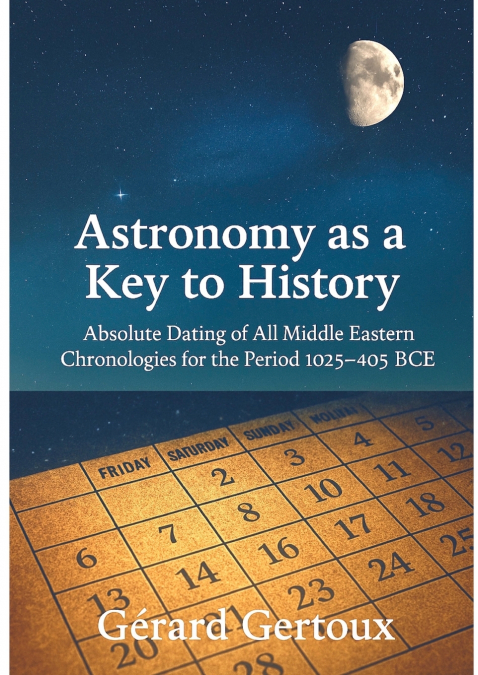
    Astronomy has long played a crucial role in humanity’s understanding of time and history. By analysing astronomical events such as solar and lunar eclipses, as well as planetary conjunctions, historians and archaeologists can refine and validate historical chronologies. This monograph explores the intersection between astronomy and historical studies, demonstrating how astronom...
    Disponible

    27,68 €

  • Astronomy as a Key to History
    GERARD GERTOUX
    This monograph delves into astronomy’s crucial role in refining historical timelines. By analyzing phenomena like solar/lunar eclipses and planetary conjunctions, it offers precise chronological markers that help historians and archaeologists validate ancient civilizations’ timelines.Drawing on interdisciplinary research, it highlights cases where astronomical calculations reso...
    Disponible

    34,90 €

  • Mesopotamian chronology (2340-539 BCE) through astronomically dated synchronisms and comparison with carbon-14 dating
    GERARD GERTOUX
    The 614 Assyrian eponyms between the first year of Šamšî-Adad I and the first year of Tiglath-pileser I (1115-1076) allow us to date the reign of Šamšî-Adad I (1728-1695) approximately. As the Assyrian years were lunar before the reign of Ninurta-apil-Ekur (1192-1179), this makes it possible to slightly correct the reign of Šamšî-Adad I (1712-1680), yet as this Amorite king die...
    Disponible

    41,30 €

  • Absolute Mesopotamian chronology from Gilgamesh (2447-2401) to Darius II (424-405)
    Gerard Gertoux
    The Egyptian king lists were commissioned, as early as the first dynasty, by kings wishing to legitimise their royal descent from Narmer (2838-2808), the founder of the Egyptian empire. On the other hand, Sumerian king lists were commissioned by Shulgi (2002-1954), a powerful king of Ur III in the last Sumerian dynasty, who presented himself as the heir of the famous Gilgamesh ...
    Disponible

    49,93 €

  • Who Built the Tower of Babel When and Why? (History Begins at Sumer)
    Gerard Gertoux
    Historical truth progresses by relying on authentic documents validated by absolute dates just as scientific truth progresses by relying on theories validated by measurements. However, the history of origins eludes historians because of the lack of authenticated documents and reliable dates. The first king of the first Egyptian dynasty was Narmer (2838-2808), however he was pre...
    Disponible

    37,52 €

  • Absolute Chronology of the Ancient Worlds, from 2838 BCE to 394 BCE, Compared to Carbon-14 Dating
    GERARD GERTOUX
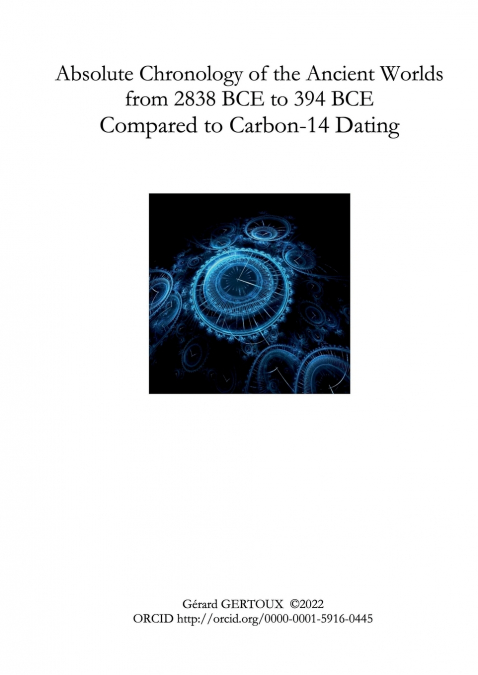
    The first scientific chronology of the Egyptian civilisation, calculated by Olaf A. Toffteen in his monograph: Ancient Chronology (1907), fixed the beginning of the First Dynasty in 3285 BCE. In their academic study: Ancient Egyptian Chronology (2006), Erik Hornung, Rolf Krauss and David A. Warburton set the beginning of the First Dynasty around 2900 BCE, a rejuvenation of 385 ...
    Disponible

    30,57 €