
Inicio > Humanidades > Historia > Historia: primitiva hasta la actualidad > Historia antigua: hasta c. 500 e. c. > Mesopotamian chronology (2340-539 BCE) through astronomically dated synchronisms and comparison with carbon-14 dating
Mesopotamian chronology (2340-539 BCE) through astronomically dated synchronisms and comparison with carbon-14 dating

Mesopotamian chronology (2340-539 BCE) through astronomically dated synchronisms and comparison with carbon-14 dating

GERARD GERTOUX

41,30 €
IVA incluido
Disponible
Editorial:
Lulu Press
Año de edición:
2024
Materia
Historia antigua: hasta c. 500 e. c.
ISBN:
9781326795283
41,30 €
IVA incluido
Disponible

Selecciona una librería:

  • Librería Samer Atenea
  • Librería Aciertas (Toledo)
  • Kálamo Books
  • Librería Perelló (Valencia)
  • Librería Elías (Asturias)
  • Donde los libros
  • Librería Kolima (Madrid)
  • Librería Proteo (Málaga)

The 614 Assyrian eponyms between the first year of Šamšî-Adad I and the first year of Tiglath-pileser I (1115-1076) allow us to date the reign of Šamšî-Adad I (1728-1695) approximately. As the Assyrian years were lunar before the reign of Ninurta-apil-Ekur (1192-1179), this makes it possible to slightly correct the reign of Šamšî-Adad I (1712-1680), yet as this Amorite king died in the 17th/18th year of King Hammurabi , so this synchronism fixes the dating of this Babylonian king (1697-1654). This dating does not correspond to the Middle Chronology but, on the other hand, exactly satisfies the astronomical dating of the Ammisaduqa tablet on Venus, according to the Ultra-Low Chronology. In addition, one tablet of astronomical omens (Enuma Anu Enlil 20) mentions a lunar eclipse dated 14 Simanu at the end of the reign of Šulgi (14/III/48, 27 June 1954 BCE), and another (Enuma Anu Enlil 21) mentions a lunar eclipse dated 14 Addaru at the end of the third dynasty Ur, which ended with the reign of Ibbi-Sin (14/XII/24, 6 March 1911 BCE). These two total lunar eclipses are separated by 42 years of reign (= 9 years of Amar-Sin + 9 years of Šu-Sîn + 24 years of Ibbi-Sin) and 9 months (=XII - III). During the period 2200-1850 BCE, there was only one couple of lunar eclipses spaced 42 years and 9 months apart, and visible at Ur, corresponding to the description of the astronomical omens. These two total lunar eclipses confirm the absolute dating of the reign of Hammurabi (1697-1654) and allow to anchor the reign of Sargon of Akkad (2243-2187). Secondly, as there is a synchronism (+/- 10 years) between Neferhotep I (1701-1690) and Ibni-Addu (1700-1680), the king of Hazor, and another synchronism between Ibni-Addu and Hammurabi (1697-1654), the king of Babylon, this reign could be determined indirectly by carbon-14 (IntCal20) and is again in perfect agreement with the 'Ultra-Low chronology'. Finally, the best confirmation of the accuracy of this absolute chronology is the complete reconstitution from 2040 to 1050 BCE, year by year, of the main Mesopotamian chronologies: Uruk IV, Mari, Gutium, Assyria, Elam, Uruk V, Ur III, Larsa, Isin I, Babylon, Hana, Kassite and Sealand, with their synchronisms as well as their dates anchored on astronomical phenomena such as the total eclipses of the moon (Gertoux, NABU 2021-3, 171-172).

Artículos relacionados

  • Iron Age Societies in the Severn-Cotswolds
    Tom Moore
    The central theme of this study is an examination of the processes of change in Iron Age social organisation and identity on a regional scale using the Severn-Cotswolds area in England as a case study. It aims to provide a coherent narrative of the period in the region based on the wealth of current data now available, providing a basic storyboard against which future studies c...
    Disponible

    144,57 €

  • Somewhere Beyond The Sea Les îles bretonnes (France)
    The Seminar on the Archaeology of Western France, which focused on the islands of Brittany, was held on 1 April 2014 at the University of Rennes 1. The desire to organize this seminar arose spontaneously from the dynamism which currently animates archaeological research on island spaces of the western seaboard of France. Indeed, the seminar took place during a pivotal period of...
    Disponible

    86,11 €

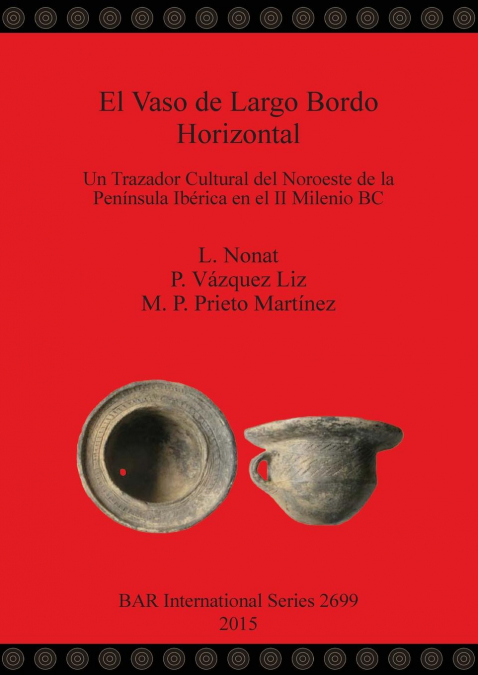
  • El Vaso de Largo Bordo Horizontal
    L. Nonat / LNonat / M. P. Prieto Martínez / MPPrieto Martínez / P. Vázquez Liz / PVázquez Liz
    In this paper the authors study a specific type of pottery from the northwest Iberian Peninsula, known as the Wide Horizontal Rim (WHR) vessel. One of its distinctive aspects is precisely the fact that it is exclusively found in this region, which now comprises the Spanish region of Galicia and northern Portugal, as far south as the River Duero. This type of pottery, of which t...
    Disponible

    115,71 €

  • A Connecting Sea
    Stašo Forenbaher
    This book includes papers stemming from a session at the EAA conference held in Zadar in September 2007.                          ...
    Disponible

    79,97 €

  • The Roman Pottery Production Site at Wickham Barn, Chiltington, East Sussex
    Chris Butler / Malcolm Lyne
    The excavations undertaken at Chiltington in East Sussex revealed two Roman pottery kilns, as well as remains from prehistory and from medieval period.The kilns are well documented, and all the finds were examined and catalogued. Three phases were identified. The pottery produced on the site indicate a strong New Forest influence. ...
    Disponible

    55,62 €

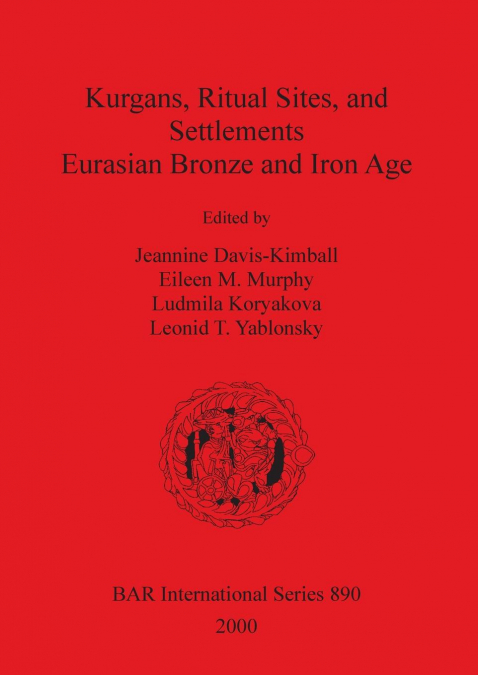
  • Kurgans, Ritual Sites, and Settlements
    Edited by: Jeannine Davis-Kimball, Eileen M. Murphy, Ludmila Koryakova and Leonid T. YablonskyThis richly illustrated volume adds immensely to the small but growing corpus of Eurasian Archaeology published in the English language. Comprised of thirty articles, the authors have focused on the Bronze Age, continuing to include the first millennium BC Early Iron Age, with a termin...
    Disponible

    158,26 €

Otros libros del autor

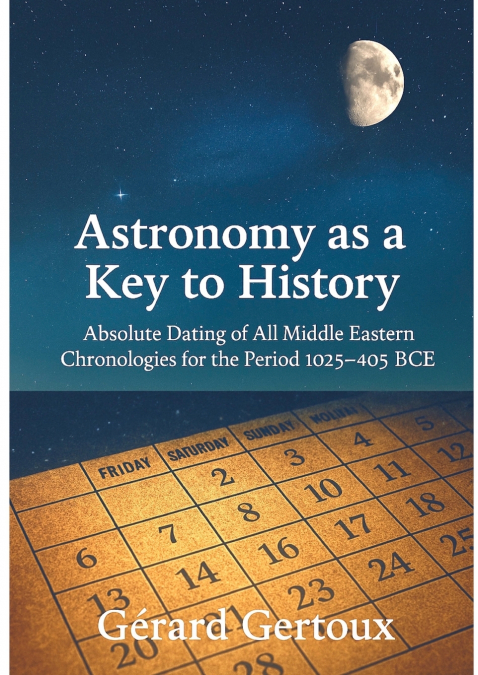
  • Astronomy as a Key to History
    Gérard Gertoux
    Astronomy has long played a crucial role in humanity’s understanding of time and history. By analysing astronomical events such as solar and lunar eclipses, as well as planetary conjunctions, historians and archaeologists can refine and validate historical chronologies. This monograph explores the intersection between astronomy and historical studies, demonstrating how astronom...
    Disponible

    27,68 €

  • Astronomy as a Key to History
    GERARD GERTOUX
    This monograph delves into astronomy’s crucial role in refining historical timelines. By analyzing phenomena like solar/lunar eclipses and planetary conjunctions, it offers precise chronological markers that help historians and archaeologists validate ancient civilizations’ timelines.Drawing on interdisciplinary research, it highlights cases where astronomical calculations reso...
    Disponible

    34,90 €

  • Absolute Mesopotamian chronology from Gilgamesh (2447-2401) to Darius II (424-405)
    Gerard Gertoux
    The Egyptian king lists were commissioned, as early as the first dynasty, by kings wishing to legitimise their royal descent from Narmer (2838-2808), the founder of the Egyptian empire. On the other hand, Sumerian king lists were commissioned by Shulgi (2002-1954), a powerful king of Ur III in the last Sumerian dynasty, who presented himself as the heir of the famous Gilgamesh ...
    Disponible

    49,93 €

  • Who Built the Tower of Babel When and Why? (History Begins at Sumer)
    Gerard Gertoux
    Historical truth progresses by relying on authentic documents validated by absolute dates just as scientific truth progresses by relying on theories validated by measurements. However, the history of origins eludes historians because of the lack of authenticated documents and reliable dates. The first king of the first Egyptian dynasty was Narmer (2838-2808), however he was pre...
    Disponible

    37,52 €

  • Absolute Chronology of the Ancient Worlds, from 2838 BCE to 394 BCE, Compared to Carbon-14 Dating
    GERARD GERTOUX
    The first scientific chronology of the Egyptian civilisation, calculated by Olaf A. Toffteen in his monograph: Ancient Chronology (1907), fixed the beginning of the First Dynasty in 3285 BCE. In their academic study: Ancient Egyptian Chronology (2006), Erik Hornung, Rolf Krauss and David A. Warburton set the beginning of the First Dynasty around 2900 BCE, a rejuvenation of 385 ...
    Disponible

    30,57 €

  • Absolute Egyptian chronology
    GERARD GERTOUX
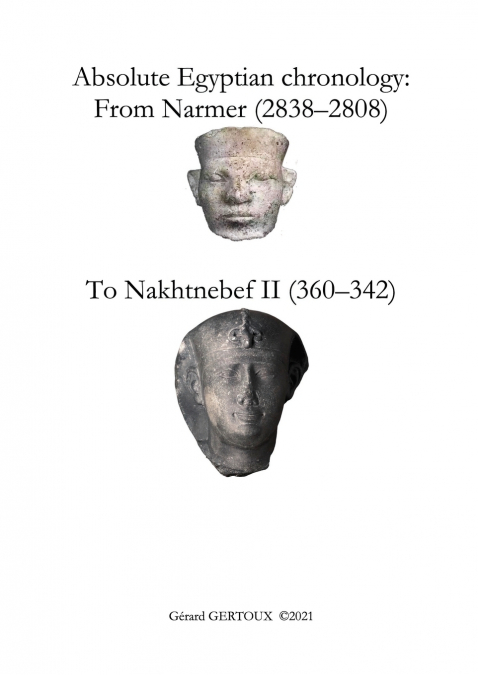
    Egyptian king lists make it possible to elaborate a chronology of all kings up to Narmer (2838-2808), because the numerous synchronisms between Egyptian and Mesopotamian reigns make it possible to anchor the 30 dynasties of this Egyptian chronology. These synchronisms with the Achaemenid and Babylonian chronologies, which are anchored on absolute dates obtained by astronomy ove...
    Disponible

    51,20 €