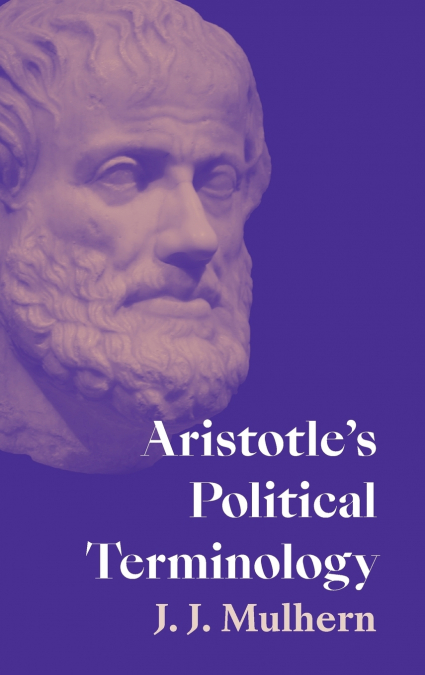

Aristotle’s Political Terminology

Aristotle’s Political Terminology

J. J. Mulhern

141,51 €
IVA incluido
Consulta disponibilidad
Editorial:
State University of New York Press
Año de edición:
2025
Materia
Filosofía occidental: antigua, hasta c. 500
ISBN:
9798855803723

Selecciona una librería:

  • Librería Samer Atenea
  • Librería Aciertas (Toledo)
  • Kálamo Books
  • Librería Perelló (Valencia)
  • Librería Elías (Asturias)
  • Donde los libros
  • Librería Kolima (Madrid)
  • Librería Proteo (Málaga)

Comprehensive examination of the different senses in which Aristotle uses a group of the most important expressions in his political writings, with the aim of making possible a firmer understanding of his positions.Aristotle’s Political Terminology offers a fresh approach to Aristotle’s political thought by examining the language he uses in a more complete way than was possible before the appearance of the Thesaurus Linguae Graecae. It allows the reader to see clearly the difficulty scholars have had in commenting on and translating Aristotle’s political works, which often ends in sharp differences among scholars who approach Aristotle with differing prior philosophical, political, historical, or ideological commitments. The book addresses eleven words and cognates or phrases that are fundamental to understanding Aristotle’s text, many of them related to one another. They include the Greek expressions often translated, and sometimes mistranslated, by nature, property, constitution, and ideal. Helpful in teaching both undergraduate and graduate students, this work gives examples of Aristotle’s uses of an expression in a defined universe, as in the case of the 522 occurrences in the Politics alone of the word often rendered by constitution, to give a flavor for how Aristotle might be read to avoid misimpressions. These examples sometimes are accompanied by tabular worksheets so that readers may check the author’s work more easily. Further, the pages use transliteration in the main text, with a few mandatory exceptions, as in quoted titles of articles, so that readers whose Greek is not strong can follow the argument; the Greek text is provided in footnotes.


Artículos relacionados

  • The Nature of Things
    Lucretius Lucretius
    De rerum natura (On the Nature of Things) is a 1st century BC didactic poem by the Roman poet and philosopher Lucretius with the goal of explaining Epicurean philosophy to a Roman audience. Lucretius presents the principles of atomism; the nature of the mind and soul; explanations of sensation and thought; the development of the world and its phenomena; and explains a variety o...
  • Pompeii
    Fergus Mason
    Pompeii was one of most advanced cities of its time; it had a complex water system, gymnasium, and an amphitheater. Despite it's advancements, there was one thing it wasn't ready for: Mount Vesuvius—the volcano that led to its ultimate doom.  The 79 AD eruption of Mount Vesuvius was one of the worst disasters in all of European history. In a near instant, over 15,000 p...
    Disponible

    10,36 €

  • Middle Platonism and Neoplatonism, Volume 1
    Stephen Gersh
    'It is generally agreed that those types of philosophy that are loosely called ’Platonic’ and ’Neoplatonic’ played a crucial role in the history of European culture during the centuries between antiquity and the Renaissance. However, until now no scholar has attempted to describe the evolution of these forms of thought in a single comprehensive academic study.' So writes Stephe...
  • Middle Platonism and Neoplatonism, Volume 2
    Stephen Gersh
    It is generally agreed that those types of philosophy that are loosely called 'Platonic' and 'Neoplatonic' played a crucial role in the history of European culture during the centuries between antiquity and the Middle Ages. However, until now no scholar has attempted to describe the evolution of these forms of thought in a single comprehensive academic study. Middle Platonism a...
  • Porphyry’s Commentary on Ptolemy’s Harmonics
    Andrew Barker
    ...
    Disponible

    77,17 €

  • The Roots of Platonism
    John Dillon
    ...
    Disponible

    25,29 €