 Librería Samer Atenea
 Kálamo Books
 Librería Elías (Asturias)
 Librería Kolima (Madrid)
 Librería Proteo (Málaga)
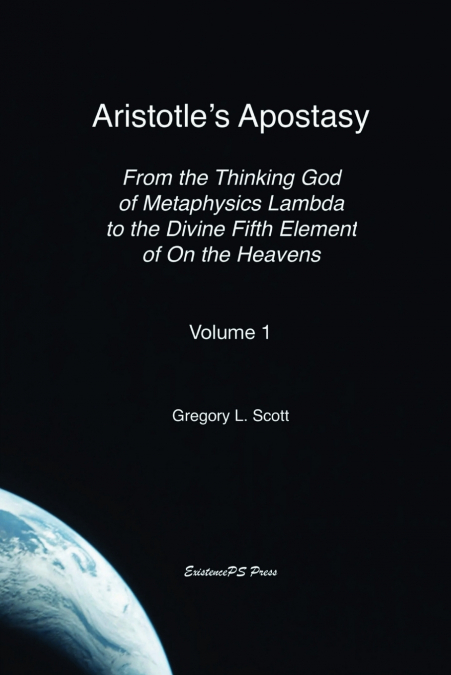
In METAPHYSICS Lambda, the ancient Stagirite from Northern Greece offers powerful arguments for an eternal immaterial Unmoved Mover. On almost all, if not all, accounts starting with the commentator Alexander of Aphrodisias (3rd century CE), the Mover is identified with a god that has a blessed life and that thinks of itself thinking for all eternity. This Mover grounds the contingent physical universe, with the heavenly ensouled outer spheres desiring the Mover and for this reason moving eternally themselves. Later theologians like Thomas Aquinas base proofs for the existence of a Christian god on Aristotle’s arguments, leaving aside both the incongruity of the entity being immaterial while leading a blessed life and the god being so narcissistic that it cannot even be aware of the universe, much less mortal human beings. Other dilemmas in Lambda are similarly legion and have exercised philosophers, classicists and theologians since Alexander.In Volumes 1 and 2, Scott demonstrates, however, that the commentator from Aphrodisias was the first to attribute the narcissistic god to Aristotle, with no previous philosopher for 500 years even discussing it much less embracing it. Aristotle allows material prime unmoved movers like the 55 outer spheres in Lambda 8 and the rock-hitting man of PHYSICS VIII 5. Moreover, Theophrastus, Aristotle’s friend and subsequent head of the Lyceum, and the later Peripatetics, including Strato, Critolaus, and Xenarchus of Seleucia, all seemingly accept a type of 'metaphysical primitivism,' according to which the universe moves eternally in virtue of its own nature, even though their details may differ. For the Stagirite, the weightless fifth element or 'ether' and the ethereal outer spheres that changelessly and perpetually circle are explicitly the divine primary ontological entities in ON THE HEAVENS.Modern specialists still explicitly attribute souls to the ethereal outer spheres for Aristotle, or are committed to that position, all of which is as absurd as attributing souls to instances of the other four elements-fire, air, water and earth-despite the academics’ creative attempts at a reconciliation of Lambda and ON THE HEAVENS. Scott demonstrates that Aristotle instead believed in ensouled spheres only when youthfully Platonic but then evolved to the fifth element.Volume 1 builds on previous publications: Aristotle’s 'Not to Fear' Proof for the Necessary Eternity of the Universe (2019) and 8 later 'digital extensions,' individuals pdf files that are reproduced and collected in Volume 2.