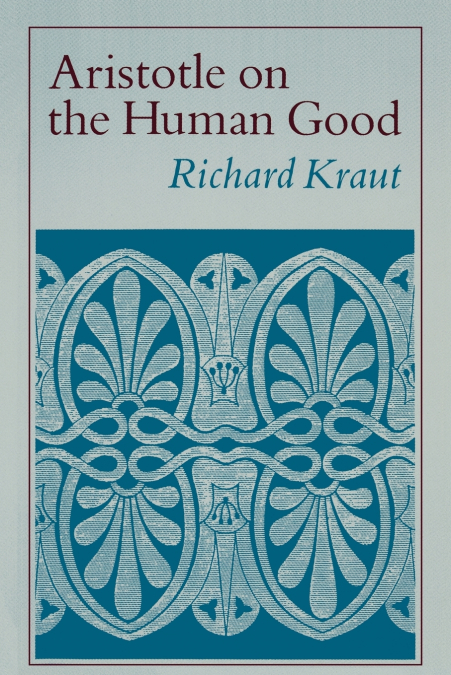

Aristotle on the Human Good

Aristotle on the Human Good

Aristotle on the Human Good

Richard Kraut

92,51 €
IVA incluido
Disponible
Editorial:
Princeton University Press
Año de edición:
1991
Materia
Filosofía occidental: antigua, hasta c. 500
ISBN:
9780691020716
92,51 €
IVA incluido
Disponible

Selecciona una librería:

  • Librería Samer Atenea
  • Librería Aciertas (Toledo)
  • Kálamo Books
  • Librería Perelló (Valencia)
  • Librería Elías (Asturias)
  • Donde los libros
  • Librería Kolima (Madrid)
  • Librería Proteo (Málaga)

Aristotle’s Nicomachean Ethics, which equates the ultimate end of human life with happiness (eudaimonia), is thought by many readers to argue that this highest goal consists in the largest possible aggregate of intrinsic goods. Richard Kraut proposes instead that Aristotle identifies happiness with only one type of good: excellent activity of the rational soul. In defense of this reading, Kraut discusses Aristotle’s attempt to organize all human goods into a single structure, so that each subordinate end is desirable for the sake of some higher goal. This book also emphasizes the philosopher’s hierarchy of natural kinds, in which every type of creature achieves its good by imitating divine life. As Kraut argues, Aristotle’s belief that thinking is the sole activity of the gods leads him to an intellectualist conception of the ethical virtues. Aristotle values these traits because, by subordinating emotion to reason, they enhance our ability to lead a life devoted to philosophy or politics.

Artículos relacionados

  • The Nature of Things
    Lucretius Lucretius
    De rerum natura (On the Nature of Things) is a 1st century BC didactic poem by the Roman poet and philosopher Lucretius with the goal of explaining Epicurean philosophy to a Roman audience. Lucretius presents the principles of atomism; the nature of the mind and soul; explanations of sensation and thought; the development of the world and its phenomena; and explains a variety o...
  • Pompeii
    Fergus Mason
    Pompeii was one of most advanced cities of its time; it had a complex water system, gymnasium, and an amphitheater. Despite it's advancements, there was one thing it wasn't ready for: Mount Vesuvius—the volcano that led to its ultimate doom.  The 79 AD eruption of Mount Vesuvius was one of the worst disasters in all of European history. In a near instant, over 15,000 p...
    Disponible

    10,36 €

  • Middle Platonism and Neoplatonism, Volume 1
    Stephen Gersh
    'It is generally agreed that those types of philosophy that are loosely called ’Platonic’ and ’Neoplatonic’ played a crucial role in the history of European culture during the centuries between antiquity and the Renaissance. However, until now no scholar has attempted to describe the evolution of these forms of thought in a single comprehensive academic study.' So writes Stephe...
  • Middle Platonism and Neoplatonism, Volume 2
    Stephen Gersh
    It is generally agreed that those types of philosophy that are loosely called 'Platonic' and 'Neoplatonic' played a crucial role in the history of European culture during the centuries between antiquity and the Middle Ages. However, until now no scholar has attempted to describe the evolution of these forms of thought in a single comprehensive academic study. Middle Platonism a...
  • Porphyry’s Commentary on Ptolemy’s Harmonics
    Andrew Barker
    ...
    Disponible

    77,17 €

  • The Roots of Platonism
    John Dillon
    ...
    Disponible

    25,29 €

Otros libros del autor

  • Quality of Life
    Richard Kraut
    The Quality of Life: Aristotle Revised presents a philosophical theory about the constituents of human well-being. The principal idea is that what Aristotle calls ’external goods’ - wealth, reputation, power - have at most an indirect bearing on the quality of our lives. Starting withAristotle’s thoughts about this topic, Kraut increasingly modifies (and occasionally rejects) t...
  • Against Absolute Goodness
    Richard Kraut
    Are there things we should value because they are, quite simply, good? If so, such things might be said to have 'absolute goodness.' They would be good simpliciter or full stop - not good for someone, not good of a kind, but nonetheless good (period). They might also be called 'impersonal values.' The reason why we ought to value such things, if there are any, would merely be t...
  • Aristotle’s Politics
    Richard Kraut
    Aristotle’s Politics is widely recognized as one of the classics of the history of political philosophy, and like every other such masterpiece, it is a work about which there is deep division. ...
  • Founders of Modern Political and Social Thought
    Richard Kraut
    ...
    Disponible

    85,04 €

  • Plato’s Republic
    Richard Kraut
    Bringing between two covers the most influential and accessible articles on Plato’s Republic, this collection illuminates what is widely held to be the most important work of Western philosophy and political theory. It will be valuable not only to philosophers, but to political theorists, historians, classicists, literary scholars, and interested general readers. ...
    Disponible

    55,69 €

  • Socrates and the State
    Richard Kraut
    This fresh outlook on Socrates’ political philosophy in Plato’s early dialogues argues that it is both more subtle and less authoritarian than has been supposed. Focusing on the Crito, Richard Kraut shows that Plato explains Socrates’ refusal to escape from jail and his acceptance of the death penalty as arising not from a philosophy that requires blind obedience to every legal...
    Disponible

    71,91 €