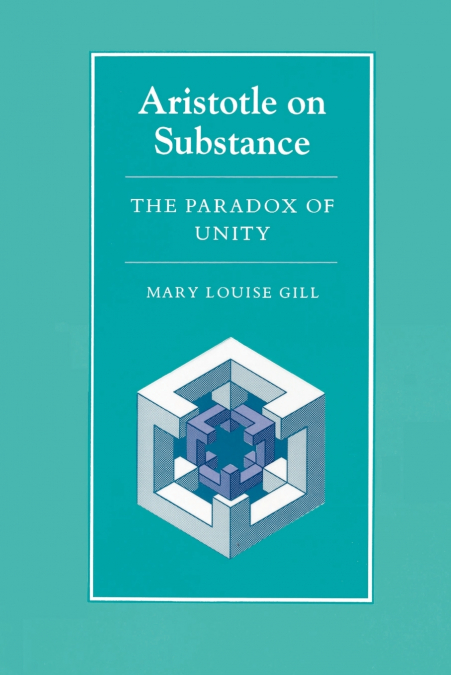

Aristotle on Substance

Aristotle on Substance

Aristotle on Substance

Mary Louise Gill

85,98 €
IVA incluido
Disponible
Editorial:
Princeton University Press
Año de edición:
1991
Materia
Filosofía occidental: antigua, hasta c. 500
ISBN:
9780691020709
85,98 €
IVA incluido
Disponible

Selecciona una librería:

  • Librería Samer Atenea
  • Librería Aciertas (Toledo)
  • Kálamo Books
  • Librería Perelló (Valencia)
  • Librería Elías (Asturias)
  • Donde los libros
  • Librería Kolima (Madrid)
  • Librería Proteo (Málaga)

This book explores a fundamental tension in Aristotle’s metaphysics: how can an entity such as a living organisma composite generated through the imposition of form on preexisting matterhave the conceptual unity that Aristotle demands of primary substances? Mary Louise Gill bases her treatment of the problem of unity, and of Aristotle’s solution, on a fresh interpretation of the relation between matter and form. Challenging the traditional understanding of Aristotelian matter, she argues that material substances are subverted by matter and maintained by form that controls the matter to serve a positive end. The unity of material substances thus involves a dynamic relation between resistant materials and directive ends. Aristotle on Substance offers both a general account of matter, form, and substantial unity and a specific assessment of particular Aristotelian arguments. At every point, Gill engages Aristotle on his own philosophical ground through the detailed analysis of central, and often controversial, texts from the Metaphysics, Physics, On Generation and Corruption, De Anima, De Caelo, and the biological works. The result is a coherent, firmly grounded rethinking of Aristotle’s central metaphysical concepts and of his struggle toward a fully consistent theory of material substances.
Artículos relacionados

  • The Nature of Things
    Lucretius Lucretius
    De rerum natura (On the Nature of Things) is a 1st century BC didactic poem by the Roman poet and philosopher Lucretius with the goal of explaining Epicurean philosophy to a Roman audience. Lucretius presents the principles of atomism; the nature of the mind and soul; explanations of sensation and thought; the development of the world and its phenomena; and explains a variety o...
  • Pompeii
    Fergus Mason
    Pompeii was one of most advanced cities of its time; it had a complex water system, gymnasium, and an amphitheater. Despite it's advancements, there was one thing it wasn't ready for: Mount Vesuvius—the volcano that led to its ultimate doom.  The 79 AD eruption of Mount Vesuvius was one of the worst disasters in all of European history. In a near instant, over 15,000 p...
    Disponible

    10,36 €

  • Middle Platonism and Neoplatonism, Volume 1
    Stephen Gersh
    'It is generally agreed that those types of philosophy that are loosely called ’Platonic’ and ’Neoplatonic’ played a crucial role in the history of European culture during the centuries between antiquity and the Renaissance. However, until now no scholar has attempted to describe the evolution of these forms of thought in a single comprehensive academic study.' So writes Stephe...
  • Middle Platonism and Neoplatonism, Volume 2
    Stephen Gersh
    It is generally agreed that those types of philosophy that are loosely called 'Platonic' and 'Neoplatonic' played a crucial role in the history of European culture during the centuries between antiquity and the Middle Ages. However, until now no scholar has attempted to describe the evolution of these forms of thought in a single comprehensive academic study. Middle Platonism a...
  • Porphyry’s Commentary on Ptolemy’s Harmonics
    Andrew Barker
    ...
    Disponible

    77,17 €

  • The Roots of Platonism
    John Dillon
    ...
    Disponible

    25,29 €