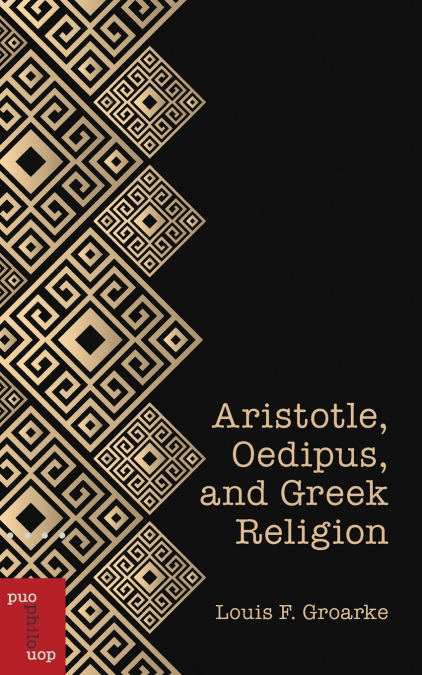

Aristotle, Oedipus, and Greek Religion

Aristotle, Oedipus, and Greek Religion

Louis F Groarke

46,22 €
IVA incluido
Disponible
Editorial:
University of Ottawa Press
Año de edición:
2025
Materia
Filosofía occidental: antigua, hasta c. 500
ISBN:
9780776642420
46,22 €
IVA incluido
Disponible

Selecciona una librería:

  • Librería Samer Atenea
  • Librería Aciertas (Toledo)
  • Kálamo Books
  • Librería Perelló (Valencia)
  • Librería Elías (Asturias)
  • Donde los libros
  • Librería Kolima (Madrid)
  • Librería Proteo (Málaga)

Aristotle, Oedipus, and Greek Religion explores an important religious side of ancient Aristotelianism, one which has an impact on contemporary philosophical debates.Louis F. Groarke shows how an exegetical perspective open to and respectful of Greek Pagan religion allows readers to discover a remarkably different Aristotle than the one to which we have grown accustomed.To begin with, one must discover what Aristotle (and his school) taught, not by examining isolated passages, but by getting a sense of his philosophy as a whole. One has to make sense of the circumstantial evidence and carefully piece together a coherent technical case for the overall argument.In each chapter, Groarke considers another aspect of Aristotelian thought; this is in opposition to mainstream opinion which often describes Aristotle as a secret atheist, an agnostic, or as something akin to a modern-day positivist or a reductionist.The author goes on to show that Aristotle valued religious practice on a personal and social level, that his metaphysics are marked by intimations of the divine, that he provides an epistemological space for both science and religion, that his account of Greek tragedy has an inalienable moral and religious side, and that his account of the origins of cognition is not so far removed from religious scripture.Aristotle, Oedipus, and Greek Religion is an analysis of universal themes from the viewpoint of an enormously influential ancient thinker, and an adventure into the history of ideas.

Artículos relacionados

  • The Nature of Things
    Lucretius Lucretius
    De rerum natura (On the Nature of Things) is a 1st century BC didactic poem by the Roman poet and philosopher Lucretius with the goal of explaining Epicurean philosophy to a Roman audience. Lucretius presents the principles of atomism; the nature of the mind and soul; explanations of sensation and thought; the development of the world and its phenomena; and explains a variety o...
  • Pompeii
    Fergus Mason
    Pompeii was one of most advanced cities of its time; it had a complex water system, gymnasium, and an amphitheater. Despite it's advancements, there was one thing it wasn't ready for: Mount Vesuvius—the volcano that led to its ultimate doom.  The 79 AD eruption of Mount Vesuvius was one of the worst disasters in all of European history. In a near instant, over 15,000 p...
    Disponible

    10,36 €

  • Middle Platonism and Neoplatonism, Volume 1
    Stephen Gersh
    'It is generally agreed that those types of philosophy that are loosely called ’Platonic’ and ’Neoplatonic’ played a crucial role in the history of European culture during the centuries between antiquity and the Renaissance. However, until now no scholar has attempted to describe the evolution of these forms of thought in a single comprehensive academic study.' So writes Stephe...
  • Middle Platonism and Neoplatonism, Volume 2
    Stephen Gersh
    It is generally agreed that those types of philosophy that are loosely called 'Platonic' and 'Neoplatonic' played a crucial role in the history of European culture during the centuries between antiquity and the Middle Ages. However, until now no scholar has attempted to describe the evolution of these forms of thought in a single comprehensive academic study. Middle Platonism a...
  • Porphyry’s Commentary on Ptolemy’s Harmonics
    Andrew Barker
    ...
    Disponible

    77,17 €

  • The Roots of Platonism
    John Dillon
    ...
    Disponible

    25,29 €