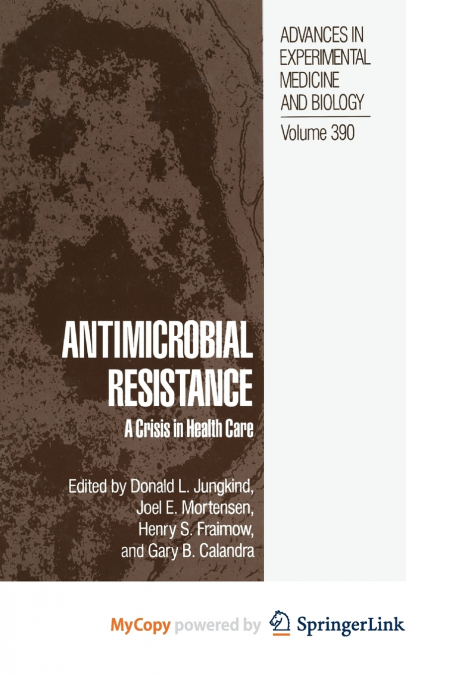

Antimicrobial Resistance

Antimicrobial Resistance


47,98 €
IVA incluido
Disponible
Editorial:
Springer Nature B.V.
Año de edición:
2013
Materia
Farmacología
ISBN:
9781475792041
47,98 €
IVA incluido
Disponible

Selecciona una librería:

  • Librería Samer Atenea
  • Librería Aciertas (Toledo)
  • Kálamo Books
  • Librería Perelló (Valencia)
  • Librería Elías (Asturias)
  • Donde los libros
  • Librería Kolima (Madrid)
  • Librería Proteo (Málaga)

Development and Implications of Antimicrobial Resistance One of the most ominous trends in the field of antimicrobial chemotherapy over the past decade has been the increasing pace of development of antimicrobial resistance among microbial pathogens. The hypothesis that man can discover a magic bullet to always cure a particular infection has proved false. Physicians are now seeing and treating patients for which there are few therapeutic alternatives, and in some cases, none at all. Until recently there was little concern that physicians might be losing the war in our ability to compete with the evolving resistance patterns of microbial pathogens. Now the general public is very aware of the threat to them if they become infected, thanks to cover story articles in major magazines such as Time, Newsweek, newspapers, and other news sources. Antimicrobial resistance is not a novel problem. Shortly after the widespread introduction of penicillin in the early 1940s, the first strains of penicillin-resistant staphylococci were described. Today it is an uncommon event for a clinical laboratory to isolate an S. aureus that is sensitive to penicillin. Other gram-positive strains of bacteria have become resistant, including the exquisitely sensitive Streptococcus pneumoniae. Sensitivity to vancomycin was once so uniform that it was used in routine clinical laboratories as a surrogate marker for whether an organism should be classified as a gram-positive. That criterion can no longer be relied upon because of emerging resistance among some species. Gram-negative bacteria, viruses, fungi, and parasites all have succeeded in developing resistance.

Artículos relacionados

  • Identification and Characterization of Antimicrobial Peptides with Therapeutic Potential
    Guangshun Wang
    Antimicrobial peptides are key defense molecules adopted by all life forms to prevent infection. They also have other beneficial effects such as boosting immune response, anticancer, and wound healing. The antiviral effects of antimicrobial peptides have laid the foundations for developing new agents to combat seasonal Flu, HIV-1, RSV, Zika, and Ebola. This eBook is constructed...
    Disponible

    67,96 €

  • Mind Maps of Clinical Research Basics
    Amrita Akhouri
    The concepts of Clinical Research have been depicted through mind maps in this book which makes the subject fundamentals very easy to understand and convenient to revise. The chapter on career in clinical research gives an insight into the main job roles currently known in this field along with the focus on how to build preparedness for job interviews. Hence, this book will be ...
    Disponible

    25,42 €

  • Marine Polysaccharides Volume 2
    Paola Laurienzo
    The field of marine polysaccharides is constantly evolving, due to progress in the discovery and production of new marine polysaccharides. Seaweed remains the most abundant source of polysaccharides, but recent advances in biotechnology have allowed the production of large quantities of polysaccharides from a variety of micro-algae, by controlling growth conditions and tailorin...
    Disponible

    75,84 €

  • Marine Polysaccharides Volume 3
    Paola Laurienzo
    The field of marine polysaccharides is constantly evolving, due to progress in the discovery and production of new marine polysaccharides. Seaweed remains the most abundant source of polysaccharides, but recent advances in biotechnology have allowed the production of large quantities of polysaccharides from a variety of micro-algae, by controlling growth conditions and tailorin...
    Disponible

    116,84 €

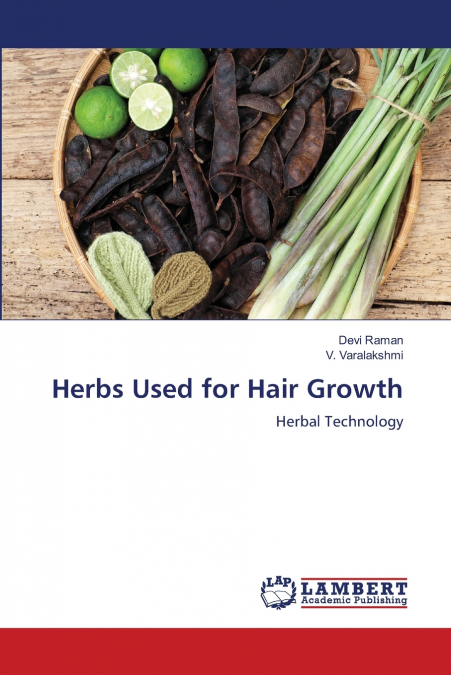
  • Herbs Used for Hair Growth
    Devi Raman / V. Varalakshmi
    Natural medicine has many benefits, from nourishing the scalp to stimulating hair follicles. Some popular herbs that aid hair growth include rosemary, ginseng, aloe vera, and fenugreek. Each plant has unique properties that help strengthen hair, prevent breakage, and promote growth, healthy growth. Of course, many herbs are popular for their beneficial effects in promoting hair...
    Disponible

    54,32 €

  • Novel Anti-proliferative Agents
    Valentina Onnis
    This Special Issue of Pharmaceuticals presented the recent findings on antiproliferative compounds and highlighted possible routes to discover new drugs used to treat cancer. In this Special Issue, different studies on kinase and methyltransferase-like proteins 3 inhibitors and compounds capable of altering the tumor microenvironment or acting at the mitotic stage of the cell c...