 Librería Samer Atenea
 Kálamo Books
 Librería Elías (Asturias)
 Librería Kolima (Madrid)
 Librería Proteo (Málaga)
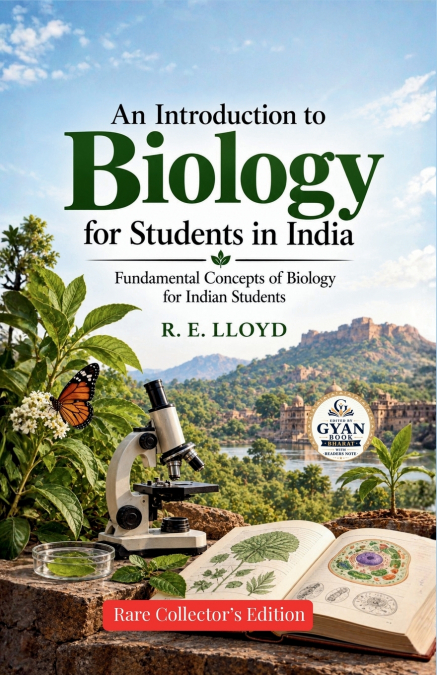
R. E. Lloyd’s An Introduction to Biology was written for students in India at a time when elementary biology teaching was being adapted to local medical and university needs. Rather than attempting to survey every branch of life science, Lloyd builds the course around selected animal types, practical observation, and comparative structure. The result is a compact zoological introduction whose examples are closely tied to organisms students in India could realistically encounter.The opening material explains the discipline of observing living things and gives unusually concrete guidance on laboratory habits. Lloyd discusses the use of the microscope, preparation of temporary mounts, dissection, injection, and the value of drawing what is actually seen rather than copying an idealized diagram. The text then moves into protozoa and other invertebrate groups, using familiar forms such as Amoeba and Spirogyra-like microscopic material as a basis for understanding cells, movement, feeding, reproduction, and organization.The book’s contents extend through Porifera, Coelenterata, Platyhelminthes, Nematoda, Arthropoda, and related forms, with special attention to examples of medical or regional interest. Its plates and diagrams were intended to support identification and laboratory work, while the explanatory prose connects individual organisms with broader biological ideas such as specialization, adaptation, life history, and the relation between structure and function.This 1921 new impression is especially valuable as a document of early twentieth-century biology education in India. Modern taxonomy, terminology, laboratory safety, and biological interpretation have changed substantially, so the book is best read as a historical teaching text rather than as a current scientific manual. For students of zoology, medical education, colonial science, and the history of laboratory instruction, it preserves a clear picture of how practical biology was taught.