Inicio > Artes > Artes: aspectos generales > An Analysis of Alasdair MacIntyre’s After Virtue
An Analysis of Alasdair MacIntyre’s After Virtue

An Analysis of Alasdair MacIntyre’s After Virtue

Jon W. Thompson

11,64 €
IVA incluido
Disponible
Editorial:
Taylor & Francis Ltd
Año de edición:
2017
Materia
Artes: aspectos generales
ISBN:
9781912127795
11,64 €
IVA incluido
Disponible

Selecciona una librería:

  • Librería Samer Atenea
  • Librería Aciertas (Toledo)
  • Kálamo Books
  • Librería Perelló (Valencia)
  • Librería Elías (Asturias)
  • Donde los libros
  • Librería Kolima (Madrid)
  • Librería Proteo (Málaga)

Alasdair MacIntyre’s 1981 After Virtue was a ground-breaking contribution to modern moral philosophy. Dissatisfied with the major trends in the moral philosophy of his time, MacIntyre argued that modern moral discourse had no real rational basis. Instead, he suggested, if one wanted to build a rational theory for morality and moral actions, one would have to go all the way back to Aristotle. To build his arguments - which are widely acknowledged to be as important as they are complex - MacIntyre relies on two critical thinking skills above all others: evaluation and interpretation.The primary goal of evaluation is to judge the strength or weakness of arguments, asking how acceptable a given line of reasoning is, and how adequate it is to the situation. In After Virtue, MacIntyre applies incisive evaluation skills to major positions and figures in moral philosophy one after the other - showing how and why Aristotle’s template remains a stronger way of considering moral questions. Throughout this process, MacIntyre also relies on his interpretative skills. As MacIntyre knows, clarifying meanings, questioning definitions, and laying down definitions of his key terms is as vital to advancing his arguments as it is to evaluating those of other philosophers.
Artículos relacionados

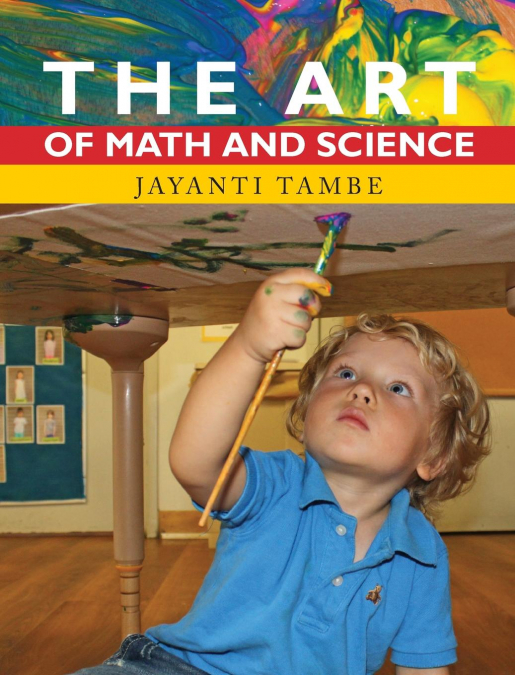
  • The Art of Math and Science
    Jayanti Tambe
    The Art of Math and Science guides teachers to introduce masterpiece art to young children, so they can tell you about “paints with hidden floats” and ask questions like, “When painting the Sistine Chapel, do you think Michelangelo had many headaches?”This book helps parents and educators look at the subject through the prism of mathematical and scientific experiences. This boo...
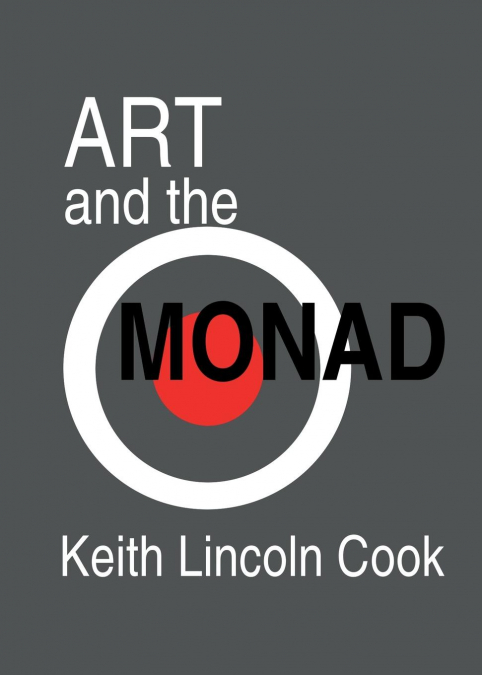
  • Art and the Monad
    Keith Lincoln Cook
    Keith Lincoln Cook's essay centres on his diagram of the monad: a circular diagram, showing the relationship between external stimuli, the intellect and the emotions. Although everyone should be able to freely respond to the vast amount of external stimuli collected by the senses, many people will block off their responses, collecting the stimuli in the band of intellect an...
    Disponible

    6,17 €

  • Slow Down
    Todd Webb
    Color everything and color nothing on your path to mindfulness with this playful coloring book!Packed with just enough to keep you entertained in the present moment, SLOW DOWN is sure to become your go-to meditation guide as you color your way to a calmer, less stressful life. With simple illustrations and inspirational text it makes a great gift! "Art's purpose is to sober...
    Disponible

    12,17 €

  • Raising the Eyebrow
    Lauren Golden
    A lavish festschrift to John Onians with contributions by 28 distinguished academics. Any summary as to the direction of these contributions is, perhaps, best left to Martin Kemp and his affectionate preface, “Above all, he (John Onians) reminds us of the researchers’, writers’ and teachers’ true mission, that is the need to be radical in both asking and answering questions, an...
    Disponible

    182,20 €

  • Projective Processes and Neuroscience in Art and Design
    Rachel Zuanon
    Recent advances in neuroscience suggest that the human brain is particularly well-suited to design things: concepts, tools, languages and places. Current research even indicates that the human brain may indeed have evolved to be creative, to imagine new ideas, to put them into practice, and to critically analyze their results. Projective Processes and Neuroscience in Art and De...
  • Book of Jupiter
    Leo Valenzuela
    Book of Jupiter: Gone to Uranus is a work of imagination and fantasy by Leo Valenzuela. Explore a variety of unique creatures with interesting dialogue which included a few step tutorials on how to draw his style of work. 3 ...
    Disponible

    24,25 €

Otros libros del autor

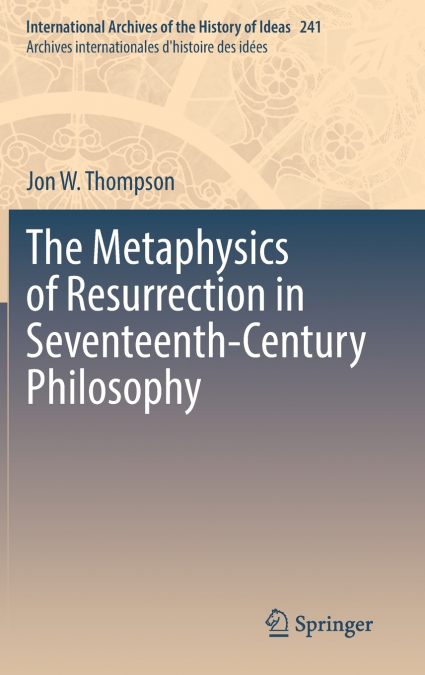
  • The Metaphysics of Resurrection in Seventeenth-Century Philosophy
    Jon W. Thompson
    This book provides a new account of the emergence of the philosophy of personal identity in the early modern period. Reflection on personal identity is often thought to have begun in earnest with John Locke’s famous consciousness-based account, published in the 2nd Edition of the Essay in 1694. The present work argues that we ought to understand modern notions of personal ident...
    Disponible

    48,18 €

  • The Metaphysics of Resurrection in Seventeenth-Century Philosophy
    Jon W. Thompson
    This book provides a new account of the emergence of the philosophy of personal identity in the early modern period. Reflection on personal identity is often thought to have begun in earnest with John Locke’s famous consciousness-based account, published in the 2nd Edition of the Essay in 1694. The present work argues that we ought to understand modern notions of personal ident...