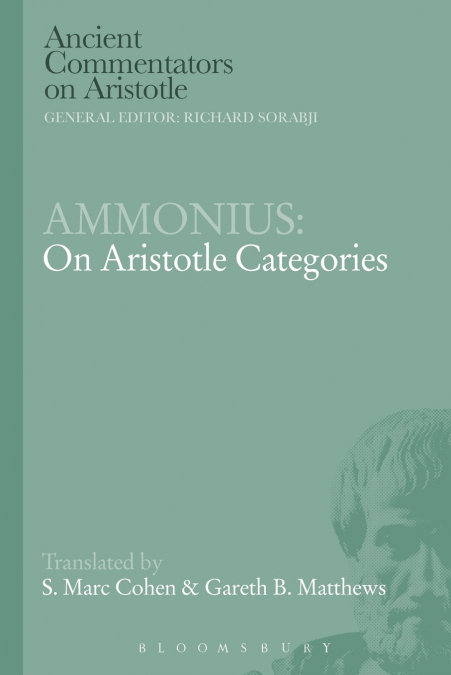
Ammonius

Ammonius

Gareth B. Matthews / S. Marc Cohen

67,09 €
IVA incluido
Disponible
Editorial:
Bloomsbury Publishing plc
Año de edición:
2014
Materia
Filosofía occidental: antigua, hasta c. 500
ISBN:
9781780933771
67,09 €
IVA incluido
Disponible

Selecciona una librería:

  • Librería Samer Atenea
  • Librería Aciertas (Toledo)
  • Kálamo Books
  • Librería Perelló (Valencia)
  • Librería Elías (Asturias)
  • Donde los libros
  • Librería Kolima (Madrid)
  • Librería Proteo (Málaga)

Ammonius, who taught most of the leading sixth-century Neoplatonists, introduced the methods of his own teacher, Proclus, from Athens to Alexandria. These are exemplified in his commentaries: for instance, in the set of ten introductory questions prefixed to this commentary, which became standard. The commentary is interesting for the light it sheds on the religious situation in Alexandria. It used to be said that the Alexandrian Neoplatonist school was allowed to remain open after the Athenian school closed because Ammonius has agreed with the Christian authorities to keep quiet about his religious views. On the contrary, as this commentary shows he freely declared his belief in the Neoplatonist deities. The philosophical problems considered by Ammonius offer a unique insight into Aristotle’s Categories. They exercise the mind and deepen understanding of the subject matter. Modern readers would do well to put the same questions to themselves.


Artículos relacionados

  • The Nature of Things
    Lucretius Lucretius
    De rerum natura (On the Nature of Things) is a 1st century BC didactic poem by the Roman poet and philosopher Lucretius with the goal of explaining Epicurean philosophy to a Roman audience. Lucretius presents the principles of atomism; the nature of the mind and soul; explanations of sensation and thought; the development of the world and its phenomena; and explains a variety o...
    Disponible

    36,76 €

  • Pompeii
    Fergus Mason
    Pompeii was one of most advanced cities of its time; it had a complex water system, gymnasium, and an amphitheater. Despite it's advancements, there was one thing it wasn't ready for: Mount Vesuvius—the volcano that led to its ultimate doom.  The 79 AD eruption of Mount Vesuvius was one of the worst disasters in all of European history. In a near instant, over 15,000 p...
    Disponible

    10,36 €

  • Middle Platonism and Neoplatonism, Volume 1
    Stephen Gersh
    'It is generally agreed that those types of philosophy that are loosely called ’Platonic’ and ’Neoplatonic’ played a crucial role in the history of European culture during the centuries between antiquity and the Renaissance. However, until now no scholar has attempted to describe the evolution of these forms of thought in a single comprehensive academic study.' So writes Stephe...
    Disponible

    179,17 €

  • Middle Platonism and Neoplatonism, Volume 2
    Stephen Gersh
    It is generally agreed that those types of philosophy that are loosely called 'Platonic' and 'Neoplatonic' played a crucial role in the history of European culture during the centuries between antiquity and the Middle Ages. However, until now no scholar has attempted to describe the evolution of these forms of thought in a single comprehensive academic study. Middle Platonism a...
    Disponible

    215,18 €

  • Porphyry’s Commentary on Ptolemy’s Harmonics
    Andrew Barker
    ...
    Disponible

    77,17 €

  • The Roots of Platonism
    John Dillon
    ...
    Disponible

    25,29 €