Amana

Amana

Don Heinrich Tolzmann / William Robertson Perkins

22,37 €
IVA incluido
Disponible
Editorial:
Heritage Books
Año de edición:
2013
Materia
Historia de América
ISBN:
9780788414824
22,37 €
IVA incluido
Disponible

Selecciona una librería:

  • Librería Samer Atenea
  • Librería Aciertas (Toledo)
  • Kálamo Books
  • Librería Perelló (Valencia)
  • Librería Elías (Asturias)
  • Donde los libros
  • Librería Kolima (Madrid)
  • Librería Proteo (Málaga)

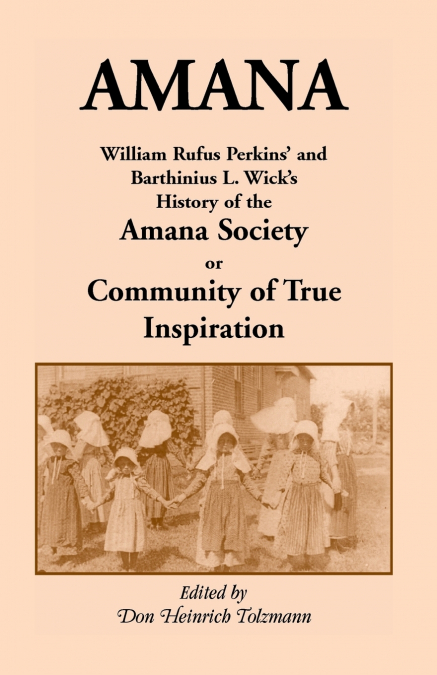
Amana (the Society of True Inspiration) was a settlement of German pietists in Iowa, consisting of seven old-fashioned villages along the Iowa River. The founders were German mystics who believed in divine inspiration, and who traced their religious ancestry back to the pietists of the sixteenth and seventeenth centuries. They opposed Lutheran formalism, refused to take oaths and render military service, and would not allow their children to attend Lutheran schools. In 1817, the group experienced a spiritual renaissance, and in 1842, several members came to the U.S. to explore the possibilities available here. This advance guard purchased 5,000 acres of the Old Seneca Indian reservation near Buffalo, New York, and six villages were built for the 800 emigrants who came over. According to the constitution of 1843, everything except clothing and household goods was to be held in common. By 1854, the community was in need of more land, and the time seemed appropriate for moving west. Eventually, it was decided to buy land in Iowa, and the community of Amana was established. By 1862, six villages lay within a radius of six miles in the Iowa River Valley, and the village of Homestead was bought outright to make the seventh, so that the community had access to a railroad for its produce. In 1859, the community was legally incorporated, and lived under a simple constitution until 1932. During the Great Depression in 1932, Amana decided to abandon communism, and reorganized as a stock company with the usual rules applicable to corporations in a capitalist society. By the end of the 1950s, over thirty enterprises were in operation in the community, and many newcomers are now employed at the various industries in the area. Much remains to reflect the German religious heritage of the community. Amana has become one of the major tourist attractions in the Midwest due to its unique architecture, its interesting shops and excellent restaurants. Amana may be seen as a community which successfully adapted itself to the American scene, and which has grown, prospered, and developed as a German-American community. This history was originally published in 1891; this edition includes a new introduction and full-name index.

Artículos relacionados

  • Pan-Africanism and Education
    Kenneth J. King / Kenneth JKing
    This is an analysis of the complex links between Black America and Africa in the period of 1880 to 1945. It examines an extended white attempt to pattern politics and education in colonial Africa upon the example of the U.S. South. This export of United States race relations to Africa was resisted by Black intellectuals in the United States and many of the early nationalists in...
    Disponible

    24,60 €

  • The Native American Cookbook Recipes From Native American Tribes
    G.W. Mullins
    Light Of The Moon Publishing along with Author G.W. Mullins and Illustrator / Artist C.L. Hause have joined together to explore Native American Indian Cooking.  More than just a cookbook, this Native American recipe collection offers a look into a forgotten past.  'The Native American Cookbook Recipes From Native American Tribes,' offers a large collection of recipes from and i...
    Disponible

    24,56 €

  • A Public Spirit
    George H. Atkinson
    George Henry Atkinson (1819-89) was a son of New England who arrived in the Oregon Territory in 1848, sent by the American Home Missionary Society. Although his commission from the Society specified that his work was to be ecclesiastical and educational, he took an approach to that assignment which went well beyond his mandate. Well-informed and energetic, he made an impact on ...
    Disponible

    10,45 €

  • North Carolina Women of the Confederacy
    Lucy London Anderson
    Long out of print, this volume of recollections, stories, and verse provides a glimpse of women's lives on the home front-and sometimes in the thick of battle-during the War between the States. Nearly fifty years after the American Civil War, Lucy Worth London Anderson (Mrs. John Huske Anderson) of Fayetteville, N.C., compiled one of the first memorial collections honoring the...
    Disponible

    17,20 €

  • Freedom by a Thread
    Freedom by a Thread: The History of Quilombos in Brazil brings together some of the best scholars in the world working on the history of quilombos (maroon societies) in Brazil from a variety of perspectives and approaches. Over 40 percent of the total volume of captive Africans arrived in Brazil during a 400-year period of legal and contraband transatlantic slaving. If slavery ...
    Disponible

    36,71 €

  • Nashville Baseball History
    Bill Traughber
    Nashville is a Big League city despite never having been home to a major league team. From the Civil War era, to star-studded exhibitions, to outstanding Negro Leagues teams, to some of the great minor league franchises of all time, few cities have as rich a baseball tradition as Nashville, Tennessee.Nashville sports historian Bill Traughber, who has been writing about baseball...
    Disponible

    13,15 €