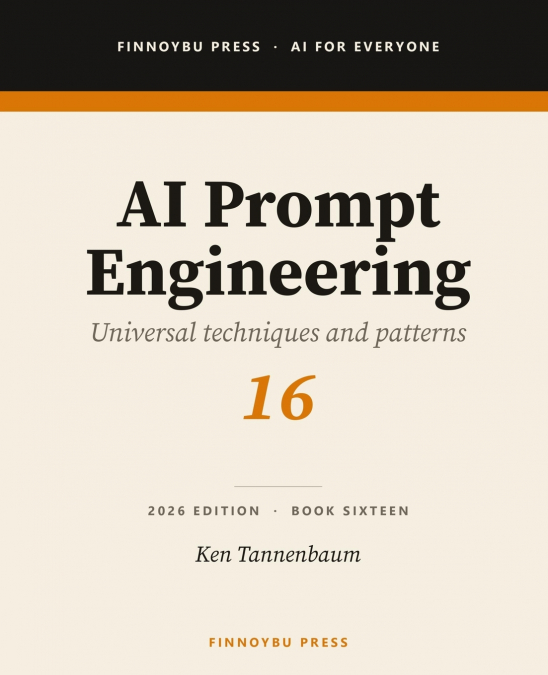

AI Prompt Engineering

AI Prompt Engineering

Ken Tannenbaum

32,18 €
IVA incluido
Disponible
Editorial:
Finnoybu Press
Año de edición:
2026
Materia
Inteligencia artificial
ISBN:
9798950533150
32,18 €
IVA incluido
Disponible

Selecciona una librería:

  • Librería Samer Atenea

  • Kálamo Books
  • Librería Elías (Asturias)
  • Librería Kolima (Madrid)
  • Librería Proteo (Málaga)

t prompts fail for the same handful of reasons. This book teaches you to fix all of them.You already know how to use AI. You have typed plenty of questions into ChatGPT, asked Claude to draft an email, had Gemini summarize a document. You are past 'wow, this is cool' and into 'why won’t it just do what I want?' That is the phase where most people quietly give up - and the phase this book is built for.This is a prompting book, not a product book. The techniques work across every major AI platform because they are rooted in how large language models actually process language, not in the quirks of any single product. The product guides teach you to drive specific cars. This book teaches you to drive.What’s inside:Foundations. Why most prompts fail, how AI models process your words, and the universal anatomy of a great prompt. Specificity as a superpower - the single highest-leverage skill in prompting.Core techniques every serious user should master. Few-shot prompting. Chain-of-thought reasoning. System prompts and instructions. Structured output (JSON, tables, schemas). Persona and voice control.Advanced methods. The iterative prompt - how to converge on great output instead of starting over. Prompt chains and pipelines. Negative prompting. Context window management. Multimodal prompting (images, audio, mixed inputs).Domain applications. Prompting for code, for writing, for analysis, and for creative work - each with worked examples and the patterns that consistently outperform generic prompts.Mastery. Testing and evaluating prompts like a real practitioner. Building and maintaining a prompt library that scales with your work and your team. Platform-specific tricks for ChatGPT, Claude, and Gemini. The future of prompting in an agentic world.50+ reusable prompt patterns, cross-platform comparison tables, a glossary, and curated further reading in the appendices.Every example was tested on real platforms - ChatGPT (GPT-5.3, GPT-5.4 Thinking, GPT-5.5), Claude (Sonnet 4.6 and Opus 4.7), and Gemini (3 Pro, 3 Flash, 3.1 Pro). The book is honest about non-determinism: the patterns are reliable even when individual outputs vary.If you are still typing 'please' and 'thank you' to AI just in case - this book will teach you to spend those tokens on results instead.Includes coverage of GPT-5.5, Claude Opus 4.7, Gemini 3.1 Pro, structured output, agentic prompting, and every 2026 platform’s quirks.
Artículos relacionados

  • Artificial Cognition Systems
    ...
  • Cross-Disciplinary Applications of Artificial Intelligence and Pattern Recognition
    Vijay Kumar Mago
    The need for intelligent machines in areas such as medical diagnostics, biometric security systems, and image processing motivates researchers to develop and explore new techniques, algorithms, and applications in this evolving field. Cross-Disciplinary Applications of Artificial Intelligence and Pattern Recognition: Advancing Technologies provides a common platform for researc...
  • Emerging Applications of Natural Language Processing
    Over the last few years, the area of Natural Language Processing has drastically grown in recognition, not only within the research and development community, but also with industry professionals. As NLP continues to be discussed and researched, certain areas continue to grow and mature. As a result, the need for advanced research and information is in high demand. Emerging App...
  • Androids, Cyborgs, and Robots in Contemporary Culture and Society
    Steven John Thompson
    Mankind’s dependence on artificial intelligence and robotics is increasing rapidly as technology becomes more advanced. Finding a way to seamlessly intertwine these two worlds will help boost productivity in society and aid in a variety of ways in modern civilization. Androids, Cyborgs, and Robots in Contemporary Culture and Society is an essential scholarly resource that delve...
  • Deep Learning Innovations and Their Convergence With Big Data
    The expansion of digital data has transformed various sectors of business such as healthcare, industrial manufacturing, and transportation. A new way of solving business problems has emerged through the use of machine learning techniques in conjunction with big data analytics. Deep Learning Innovations and Their Convergence With Big Data is a pivotal reference for the latest sc...
  • Computational Psychoanalysis and Formal Bi-Logic Frameworks
    Giuseppe Iurato
    Computational psychoanalysis is a new field stemming from Freudian psychoanalysis. The new area aims to understand the primary formal structures and running mechanisms of the unconscious while implementing them into computer sciences. Computational Psychoanalysis and Formal Bi-Logic Frameworks provides emerging information on this new field which uses psychoanalysis and the unc...

Otros libros del autor

  • Grok
    Ken Tannenbaum
    Most AI assistants are frozen in the past. Grok treats the present as a question it can go and answer.For years, every AI assistant shared the same quiet limitation: trained up to a date, then frozen - brilliant about everything before the cutoff, blank about everything after. We adapted by not asking about anything recent, until the blind spot stopped registering as one.Grok, ...
    Disponible

    31,60 €

  • Mistral
    Ken Tannenbaum
    The American AI giants make you choose: capability or control. Mistral was built to refuse that choice.For most of modern AI’s short history, the most capable assistants lived on a handful of US companies’ servers - reachable only by sending them your data, on terms you couldn’t negotiate. For many people, that’s fine. For hospitals, banks, law firms, government bodies, Europea...
    Disponible

    31,60 €

  • DeepL
    Ken Tannenbaum
    There’s a difference between a translation that’s correct and one that’s good - and DeepL is built entirely around it.For years, machine translation taught us to lower our expectations. The free translators were useful and unmistakably robotic: they got the words right and the music wrong, and we learned to accept it, quietly rewriting anything that mattered. Then DeepL transla...
    Disponible

    31,77 €

  • Codex
    Ken Tannenbaum
    The way developers use AI changed shape - and Codex is the tool that made the new shape obvious.For years, AI meant autocomplete: you typed, it finished the line, you stayed in the driver’s seat. Then the pattern flipped. Instead of asking an AI to finish your line, you hand it the whole task - 'fix the failing tests in the billing module,' 'add pagination to the admin table,' ...
    Disponible

    31,53 €

  • Automate Your Work with AI
    Ken Tannenbaum
    The most valuable thing you could automate at work is the thing you’ve stopped noticing you do by hand.It hides in plain sight. The copy-paste between two systems that don’t talk. The email you forward every time a certain thing happens. The spreadsheet you update from another spreadsheet. Each instance is small. Together they’re a part-time job you never applied for - the work...
    Disponible

    32,03 €

  • Build Apps Without Code
    Ken Tannenbaum
    For most of software’s history, there was a wall - and you were either on the side that could build apps or the side that could only wish for them. The wall was code. Now it has a door.A new generation of AI tools lets you build real, working software by describing what you want in plain language and refining it through conversation. Not a mockup, not a configured template - an...
    Disponible

    31,88 €