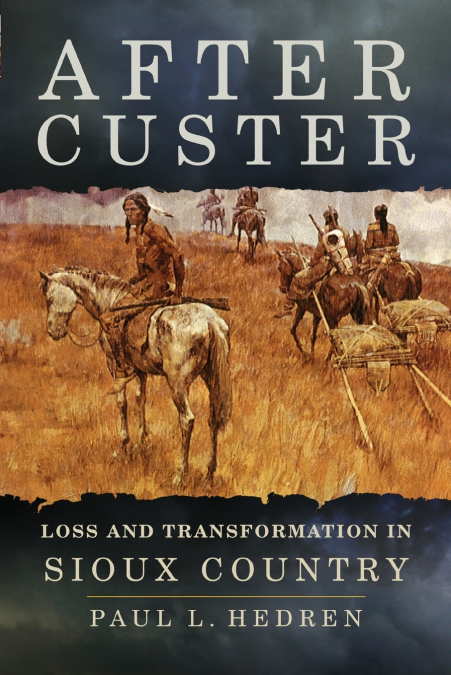

After Custer

After Custer

After Custer

Paul L. Hedren

30,99 €
IVA incluido
Disponible
Editorial:
University of Oklahoma Press
Año de edición:
2018
Materia
Historia de América
ISBN:
9780806160443
30,99 €
IVA incluido
Disponible

Selecciona una librería:

  • Librería Samer Atenea
  • Librería Aciertas (Toledo)
  • Kálamo Books
  • Librería Perelló (Valencia)
  • Librería Elías (Asturias)
  • Donde los libros
  • Librería Kolima (Madrid)
  • Librería Proteo (Málaga)

Between 1876 and 1877, the U.S. Army battled Lakota Sioux and Northern Cheyenne Indians in a series of vicious conflicts known today as the Great Sioux War. After the defeat of Custer at the Little Big Horn in June 1876, the army responded to its stunning loss by pouring fresh troops and resources into the war effort. In the end, the U.S. Army prevailed, but at a significant cost. In this unique contribution to American western history, Paul L. Hedren examines the war’s effects on the culture, environment, and geography of the northern Great Plains, their Native inhabitants, and the Anglo-American invaders.As Hedren explains, U.S. military control of the northern plains following the Great Sioux War permitted the Northern Pacific Railroad to extend westward from the Missouri River. The new transcontinental line brought hide hunters who targeted the great northern buffalo herds and ultimately destroyed them. A de-buffaloed prairie lured cattlemen, who in turn spawned their own culture. Through forced surrender of their lands and lifeways, Lakotas and Northern Cheyennes now experienced even more stress and calamity than they had endured during the war itself. The victors, meanwhile, faced a different set of challenges, among them providing security for the railroad crews, hide hunters, and cattlemen.Hedren is the first scholar to examine the events of 1876–77 and their aftermath as a whole, taking into account relationships among military leaders, the building of forts, and the army’s efforts to memorialize the war and its victims. Woven into his narrative are the voices of those who witnessed such events as the burial of Custer, the laying of railroad track, or the sudden surround of a buffalo herd. Their personal testimonies lend both vibrancy and pathos to this story of irreversible change in Sioux Country. 3

Artículos relacionados

  • Pan-Africanism and Education
    Kenneth J. King / Kenneth JKing
    This is an analysis of the complex links between Black America and Africa in the period of 1880 to 1945. It examines an extended white attempt to pattern politics and education in colonial Africa upon the example of the U.S. South. This export of United States race relations to Africa was resisted by Black intellectuals in the United States and many of the early nationalists in...
    Disponible

    24,60 €

  • The Native American Cookbook Recipes From Native American Tribes
    G.W. Mullins
    Light Of The Moon Publishing along with Author G.W. Mullins and Illustrator / Artist C.L. Hause have joined together to explore Native American Indian Cooking.  More than just a cookbook, this Native American recipe collection offers a look into a forgotten past.  'The Native American Cookbook Recipes From Native American Tribes,' offers a large collection of recipes from and i...
    Disponible

    24,56 €

  • A Public Spirit
    George H. Atkinson
    George Henry Atkinson (1819-89) was a son of New England who arrived in the Oregon Territory in 1848, sent by the American Home Missionary Society. Although his commission from the Society specified that his work was to be ecclesiastical and educational, he took an approach to that assignment which went well beyond his mandate. Well-informed and energetic, he made an impact on ...
    Disponible

    10,45 €

  • North Carolina Women of the Confederacy
    Lucy London Anderson
    Long out of print, this volume of recollections, stories, and verse provides a glimpse of women's lives on the home front-and sometimes in the thick of battle-during the War between the States. Nearly fifty years after the American Civil War, Lucy Worth London Anderson (Mrs. John Huske Anderson) of Fayetteville, N.C., compiled one of the first memorial collections honoring the...
    Disponible

    17,20 €

  • Freedom by a Thread
    Freedom by a Thread: The History of Quilombos in Brazil brings together some of the best scholars in the world working on the history of quilombos (maroon societies) in Brazil from a variety of perspectives and approaches. Over 40 percent of the total volume of captive Africans arrived in Brazil during a 400-year period of legal and contraband transatlantic slaving. If slavery ...
    Disponible

    36,71 €

  • Nashville Baseball History
    Bill Traughber
    Nashville is a Big League city despite never having been home to a major league team. From the Civil War era, to star-studded exhibitions, to outstanding Negro Leagues teams, to some of the great minor league franchises of all time, few cities have as rich a baseball tradition as Nashville, Tennessee.Nashville sports historian Bill Traughber, who has been writing about baseball...
    Disponible

    13,15 €

Otros libros del autor

  • Rosebud, June 17, 1876
    Paul L. Hedren
    The Battle of the Rosebud may well be the largest Indian battle ever fought in the American West. The monumental clash on June 17, 1876, along Rosebud Creek in southeastern Montana pitted George Crook and his Shoshone and Crow allies against Sioux and Northern Cheyennes under Sitting Bull and Crazy Horse. It set the stage for the battle that occurred eight days later when, just...
    Disponible

    41,77 €

  • Powder River
    Paul L. Hedren
    The Great Sioux War of 1876–77 began at daybreak on March 17, 1876, when Colonel Joseph J. Reynolds and six cavalry companies struck a village of Northern Cheyennes—Sioux allies—thereby propelling the Northern Plains tribes into war. The ensuing last stand of the Sioux against Anglo-American settlement of their homeland spanned some eighteen months, playing out across more than...
    Disponible

    34,55 €

  • Great Sioux War Orders of Battle
    Paul L. Hedren
    A unique resource with a new perspective on the U.S. Army in the Great Sioux War Lasting nearly two years, the Great Sioux War pitted almost one-third of the U.S. Army against Lakota Sioux and Northern Cheyennes. By the time it ended, this grueling war had played out on twenty-seven different battlefields scattered across five states, resulted in hundreds of casualties, cost mi...
    Disponible

    30,95 €