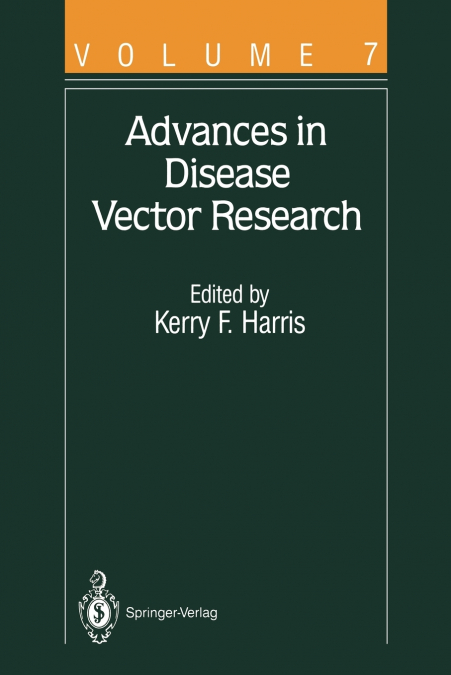

Advances in Disease Vector Research

Advances in Disease Vector Research


66,55 €
IVA incluido
Disponible
Editorial:
Springer Nature B.V.
Año de edición:
2011
Materia
Zoología y ciencias animales
ISBN:
9781461390466
66,55 €
IVA incluido
Disponible

Selecciona una librería:

  • Librería Samer Atenea
  • Librería Aciertas (Toledo)
  • Kálamo Books
  • Librería Perelló (Valencia)
  • Librería Elías (Asturias)
  • Donde los libros
  • Librería Kolima (Madrid)
  • Librería Proteo (Málaga)

We open Volume 7 with a series of four chapters on plant virus transmission by insects. In Chapter 1, Karen Gibb and John Randles present preliminary information about an association between the plant bug Cyrtopeitis nicotianae (Heteroptera: Miridae) and velvet tobacco mottle virus (VTMo V): the only reported instance of mirid transmission of a known virus. Mirids could be considered as likely vectors of plant viruses because they are phytophagous, possess a piercing-sucking-feeding apparatus, have winged adults, and are cosmopolitan pests of a wide range of crops. Surprisingly, however, there are only three plant viruses purportedly transmitted by heteropterous vectors, compared with the nearly 250 by homopterous ones. To what extent these figures reflect actual differences in the abilities of members of the two suborders to transmit plant pathogens remains to be determined. Compared with the Homop­ tera, the Heteroptera have been ignored by researchers as potential vectors of plant viruses. The authors are quick to point out that additional studies are needed before generalizations can be made about virus-mirid-plant interactions and that virus transmission by mirids is not easily characterized using the conventional transmission criteria and terminology established for such homopterous vectors as aphids and leafhoppers. Transmission of VTMoV by C. nicotianae appears to have characteristics in common with both nonpersistent noncirculative and circulative (persistent) transmission.
Artículos relacionados

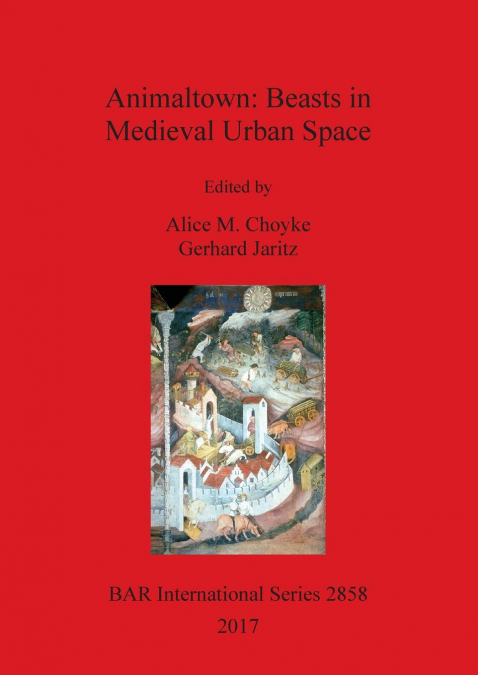
  • Animaltown
    Urban space constitutes a place where people and animals live together in close proximity with each other, creating changing landscapes of co-existence, conflict, mutual dependencies and exploitation. The medieval animals found in the articles of Animaltown: Beasts in Medieval Urban Space, appear in text and image, as well as archaeological find materials in the form of butcher...
    Disponible

    109,24 €

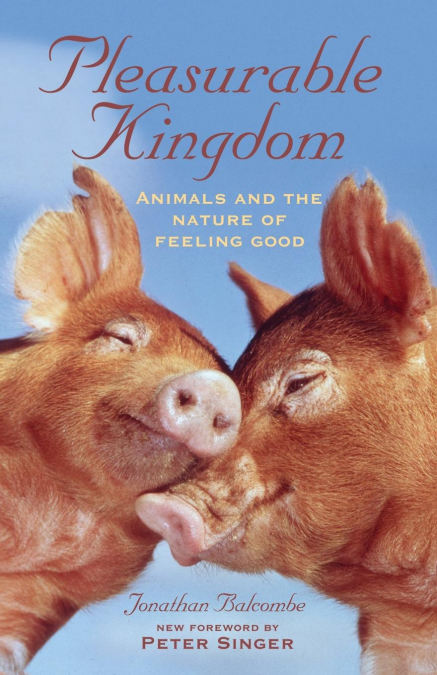
  • Pleasurable Kingdom
    Jonathan Balcombe
    Pleasurable Kingdom presents new evidence that animals--like humans--enjoy themselves. From birds to baboons, insects to iguanas, animals feel good thanks to play, sex, touch, food, anticipation, comfort, aesthetics, and more. Combining rigorous evidence, elegant argument and amusing anecdotes, leading animal behavior researcher Jonathan Balcombe shows that the possibility of p...
    Disponible

    18,96 €

  • SECOND NATURE
    Jonathan Balcombe
    ...
    Disponible

    16,52 €

  • Experimental Zoology
    Manisha R Gejage / Ramesh M Gejage
    The goal of the book is to present the practical knowledge of Zoology. Animal diversity, venomous and non-venomous snakes, study of birds, brain of fowl and hyoid apparatus, sclerotic plates, pecten and collumella of fowl, scales of fishes, biochemical tests, activity of salivary amylase, estimation of total protein and lipid, DNA isolation and estimation of uric acid are given...
  • TOXICOLOGY
    M A SUBRAMANIAN
    In an era defined by burgeoning human populations, rampant industrialization, cutting-edge technological progress, and expanding urban landscapes, the integrity of our natural environment faces unprecedented challenges. The relentless march of progress has ushered in a flood of chemicals, seeping into the very fabric of our ecosystems and posing insidious threats to biological ...
    Disponible

    23,69 €

  • Leaders in Animal Behavior
    Donald Dewsbury / Lee Drickamer
    ...
    Disponible

    64,68 €