
Inicio > Matemáticas y ciencia > Biologia, ciencias de la vida > Bioquímica > Adaptation to Life at High Salt Concentrations in Archaea, Bacteria, and Eukarya
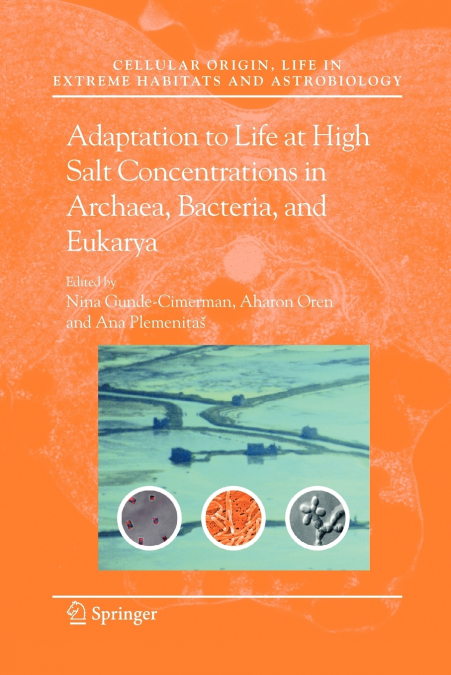
Adaptation to Life at High Salt Concentrations in Archaea, Bacteria, and Eukarya

Adaptation to Life at High Salt Concentrations in Archaea, Bacteria, and Eukarya


432,37 €
IVA incluido
Disponible
Editorial:
Springer Nature B.V.
Año de edición:
2010
Materia
Bioquímica
ISBN:
9789048169146
432,37 €
IVA incluido
Disponible

Selecciona una librería:

  • Librería Samer Atenea
  • Librería Aciertas (Toledo)
  • Kálamo Books
  • Librería Perelló (Valencia)
  • Librería Elías (Asturias)
  • Donde los libros
  • Librería Kolima (Madrid)
  • Librería Proteo (Málaga)

Salt is an essential requirement of life. Already from ancient times (e. g. , see the books of the Bible) its importance in human life has been known. For example, salt symbolizes destruction (as in Sodom and Gomorra), but on the other hand it has been an ingredient of every sacrifice during the Holy Temple periods. Microbial life in concentrated salt solutions has fascinated scientists since its discovery. Recently there have been several international meetings and books devoted entirely to halophiles. This book includes the proceedings of the 'Halophiles 2004' conference held in Ljubljana, Slovenia, in September 2004 (www. u- lj. si/~bfbhaloph/index. html). This meeting was attended by 120 participants from 25 countries. The editors have selected presentations given at the meeting for this volume, and have also invited a number of contributions from experts who had not been present in Ljubljana. This book complements 'Halophilic Microorganisms', edited by A. Ventosa and published by Springer-Verlag (2004), 'Halophilic Microorganism and their Environments' by A. Oren (2002), published by Kluwer Academic Publishers as volume 5 of 'Cellular Origins, Life in Extreme Habitats and Astrobiology' (COLE), and 'Microbiology and Biogeochemistry of Hypersaline Environments' edited by A. Oren, and published by CRC Press, Boca Raton (1999). Salt-loving (halophilic) microorganisms grow in salt solutions above seawater salinity (~3. 5% salt) up to saturation ranges (i. e. , around 35% salt). High concentrations of salt occur in natural environments (e. g.

Artículos relacionados

  • Applied Molecular Genetics of Fungi
    British Mycological Society / Peberdy
    ...
  • Horrible Biology
    Arnold Lawson
    Delve into the eerie aspects of nature with this well-illustrated and enlightening book, unveiling the ghastly facets of life that thrive amidst us. From deadly poisonous frogs to plants that can drive one mad, from minuscule spiders residing on the skin to flies feasting on human flesh, and parasitic worms inhabiting human bodies to fungi annihilating frogs - discover these an...
    Disponible

    13,88 €

  • Polar Microbiology
    Polar microbiology is a promising field of research that can tell us much about thefundamental features of life. The microorganisms that inhabit Arctic and Antarcticenvironments are important not only because of the unique species they represent, but alsobecause of their diverse and unusual physiological and biochemical properties. Furthermore,microorganisms living in Polar Reg...
  • Hands-On Experience of Microbial World
    Kyu Hong Cho
    Hands-On Experience of Microbial World: Microbiology Laboratory Exercises provides students with immersive experiences in microbiology.Organized into three comprehensive sections-general microbiology, health-related microbiology, and biotechnology utilizing microorganisms-the exercises cover a diverse range of topics. Students delve into essential techniques such as staining mi...
    Disponible

    85,01 €

  • Prostaglandins, Leukotrienes, and the Immune Response
    John L. Ninneman / John LNinneman / Ninnemann John L.
    ...
    Disponible

    71,64 €

  • Modeling Disease Transmission and Its Prevention by Disinfection
    Hurst Christon J.
    ...
    Disponible

    65,94 €