
Inicio > Tecnología, ingeniería, agricultura > > Química industrial > Acyclic, Carbocyclic and L-Nucleosides
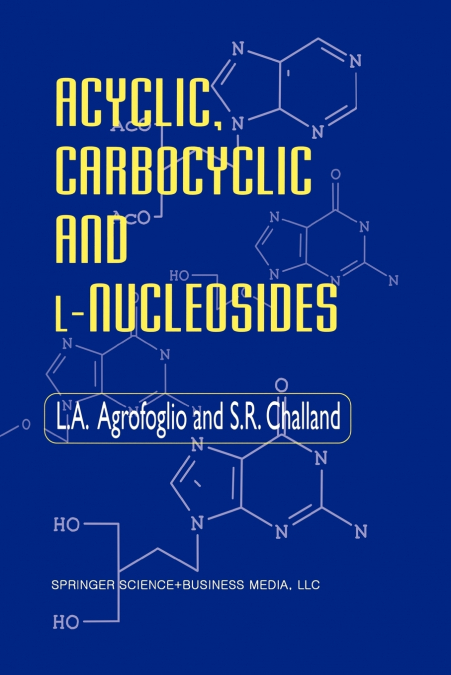
Acyclic, Carbocyclic and L-Nucleosides

Acyclic, Carbocyclic and L-Nucleosides

L. Agrofoglio / S.R. Challand

268,67 €
IVA incluido
Disponible
Editorial:
Springer Nature B.V.
Año de edición:
2012
Materia
Química industrial
ISBN:
9789401037341
268,67 €
IVA incluido
Disponible

Selecciona una librería:

  • Librería Samer Atenea
  • Librería Aciertas (Toledo)
  • Kálamo Books
  • Librería Perelló (Valencia)
  • Librería Elías (Asturias)
  • Donde los libros
  • Librería Kolima (Madrid)
  • Librería Proteo (Málaga)

Interest in chemical entities capable of blocking or modifying cell metabolism ultimately goes back to the discovery of the structure of DNA in the 1950s. Understanding of the biochemical processes involved in cell metabolism rapidly led to the idea that compounds could be designed which might interfere with these processes, and thus could be used in the treatment of the diseases caused by viral infection. Since then, several classes of drugs have been discovered which depend for their effect on modification of the proper functioning of nucleic acids and, with the introduction of acyclovir for the treatment of Herpes infections, nucleoside analogues have become the cornerstone of antiviral chemotherapy. The success of the early nucleoside agents, the toxicity and metabolic instability of many nucleoside analogues, and the effects of viral pathogens on public health are driving the design, synthesis and evaluation of new nucleoside analogues, with much attention turning to nucleosides containing `non natural’ sugar analogues. This book focuses on the development of these agents, and draws together all the available material in an easily consulted form, which at the same time guides the reader into the research literature on the subject. Written primarily for the medicinal chemist, coverage includes both synthetic strategies and outline guidance on the main trends in biological activity. Particular attention is drawn to the comparison of synthetic routes to compounds with their natural analogues. Finally, the important antiviral activities of the compounds are treated, including anti-retrovirus, anti-hepadnavirus and anti-herpes virus properties. Written mainly for medicinal chemists in the pharmaceutical industry and synthetic organic chemists in academe, this book will also be attractive to researchers in institutions focusing on cellular metabolism. Advanced students of organic chemistry will find the clear discussion of the synthetic strategies adopted in the development of these compounds a useful introduction to this exciting and challenging area.

Artículos relacionados

  • Quantitative Structure-Activity Relationships in Drug Design, Predictive Toxicology, and Risk Assessment
    Kunal Roy
    Quantitative structure-activity relationships (QSARs) represent predictive models derived from the application of statistical tools correlating biological activity or other properties of chemicals with descriptors representative of molecular structure and/or property. Quantitative Structure-Activity Relationships in Drug Design, Predictive Toxicology, and Risk Assessment discus...
  • Chemical Compound Structures and the Higher Dimension of Molecules
    Gennadiy Vladimirovich Zhizhin
    Originally, scientists believed that molecules were three-dimensional; however, studies have proven that geometric dimensions are continuous. Therefore, molecules are able to have higher dimensions which influences how they interact with other molecules leading to advances in various fields including nanomedicine, nanotoxicology and quantum biology. Chemical Compound Structures...
  • CHEMICAL THERMODYNAMICS, 2ND EDITION
    Byung Chan Eu / BYUNG CHAN EU & MAZEN AL-GHOUL / EU BYUNG CHAN / Mazen Al-Ghoul
    This book enables the reader to learn, in a single volume, equilibrium and nonequilibrium thermodynamics as well as generalized forms of hydrodynamics for linear and nonlinear processes applied to various hydrodynamic flow processes — including chemical oscillation phenomena and pattern formations, shock wave phenomena, sound wave propagations, and Liesegang pattern formation, ...
  • CARBOHYDRATE CHEMISTRY
    ALEN RAIMO / Raimo Alen
     This book presents a comprehensive approach to the versatile and fascinating field of carbohydrate chemistry. It covers, besides the colorful historical perspective within the utilization of carbohydrates and their derivatives, all modern aspects on their properties, nomenclature, uses, and natural occurrence as such or as residues in a variety of biologically active molecules...
  • Recent Developments in Geopolymers and Alkali-Activated Materials
    Sujeong Lee
    We are compiling and publishing a collection of the latest research papers in the fields of Geopolymer and Alkali-Activated Materials (AAM). This compilation includes eight original research and two review papers covering a diverse range of topics, including various raw materials, manufacturing processes, and applications in the realms of Geopolymer and AAM. The publication aim...
  • Introduction to Chemical Engineering Fluid Mechanics
    William M. Deen
    ...

Otros libros del autor

  • Acyclic, Carbocyclic and L-Nucleosides
    L. Agrofoglio / S.R. Challand
    Interest in chemical entities capable of blocking or modifying cell metabolism ultimately goes back to the discovery of the structure of DNA in the 1950s. Understanding of the biochemical processes involved in cell metabolism rapidly led to the idea that compounds could be designed which might interfere with these processes, and thus could be use...