
Inicio > Humanidades > Historia > Absolute Mesopotamian chronology
Absolute Mesopotamian chronology

Absolute Mesopotamian chronology

Gerard Gertoux

21,05 €
IVA incluido
Disponible
Editorial:
Lulu Press
Año de edición:
2021
Materia
Historia
ISBN:
9781326558239
21,05 €
IVA incluido
Disponible

Selecciona una librería:

  • Librería Samer Atenea
  • Librería Aciertas (Toledo)
  • Kálamo Books
  • Librería Perelló (Valencia)
  • Librería Elías (Asturias)
  • Donde los libros
  • Librería Kolima (Madrid)
  • Librería Proteo (Málaga)

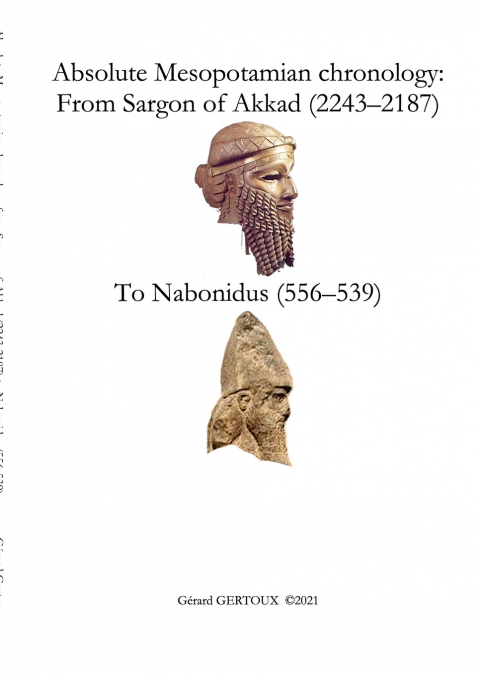
The 614 Assyrian eponyms between the first year of Šamšî-Adad I and the first year of Tiglath-pileser I (1115-1076) allow us to date approximately the reign of Šamšî-Adad I (1728-1695). As the Assyrian years were lunar before the reign of Ninurta-apil-Ekur (1192-1179), this makes it possible to slightly correct the reign of Šamšî-Adad I (1712-1680), yet as this Amorite king died in the 17th/18th year of King Hammurabi, so this synchronism fixes the dating of this Babylonian king (1697-1654). This dating does not correspond to the Middle Chronology but exactly satisfies the astronomical dating of the Ammisaduqa tablet on Venus, according to the Ultra-Low Chronology. In addition, one tablet of astronomical omens (Enuma Anu Enlil 20) mentions a lunar eclipse dated 14 Simanu at the end of the reign of Šulgi (14/III/48, 27 June 1954 BCE), and another (Enuma Anu Enlil 21) mentions a lunar eclipse dated 14 Addaru at the end of the third dynasty Ur, which ended with the reign of Ibbi-Sin (14/XII/24, 6 March 1911 BCE). These two total lunar eclipses are separated by 42 years of reign (= 9 years of Amar-Sin + 9 years of Šu-Sîn + 24 years of Ibbi-Sin) and 9 months (=XII - III). During the period 2200-1850 BCE, there was only one couple of lunar eclipses spaced 42 years and 9 months apart, and visible at Ur, corresponding to the description of the astronomical omens. These two total lunar eclipses confirm the absolute dating of the reign of Hammurabi (1697-1654) and allow to anchor the reign of Sargon of Akkad (2243-2187). Secondly, as there is a synchronism between Neferhotep I (1701-1690) and Ibni-Addu (1700-1680), the king of Hazor, and another synchronism between Ibni-Addu and Hammurabi (1697-1654), the king of Babylon, this reign could be determined indirectly by carbon-14 and is again in perfect agreement with the 'Ultra-Low chronology'. Finally, the best confirmation of the accuracy of this absolute chronology is the complete reconstitution from 2040 to 1050 BCE, year by year, of the main Mesopotamian chronologies: Uruk IV, Mari, Gutium, Assyria, Elam, Uruk V, Ur III, Larsa, Isin I, Babylon, Hana, Kassite and Sealand, with their synchronisms as well as their dates anchored on astronomical phenomena such as the total eclipses of the moon (Gertoux, NABU 2021-3, 171-172).


Artículos relacionados

  • Raising Freedom's Banner
    Paul Harris
    World wide history of peaceful street demonstrations from their earliest beginning in eighteenth century England to their use throughout the world in the twenty-first century. Describes why some demonstration movements succeeded and others failed. Contrasts demonstrations within the law with civil disobedience demonstrations. Describes Peterloo, the Chartists, the Suffragettes,...
    Disponible

    23,59 €

  • Waipi’o Valley
    Jeffrey L. Gross
    Waipi’o Valley: A Polynesian Journey from Eden to Eden recounts the remarkable migrations of the Polynesians across a third of the circumference of the earth. Their amazing journey began from Kalana i Hau’ola, the biblical “Garden of Eden” located along the shore of the Persian Gulf, extended to the Indus River Valley of ancient Vedic India, to Egypt where some ancestors of the...
  • Floralia
    June Rainsford Butler
    A century characterized by a growing interest in science, the opportunity for travel, and leisure for gardening furnishes the setting for Butler’s book. The rise of landscape gardening in England is traced, and the origin and history of its most famous gardens are given. The close relation between England and America in the field of horticulture is also discussed.Originally pub...
    Disponible

    61,20 €

  • President Wilson’s Addresses
    Woodrow Wilson
    'These addresses of President Woodrow Wilson are almost entirely concerned with political affairs, and more specifically with defining Americanism. Yet they also show that even as he moved from academia to the heights of politics, Wilson retained something of the teacher’s interest in showing the relation between specific instances and the general forms of thought or action of ...
  • The Story of my Life
    John Albert Macy
    The Story of My Life, is Helen Keller’s autobiography detailing her early life, especially her experiences with Anne Sullivan. The book is dedicated to inventor Alexander Graham Bell. The dedication reads, 'To ALEXANDER GRAHAM BELL Who has taught the deaf to speak and enabled the listening ear to hear speech from the Atlantic to the Rockies, I dedicate this Story of My Life.' ...
  • The Story of My Life Vol. 6 Spanish Passions
    Giacomo Casanova
    Casanova was an Italian adventurer and author from the Republic of Venice. His autobiography, Histoire de ma vie (Story of My Life), is regarded as one of the most authentic sources of the customs and norms of European social life during the 18th century. He has become so famous for his often complicated and elaborate affairs with women that his name is now synonymous with 'wom...

Otros libros del autor

  • Astronomy as a Key to History
    Gérard Gertoux
    Astronomy has long played a crucial role in humanity’s understanding of time and history. By analysing astronomical events such as solar and lunar eclipses, as well as planetary conjunctions, historians and archaeologists can refine and validate historical chronologies. This monograph explores the intersection between astronomy and historical studies, demonstrating how astronom...
    Disponible

    27,68 €

  • Astronomy as a Key to History
    GERARD GERTOUX
    This monograph delves into astronomy’s crucial role in refining historical timelines. By analyzing phenomena like solar/lunar eclipses and planetary conjunctions, it offers precise chronological markers that help historians and archaeologists validate ancient civilizations’ timelines.Drawing on interdisciplinary research, it highlights cases where astronomical calculations reso...
    Disponible

    34,90 €

  • Mesopotamian chronology (2340-539 BCE) through astronomically dated synchronisms and comparison with carbon-14 dating
    GERARD GERTOUX
    The 614 Assyrian eponyms between the first year of Šamšî-Adad I and the first year of Tiglath-pileser I (1115-1076) allow us to date the reign of Šamšî-Adad I (1728-1695) approximately. As the Assyrian years were lunar before the reign of Ninurta-apil-Ekur (1192-1179), this makes it possible to slightly correct the reign of Šamšî-Adad I (1712-1680), yet as this Amorite king die...
    Disponible

    41,30 €

  • Absolute Mesopotamian chronology from Gilgamesh (2447-2401) to Darius II (424-405)
    Gerard Gertoux
    The Egyptian king lists were commissioned, as early as the first dynasty, by kings wishing to legitimise their royal descent from Narmer (2838-2808), the founder of the Egyptian empire. On the other hand, Sumerian king lists were commissioned by Shulgi (2002-1954), a powerful king of Ur III in the last Sumerian dynasty, who presented himself as the heir of the famous Gilgamesh ...
    Disponible

    49,93 €

  • Who Built the Tower of Babel When and Why? (History Begins at Sumer)
    Gerard Gertoux
    Historical truth progresses by relying on authentic documents validated by absolute dates just as scientific truth progresses by relying on theories validated by measurements. However, the history of origins eludes historians because of the lack of authenticated documents and reliable dates. The first king of the first Egyptian dynasty was Narmer (2838-2808), however he was pre...
    Disponible

    37,52 €

  • Absolute Chronology of the Ancient Worlds, from 2838 BCE to 394 BCE, Compared to Carbon-14 Dating
    GERARD GERTOUX
    The first scientific chronology of the Egyptian civilisation, calculated by Olaf A. Toffteen in his monograph: Ancient Chronology (1907), fixed the beginning of the First Dynasty in 3285 BCE. In their academic study: Ancient Egyptian Chronology (2006), Erik Hornung, Rolf Krauss and David A. Warburton set the beginning of the First Dynasty around 2900 BCE, a rejuvenation of 385 ...
    Disponible

    30,57 €