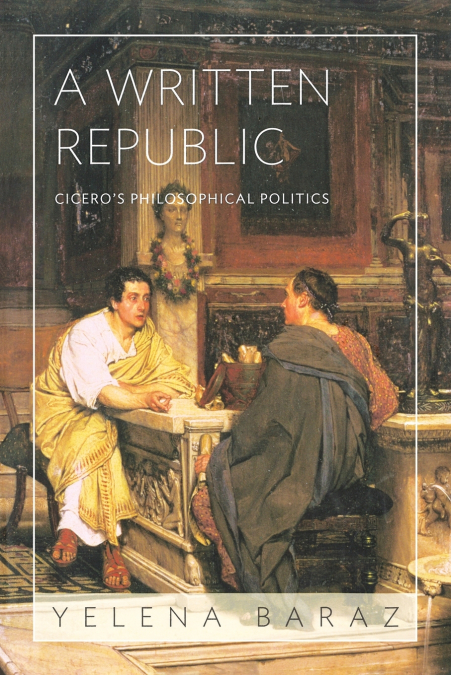

A Written Republic

A Written Republic

Yelena Baraz

54,28 €
IVA incluido
Disponible
Editorial:
Princeton University Press
Año de edición:
2024
Materia
Filosofía occidental: antigua, hasta c. 500
ISBN:
9780691264820
54,28 €
IVA incluido
Disponible

Selecciona una librería:

  • Librería Samer Atenea
  • Kálamo Books
  • Librería Elías (Asturias)
  • Librería Kolima (Madrid)
  • Librería Proteo (Málaga)

Why philosophy was politics by other means for Rome’s greatest statesmanIn the 40s BCE, during his forced retirement from politics under Caesar’s dictatorship, Cicero turned to philosophy, producing a massive and important body of work. As he was acutely aware, this was an unusual undertaking for a Roman statesman because Romans were often hostile to philosophy, perceiving it as foreign and incompatible with fulfilling one’s duty as a citizen. How, then, are we to understand Cicero’s decision to pursue philosophy in the context of the political, intellectual, and cultural life of the late Roman republic? In A Written Republic, Yelena Baraz takes up this question and makes the case that philosophy for Cicero was not a retreat from politics but a continuation of politics by other means, an alternative way of living a political life and serving the state under newly restricted conditions.Baraz examines the rhetorical battle that Cicero stages in his philosophical prefaces—a battle between the forces that would oppose or support his project. He presents his philosophy as intimately connected to the new political circumstances and his exclusion from politics. His goal—to benefit the state by providing new moral resources for the Roman elite—was traditional, even if his method of translating Greek philosophical knowledge into Latin and combining Greek sources with Roman heritage was unorthodox.A Written Republic provides a new perspective on Cicero’s conception of his philosophical project while also adding to the broader picture of late-Roman political, intellectual, and cultural life.


Artículos relacionados

  • The Nature of Things
    Lucretius Lucretius
    De rerum natura (On the Nature of Things) is a 1st century BC didactic poem by the Roman poet and philosopher Lucretius with the goal of explaining Epicurean philosophy to a Roman audience. Lucretius presents the principles of atomism; the nature of the mind and soul; explanations of sensation and thought; the development of the world and its phenomena; and explains a variety o...
  • Pompeii
    Fergus Mason
    Pompeii was one of most advanced cities of its time; it had a complex water system, gymnasium, and an amphitheater. Despite it's advancements, there was one thing it wasn't ready for: Mount Vesuvius—the volcano that led to its ultimate doom.  The 79 AD eruption of Mount Vesuvius was one of the worst disasters in all of European history. In a near instant, over 15,000 p...
    Disponible

    10,36 €

  • Middle Platonism and Neoplatonism, Volume 1
    Stephen Gersh
    'It is generally agreed that those types of philosophy that are loosely called ’Platonic’ and ’Neoplatonic’ played a crucial role in the history of European culture during the centuries between antiquity and the Renaissance. However, until now no scholar has attempted to describe the evolution of these forms of thought in a single comprehensive academic study.' So writes Stephe...
  • Middle Platonism and Neoplatonism, Volume 2
    Stephen Gersh
    It is generally agreed that those types of philosophy that are loosely called 'Platonic' and 'Neoplatonic' played a crucial role in the history of European culture during the centuries between antiquity and the Middle Ages. However, until now no scholar has attempted to describe the evolution of these forms of thought in a single comprehensive academic study. Middle Platonism a...
  • Porphyry’s Commentary on Ptolemy’s Harmonics
    Andrew Barker
    ...
    Disponible

    80,87 €

  • The Roots of Platonism
    John Dillon
    ...
    Disponible

    26,54 €

Otros libros del autor

  • Reading Roman Pride
    Yelena Baraz
    Pride is pervasive in Roman texts, as an emotion and a political and social concept implicated in ideas of power. This study examines Roman discourse of pride from two distinct complementary perspectives. The first is based on scripts, mini-stories told to illustrate what pride is, how it arises and develops, and where it fits within the Roman emotional landscape. The second is...