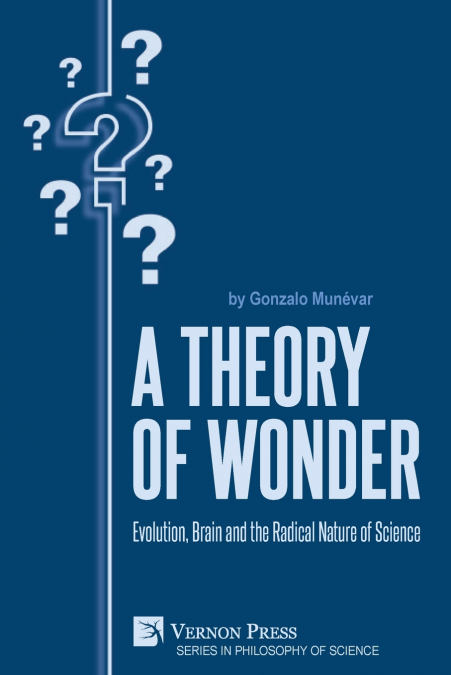

A Theory of Wonder

A Theory of Wonder

Gonzalo Munévar

77,03 €
IVA incluido
Disponible
Editorial:
Vernon Art and Science
Año de edición:
2021
Materia
Influencia de la ciencia y la tecnología sobre la sociedad
ISBN:
9781648893537
77,03 €
IVA incluido
Disponible

Selecciona una librería:

  • Librería Desdémona
  • Librería Samer Atenea
  • Librería Aciertas (Toledo)
  • Kálamo Books
  • Librería Perelló (Valencia)
  • Librería Elías (Asturias)
  • Donde los libros
  • Librería Kolima (Madrid)
  • Librería Proteo (Málaga)

’A Theory of Wonder’ aims to determine the best way science can satisfy our sense of wonder by exploring the world. Empiricism tells us that science succeeds because it follows the scientific method: Observation passes judgment on Theory - supporting or rejecting it. Much credit is given to the inventor of the method, Galileo, but when historically-minded philosophers of science like Kuhn and Feyerabend called our attention to what Galileo actually wrote and did, we were shocked to find out that Galileo instead drives a dagger through the heart of empiricism; he strikes down the distinction between theory and observation. Plain facts, like the vertical fall of a stone, ruled out the motion of the Earth. To conclude that the stone really falls vertically, however, we must assume that the Earth does not move. If it does move, then the stone only 'seems' to fall vertically. Galileo then replaced the 'facts' against the motion of the Earth with 'facts' that included such motion. This process is typical during scientific revolutions. A good strategy for science is to elaborate radical alternatives; then, and on their basis, reconsider what counts as evidence. Feyerabend was called irrational for this suggestion; but looking at the practice of science from the perspective of evolution and neuroscience shows that the suggestion is very reasonable instead, and, moreover, explains why science works best as a radical form of knowledge. It also leads to a sensible biological form of relative truth, with preliminary drafts leading to exciting discussions with other researchers in the philosophy of science.This book will be of particular interest to university students, instructors and researchers in history or philosophy of science, as well as those with a general interest in the nature of science. 

Artículos relacionados

  • Interactive Media Use and Youth
    Modern advancements in technology have changed the way that young people use interactive media. Learning from such methods was not even considered until recently. It is now slowly defining the landscape of contemporary pedagogical practices. Interactive Media Use and Youth: Learning, Knowledge Exchange and Behavior provides a comprehensive collection of knowledge based on diffe...
    Disponible

    236,22 €

  • Social and Economic Effects of Community Wireless Networks and Infrastructures
    Abdelaal
    It is surprising to think that in today’s rapidly evolving world of technology, over half of the globe still does not have access to high speed internet. Creating community wireless networks has in the past been a way to provide remote communities with internet and network access. Social and Economic Effects of Community Wireless Networks and Infrastructures highlights the succ...
    Disponible

    249,30 €

  • The New Atlantis
    Francis Bacon
    In this work, Bacon portrayed a vision of the future of human discovery and knowledge, expressing his aspirations and ideals for humankind. The novel depicts the creation of a utopian land where 'generosity and enlightenment, dignity and splendour, piety and public spirit' are the commonly held qualities of the inhabitants of 'Bensalem'. ...
    Disponible

    18,12 €

  • Sport 2.0
    Andy Miah
    ...
    Disponible

    28,86 €

  • Productivity Machines
    Corinna Schlombs
    ...
    Disponible

    48,52 €

  • Open Space
    Mariel Borowitz
    ...
    Disponible

    38,25 €

Otros libros del autor

  • Teoría de las maravillas
    Gonzalo Munévar
    ’Teoría de las Maravillas: Evolución, cerebro y la naturaleza radical de la ciencia’ aspira a determinar la mejor manera en la que la ciencia puede satisfacer nuestros sentidos de maravillarnos a través de la exploración del mundo. El empirismo establece que la ciencia tiene éxito porque sigue el método científico: La observación basa su juicio en la Teoría, apoyándola o rechaz...
    Disponible

    77,04 €

  • Spanish Studies in the Philosophy of Science
    Gonzalo Munevar
    An anthology of contemporary philosophy of science in Spain. Essays on 19th Century physics, the new cosmology, philosophy of biology, scientific rationality, philosophy of mathematics, phenomenology’s account of scientific progress, science and ethics, philosophy of economics, methodology, and the philosophy of technology. ...
    Disponible

    65,85 €

  • Beyond Reason
    Gonzalo Munévar
    Some philosophers think that Paul Feyerabend is a clown, a great many others think that he is one of the most exciting philosophers of science of this century. For me the truth does not lie somewhere in between, for I am decidedly of the second opinion, an opinion that is becoming general around the world as this century comes to an end and history be...
    Disponible

    267,88 €

  • Beyond Reason
    Gonzalo Munévar
    Some philosophers think that Paul Feyerabend is a clown, a great many others think that he is one of the most exciting philosophers of science of this century. For me the truth does not lie somewhere in between, for I am decidedly of the second opinion, an opinion that is becoming general around the world as this century comes to an end and history be...
    Disponible

    266,90 €