
Inicio > Humanidades > Filosofía > Ética y filosofía moral > A Propos Du Suicide Assiste Et de L’Euthanasie Aujourd’hui
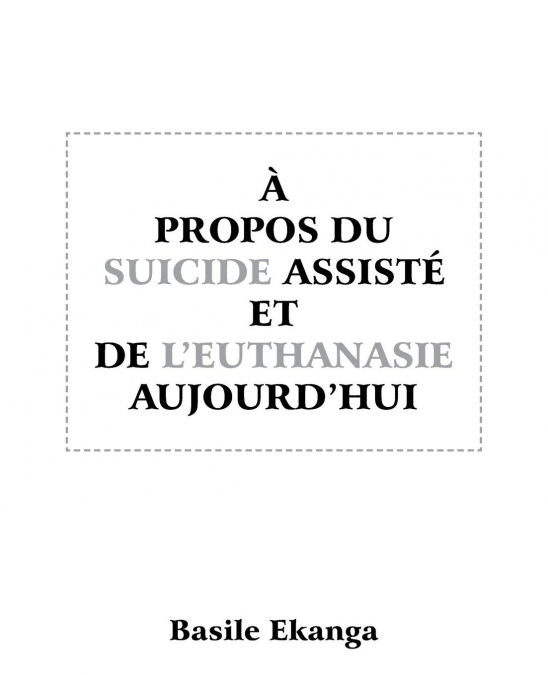
A Propos Du Suicide Assiste Et de L’Euthanasie Aujourd’hui

A Propos Du Suicide Assiste Et de L’Euthanasie Aujourd’hui

A Propos Du Suicide Assiste Et de L'Euthanasie Aujourd'hui

Basile Ekanga

47,24 €
IVA incluido
Disponible
Editorial:
iUniverse
Año de edición:
2013
Materia
Ética y filosofía moral
ISBN:
9781491702444
47,24 €
IVA incluido
Disponible

Selecciona una librería:

  • Librería Samer Atenea
  • Librería Aciertas (Toledo)
  • Kálamo Books
  • Librería Perelló (Valencia)
  • Librería Elías (Asturias)
  • Donde los libros
  • Librería Kolima (Madrid)
  • Librería Proteo (Málaga)

A propos du suicide assiste et de l’ euthanasie aujourd’ hui.L’euthanasie reste encore un sujet d’actualité dans nos sociétés modernes. Chaque société essaie d’organiser la coexistence de différentes éthiques, qui, toutes, prétendent avoir une légitime prétention de dire ce qui est bien et ce qui est mauvais. La préoccupation de l’auteur dans ce travail est de poursuivre le débat sur l’euthanasie en répertoriant les réflexions des uns et des autres. L’euthanasie a perdu son sens initial de bonne mort. Elle devient une mort provoquée par personne interposée. L’accent dans le débat fut mis à un moment donné de l’histoire sur la manière de mourir ; et actuellement le débat porte surtout sur la dignité humaine qu’il faudrait préserver jusqu’au dernier soupir. Ce dernier volet du débat reflète l’héritage de la longue histoire de l’Église catholique qui a marqué presque toute la tradition occidentale et même au-delà. Pendant que le débat fait rage dans certaines sociétés, deux pays européens, la Hollande et la Belgique, ont légalisé l’euthanasie. Ce que l’on avance le plus souvent dans le débat, c’est la gestion de la souffrance des malades. Le patient peut-il choisir de manière délibérée la mort ? Le fait que l’on soit malade, n’enlève en rien la responsabilité de celui-ci face aux nombreux problèmes qui se posent. Il est une personne capable de traiter les informations le concernant directement. À défaut, c’est le tuteur ou les parents qui agissent à la place de l’enfant malade ou de l’adulte incompétent. Être malade avec toutes les souffrances physiques et mentales qui s’en suivent n’ouvre pas nécessairement la porte à écourter la vie. Les soins palliatifs sont indiqués et semblent être une alternative crédible pour les personnes malades se trouvant en phase finale de leur maladie. Il faudrait cheminer avec ces malades tout en se gardant de tomber dans l’acharnement thérapeutique.------------------------------------------(English Translation)The Situation of Assisted Suicide and Euthanasia TodayEuthanasia remains a topical subject. Any community deems it wise to organize a peaceful coexistence of its different ethical theories which claim to have the right solution to all debatable problems. The main concern all along is to outline the variety of stances in the euthanasia debate. The initial notion of euthanasia, i.e. good death, is no longer in use. Instead, the current meaning lays stress on death caused by a third party especially a doctor. The accent was in a certain time in the debate stressed on the way each human being has to pass away. Nowadays the accent is more stressed on human dignity which any patient has to protect until death occurs. The use of human dignity in the debate reflects the influence of the Catholic Church that stood out in the long Western tradition and even beyond. Taking into account certain conditions euthanasia is legalized in the Netherlands and in Belgium. The core of the whole debate stands on the management of the physical suffering of the patient. How to cope with the patient’s great pain? Some say euthanasia is the best answer; others bring forward palliative care by minimizing to prolong life by any technological means. The debate goes on.
Artículos relacionados

  • Ka Ab Ba Building The Lighted Temple
    Dr Terri R. Nelson / Dr Terri RNelson
    The book KaAbBa Building The Lighted Temple/Metaphysical Keys to the Tree of Life draws a circle that is inclusive of the Afrikan origin of the Ancient Kemetic/Egyptian wisdom. It reveals the undeniable root and link of Ancient Africa to all the religious systems that would develop worldwide. This book is explosive in its power to convey the meaning of KaAbBa, the Medu Neter  (...
    Disponible

    37,41 €

  • Technoethics and the Evolving Knowledge Society
    Rocci Luppicini
    Recently, there has been a major push to rediscover the ethical dimension of technology across the sciences, social sciences, and humanities. Technoethics and the Evolving Knowledge Society: Ethical Issues in Technological Design, Research, Development, and Innovation examines human processes and practices connected to technology embedded within social, political, and moral sph...
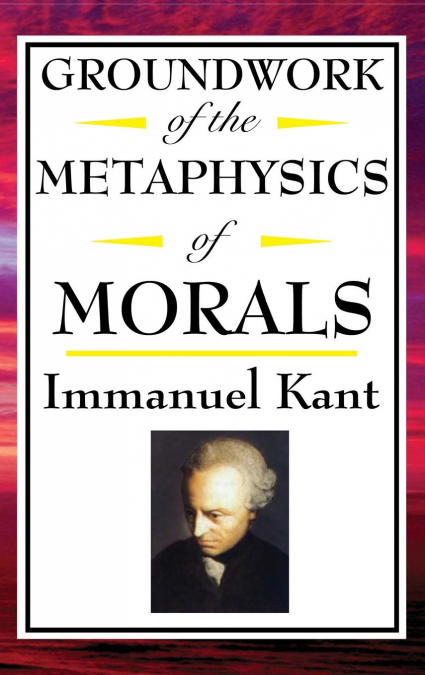
  • Kant
    Immanuel Kant
    Kant’s Groundwork of the Metaphysics of Morals is one of the most important works in modern moral philosophy. It belongs beside Plato, Aristotle, Machiavelli, and Hobbes. Here Kant sets out to articulate and defend the Categorical Imperative - the fundamental principle that underlies moral reasoning - and to lay the foundation for a comprehensive account of justice and human vi...
  • On the Duty of Civil Disobedience
    HENRY DAVID THOREAU
    Civil Disobedience argues that citizens should not permit their governments to overrule their consciences, and that they have a duty to avoid allowing their acquiescence to enable the government to make them the agents of injustice. Thoreau was motivated in part by his disgust with slavery and the Mexican-American War, but the sentiments he expresses here are just as pertinent ...
  • Beyond Good and Evil
    Friedrich Nietzsche
    Nietzsche, though primarily a philosopher, wrote widely on art, philology, history, religion, tragedy, culture, and science.  In 1886, at the height of his powers, he published Beyond Good and Evil.  Here he examines much of the best of human thought--dogmatic philosophy, Judeo-Christian morality, science and democracy – and finds it lacking.  Rejecting “slave-morality” he pres...
  • Beyond Good and Evil
    Friedrich Nietzsche
    Nietzsche, though primarily a philosopher, wrote widely on art, philology, history, religion, tragedy, culture, and science.  In 1886, at the height of his powers, he published Beyond Good and Evil.  Here he examines much of the best of human thought--dogmatic philosophy, Judeo-Christian morality, science and democracy – and finds it lacking.  Rejecting “slave-morality” he pres...
    Disponible

    9,99 €

Otros libros del autor

  • Les Fondements Ethiques de La Bioethique
    Basile Ekanga
    Les fondements éthiques de la bioéthique La bioéthique est une discipline très jeune qui n’a pas encore trouvé de bases solides. Elle est née au moment où des nouveaux problèmes, jusque-là inconnus, sont apparus en sciences biomédicales. Les préoccupations de l’éthique médicale étaient totalement tournées vers le médecin en évaluant ce qu’il devait faire et ce qu’il ne devait p...
    Disponible

    45,21 €

  • L’Interruption Volontaire de Grossesse
    Basile Ekanga
    L’interruption volontaire de grossesse État de la question, suivi du problème de stérilisation Une femme qui prend la décision de faire un avortement engage sa vie et surtout celle de l’enfant se trouvant dans son sein. On ne fait pas un avortement avec comme seul objectif de mettre fin à la vie du fœtus. Il faut toujours faire un lien entre les circonstances vécues par la femm...
    Disponible

    15,68 €