 Librería Samer Atenea
 Kálamo Books
 Librería Elías (Asturias)
 Librería Kolima (Madrid)
 Librería Proteo (Málaga)
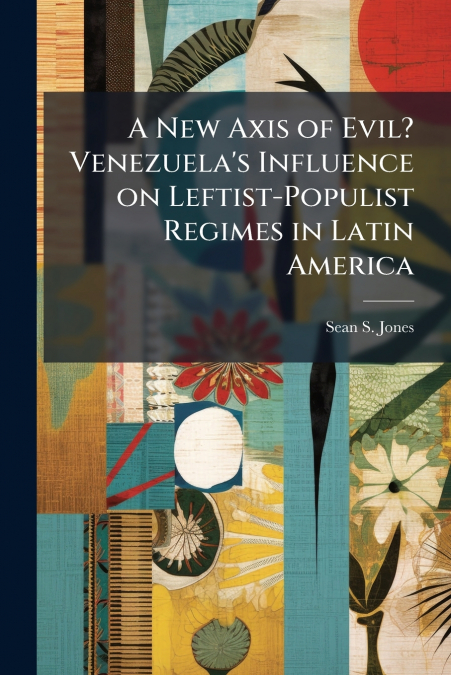
The demagogic Hugo Chavez routinely rails against neo-liberalism, globalization, and free-market capitalism in an effort to counter the U.S. influence in the Western Hemisphere. He plans to export his 'Bolivarian Revolution' to other Latin American countries like Bolivia, Ecuador, and Nicaragua. Since winning the presidential election in 1998, Chavez has been successful in conducting his Bolivarian social experiment by providing education and health programs to the masses in Venezuela, funded by the country’s oil revenue. Chavez understands that oil can be a 'geopolitical weapon' that can be wielded to realize his vision of '21st Century Socialism,' establish Venezuela as the regional hegemon, decrease dependence on the United States, and further integrate South American countries. In addition to strengthening ties with leftist-populist regimes in Latin America, Chávez has also formed informal alliances with Iran and purchased billions of dollars of military equipment from Russia. In light of these recent developments, the United States should consider the implications of Venezuela’s influence on Latin American leftist-populist governments and how it affects security in the Western Hemisphere. If the United States wishes to protect its interests and promote stability in the Latin American region, it should first determine the level of threat before deciding on the appropriate course of action. Specifically, the United States should ask the following questions: How should Venezuela’s actions shape U.S. strategy and foreign policy in the region? Do the ties between Iran, Venezuela and other Latin American leftist-populist governments (e.g., Bolivia, Ecuador, and Nicaragua) pose a strategic security threat to the United States? How should the United States respond? To that end, this research paper will address these questions by examining the historical background of Venezuela and other leftist-populist governments while focusing on their leadership.This work has been selected by scholars as being culturally important, and is part of the knowledge base of civilization as we know it. This work was reproduced from the original artifact, and remains as true to the original work as possible. Therefore, you will see the original copyright references, library stamps (as most of these works have been housed in our most important libraries around the world), and other notations in the work.This work is in the public domain in the United States of America, and possibly other nations. Within the United States, you may freely copy and distribute this work, as no entity (individual or corporate) has a copyright on the body of the work.As a reproduction of a historical artifact, this work may contain missing or blurred pages, poor pictures, errant marks, etc. Scholars believe, and we concur, that this work is important enough to be preserved, reproduced, and made generally available to the public. We appreciate your support of the preservation process, and thank you for being an important part of keeping this knowledge alive and relevant.