 Librería Samer Atenea
 Kálamo Books
 Librería Elías (Asturias)
 Librería Kolima (Madrid)
 Librería Proteo (Málaga)
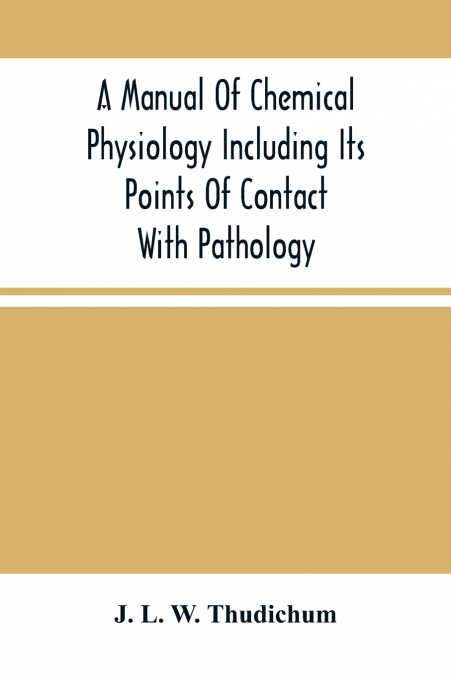
Before enzymes had names and biochemistry became a discipline, J. L. W. Thudichum mapped the chemistry of life with a clinician’s eye. Science meets the Victorian sickroom. In A Manual Of Chemical Physiology Including Its Points Of Contact With Pathology, he unites a medical chemistry textbook’s rigour with the practical urgency of disease, moving from the constitution of blood, urine, bile and other body fluids to the chemical changes that accompany illness. Its tone is direct and procedural, balancing chemical theory with the demands of hospital practice and laboratory routine. Read as a physiological chemistry manual and a clinical pathology reference, it tracks metabolism and body fluids as measurable evidence, and sets out biochemical laboratory methods that helped turn bedside observation into testable results. It is meticulous, ambitious, and concrete in scope.Written at the height of Victorian era medical science, this work stands among the early biochemistry classics and a cornerstone in the history of clinical chemistry: an ambitious attempt to describe chemical physiology and pathology in one continuous argument. Modern readers will find a vivid window onto nineteenth century biochemistry; medical students will spot a medical students study guide in embryo, and clinicians a physicians diagnostic handbook taking shape. For collectors of scientific heritage, the binding between physiology and diagnosis marks quietly a turning point in medical thought itself. Out of print for decades and now republished by Alpha Editions. Restored for today’s and future generations. More than a reprint -- a collector’s item and a cultural treasure.