American Association for International C / Felix Lutwig Calonder / Sir William Job Collins
 Librería Samer Atenea
 Kálamo Books
 Librería Elías (Asturias)
 Librería Kolima (Madrid)
 Librería Proteo (Málaga)
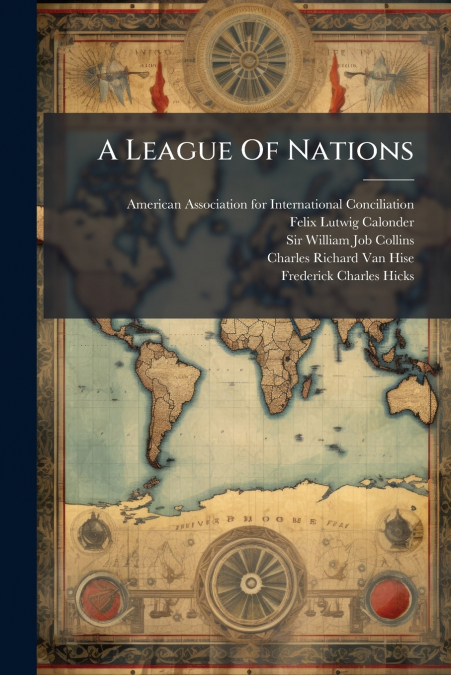
'A League of Nations' delves into the early 20th-century vision of international cooperation and collective security. This collection of essays and addresses by prominent figures associated with the American Association for International Conciliation explores the concept, structure, and potential of a League of Nations aimed at preventing future global conflicts. Contributors such as Felix Lutwig Calonder, Sir William Job Collins, Charles Richard Van Hise, and Frederick Charles Hicks examine the historical context, legal frameworks, and moral imperatives behind establishing such an organization.This volume offers valuable insights into the intellectual debates and political considerations that shaped the formation of the League of Nations following World War I. It reflects a hopeful yet pragmatic approach to building a more peaceful and interconnected world, capturing the spirit of an era grappling with the aftermath of unprecedented devastation and seeking innovative solutions to ensure lasting peace. 'A League of Nations' remains a vital resource for understanding the origins of modern international organizations and the enduring quest for global cooperation.This work has been selected by scholars as being culturally important, and is part of the knowledge base of civilization as we know it. This work was reproduced from the original artifact, and remains as true to the original work as possible. Therefore, you will see the original copyright references, library stamps (as most of these works have been housed in our most important libraries around the world), and other notations in the work.This work is in the public domain in the United States of America, and possibly other nations. Within the United States, you may freely copy and distribute this work, as no entity (individual or corporate) has a copyright on the body of the work.As a reproduction of a historical artifact, this work may contain missing or blurred pages, poor pictures, errant marks, etc. Scholars believe, and we concur, that this work is important enough to be preserved, reproduced, and made generally available to the public. We appreciate your support of the preservation process, and thank you for being an important part of keeping this knowledge alive and relevant.