 Librería Samer Atenea
 Librería Aciertas (Toledo)
 Kálamo Books
 Librería Perelló (Valencia)
 Librería Elías (Asturias)
 Donde los libros
 Librería Kolima (Madrid)
 Librería Proteo (Málaga)
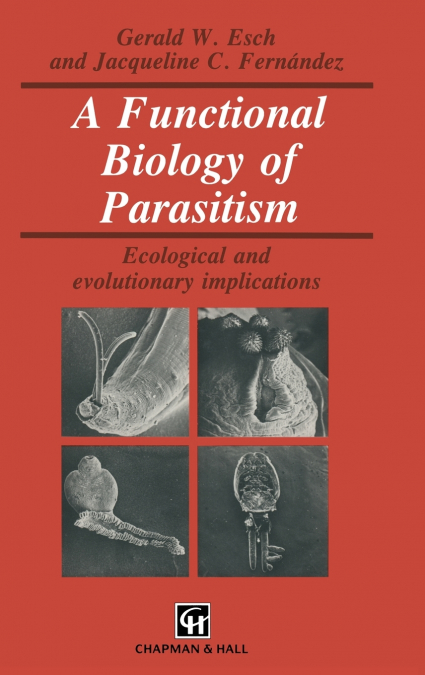
1 Introduction.- 1.1 The extent of parasitism.- 1.2 Definitions.- 1.3 The concept of harm.- 1.4 Some adaptations to parasitism.- 1.5 Life cycle and ecology.- >2 Population concepts.- 2.1 Background.- 2.2 General definitions.- 2.3 Factors affecting parasite populations.- 2.4 The dispersion concept.- 2.5 Dynamics of population growth.- 3 Factors influencing parasite populations.- 3.1 Density-independent factors: introduction.- 3.2 Density-independent factors: case histories.- 3.3 Density-dependent factors: introduction.- 3.4 Density-dependent factors: case histories.- 3.5 Suprapopulation dynamics: introduction.- 3.6 Suprapopulation dynamics: case histories.- 4 Influence of parasites on host populations.- 4.1 Introduction to the concept of regulation.- 4.2 Crofton’s approach.- 4.3 Overdispersion and regulation: introduction.- 4.4 Overdispersion and regulation: case histories.- 4.5 Epidemiological implications.- 4.6 Models.- 5 Life history strategies.- 5.1 Introduction.- 5.2 Reproductive strategies.- 5.3 Colonization strategies.- 5.4 Host behaviour and transmission.- 5.5 Theoretical considerations.- 6 Infracommunity dynamics.- 6.1 Introduction.- 6.2 The evolution of parasite communities.- 6.3 Infracommunity structure.- 6.4 The screen/filter concept.- 7 Component and compound communities.- 7.1 Introduction.- 7.2 Core-satellite and generalist-specialist species concepts.- 7.3 Determinants of component communities.- 7.4 Habitat variability (succession) and parasitism.- 7.5 The biocoenosis and parasite flow.- 7.6 The allogenic-autogenic species concept.- 8 Biogeographical aspects.- 8.1 Introduction.- 8.2 Factors affecting the geographical distribution of parasites.- 8.3 Patterns of distribution.- 8.4 Ecological aspects.- 8.5 Applied aspects of biogeography.- 9 Evolutionary aspects.- 9.1 Introduction.- 9.2 Microevolution.- 9.3 Evolution of host-parasite interactions.- 9.4 Parasite influence in the evolutionary biology of the host.- 10 Summary.- 10.1 Introduction.- 10.2 Population concepts.- 10.3 Factors influencing parasite populations.- 10.4 Influence of parasites on host populations.- 10.5 Life-history strategies.- 10.6 Infracommunity dynamics.- 10.7 Component and compound communities.- 10.8 Biogeographical aspects.- 10.9 Evolutionary aspects.- 10.10 What next for the evolution and ecology of parasitism?.- References.- Taxonomic host index.- Taxonomic parasite index.