
A Cultural History of Food in the Medieval Age

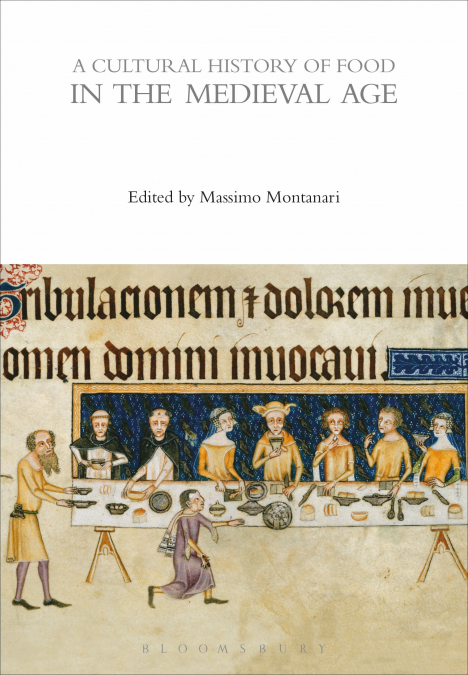
A Cultural History of Food in the Medieval Age

Massimo Montanari

173,87 €
IVA incluido
Consulta disponibilidad
Editorial:
Bloomsbury Publishing plc
Año de edición:
2014
Materia
Historia social y cultural
ISBN:
9780857850249

Selecciona una librería:

  • Librería Samer Atenea
  • Librería Aciertas (Toledo)
  • Kálamo Books
  • Librería Perelló (Valencia)
  • Librería Elías (Asturias)
  • Donde los libros
  • Librería Kolima (Madrid)
  • Librería Proteo (Málaga)

Europe was formed in the Middle Ages. The merging of the traditions of Roman-Mediterranean societies with the customs of Northern Europe created new political, economic, social and religious structures and practices. Between 500 and 1300 CE, food in all its manifestations, from agriculture to symbol, became ever more complex and integral to Europe’s culture and economy. The period saw the growth of culinary literature, the introduction of new spices and cuisines as a result of trade and war, the impact of the Black Death on food resources, the widening gap between what was eaten by the rich and what by the poor, as well as the influence of religion on food rituals.A Cultural History of Food in the Medieval Age presents an overview of the period with essays on food production, food systems, food security, safety and crises, food and politics, eating out, professional cooking, kitchens and service work, family and domesticity, body and soul, representations of food, and developments in food production and consumption globally.
Artículos relacionados

  • Arizal
    Raphael Afilalo
    The Ari overflowed with Torah. He was expert in Scripture, Mishnah, Talmud, Midrash, Maaseh Bereishit and Maaseh Merkavah. About all the different levels of prophecy, their details and from which level the prophets had their revelations.  He understood the whistling of the trees, the grass and stones, the language of the birds and other animals, the conversations of angels, the...
  • Rose-tinted Memory
    Michael S Fryer
    “Those who deny Auschwitz would be ready to remake it”.  ~ Primo Levi, Holocaust survivor and author Seventy years after the mass murder of the Jews of Europe, Holocaust denial and Holocaust revisionism are creeping into our overall perception of what actually happened.Christendom has not ‘denied’ Holocaust, but it has attempted to create a memory of Holocaust which suggests th...
    Disponible

    8,84 €

  • Pan Kapitan of Jordanow
    William Leibner
    Yeshayahu Drucker devoted a good part of his life to rescuing Jewish children from non-Jewish homes. Many parents had given their children to Polish neighbors for safekeeping during the war. Unfortunately most of the parents did not survive the Shoah. At the end of the war, there was no one to claim the children and they remained with the “adopted” Polish families. Following hi...
  • Holy Dissent
    Glenn Dynner
    BThe religious communities of early modern Eastern Europe—particularly those with a mystical bent—are typically studied in isolation. Yet the heavy Slavic imprint on Jewish popular mysticism and pervasive Judaizing tendencies among Christian dissenters call into question the presumed binary quality of Jewish-Christian interactions. In Holy Dissent: Jewish and Christian Mystics ...
  • AL-FARD
    Ali Mahdi Muhammad
    The Al-Fard, or the The Dawn, has captured the early rays of Our history. This history is essential if we are to be brought face to face with the One true and living God of the universe. The purpose of this writing is to bring the reader step by step, one degree at a time to the reality of God in person. The teachings of Our Father elevates the believer to the level of Godhood ...
  • Wild Things. Nature and the Social Imagination
    HISTORIES OF HUMAN CONSTRUCTIONS OF NATUREWild Things: Nature and the Social Imagination assembles eleven substantive and original essays on the cultural and social dimensions of environmental history. They address a global cornucopia of social and ecological systems, from Africa to Europe, North America and the Caribbean, and their temporal range extends from the 1830s into th...

Otros libros del autor

  • A Cultural History of Food in the Medieval Age
    Massimo Montanari
    Europe was formed in the Middle Ages. The merging of the traditions of Roman-Mediterranean societies with the customs of Northern Europe created new political, economic, social and religious structures and practices. Between 500 and 1300 CE, food in all its manifestations, from agriculture to symbol, became ever more complex and integral to Europe’s culture and economy. The per...
    Disponible

    52,34 €