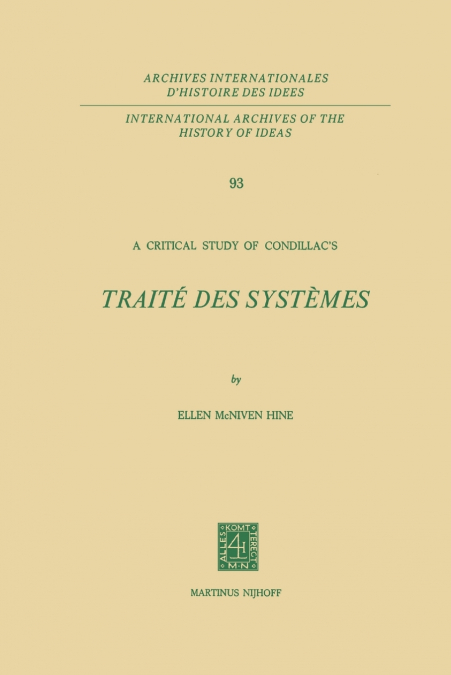
A Critical Study of Condillac’s

A Critical Study of Condillac’s

Ellen McNiven Hine

268,05 €
IVA incluido
Consulta disponibilidad
Editorial:
Springer Nature B.V.
Año de edición:
1979
Materia
Sociedad y cultura: general
ISBN:
9789024721207

Selecciona una librería:

  • Librería Samer Atenea
  • Librería Aciertas (Toledo)
  • Kálamo Books
  • Librería Perelló (Valencia)
  • Librería Elías (Asturias)
  • Donde los libros
  • Librería Kolima (Madrid)
  • Librería Proteo (Málaga)

The Traite des systemes is a milestone in the intellectual history of the eighteenth century. This is a study of its content, structure, sources and importance. It includes a discussion of Condillac’s analysis of good and bad systems, the adequacy of his knowledge and under­ standing of the speculative metaphysics of the preceding century, the effectiveness of his method of attack on seventeenth-century metaphysical systems, his conception of empirical and scientific method, and in particular his understanding of the role of hypotheses, his application of the Newtonian scientific method to politics, physics, and the arts, and, finally, his preoccupation with the meaning of words and with the origin and purpose oflanguage. Speculative metaphysical systems, such as those of Descartes, Malebranche, Boursier, Leibniz and Spinoza, are attacked by Con­ dillac, as are popular superstitions and prejudices, with the weapon of linguistic criticism. It is the systematic use of this weapon which makes the Traite des systemes more than a reflection of his contem­ poraries’ antipathy towards speculative metaphysics. In memory of my MOTHER and FATHER ACKNOWLEDGMENTS I wish to acknowledge my indebtedness to several people. I should like first and foremost to thank Dr. W. H. Barber, who has for many years tirelessly given me encouragement and invaluable assistance. I wish to thank also Professors RH. Rasmussen, A. D. Wilshere and C. Wake for their help and their support in the early days of the preparation of this study. lowe special thanks also to Mrs. M. V.


Artículos relacionados

  • The Gandhian Iceberg
    Chris D Moore-Backman
    The Gandhian Iceberg presents a bold, new interpretation of Gandhian nonviolence from the rare perspective of an author who is equal parts writer, scholar, and frontlines practitioner. The book faces the current crisis of climate change and the intensification of social unrest around the world, and calls for a new convergence of serious, spiritually-rooted US nonviolence activi...
    Disponible

    11,52 €

  • Contemporary Developments in Child Protection
    Nigel Parton
    Volume 1 "Policy Changes and Challenges" takes as its central theme the ongoing and challenging issues which child protection agencies have to address and the policy and practice initiatives that are developed to try and address these. The volume includes papers on: the relationship between the decline in the rate of ‘unnatural’ deaths and the growth of concern about child abus...
  • Diversity in Information Technology Education
    Goran Trajkovski
    ...
  • Model-Driven Software Development
    Model-driven software development (MDSD) drastically alters the software development process, characterized by a high degree of innovation and productivity. However, quality assurance application in the domain of software models and model-driven software development is still in an emergent phase. Model-Driven Software Development: Integrating Quality Assurance provides in-depth...
  • Evidence-Based Practice in Nursing Informatics
    Andrew Chasin
    Because of the constant advances and dynamics within the nascent field of nursing informatics, many nurses struggle in practice as they continue to try and apply habitual communication practices in the new environment without any critical reflection on, and adaptation of, those practices. Evidence-Based Practice in Nursing Informatics: Concepts and Applications serves as a valu...
  • Actor-Network Theory and Technology Innovation
    Arthur Tatnall
    About 25 years ago, the first developments of ANT (Actor-Network Theory) took place, but it wasn’t until much later that researchers began to take it seriously. In the late 1990s, ANT began to take hold in the scientific community as a new and exciting approach to socio-technical research and social theory. Actor-Network Theory and Technology Innovation: Advancements and New Co...

Otros libros del autor