 Librería Samer Atenea
 Kálamo Books
 Librería Elías (Asturias)
 Librería Kolima (Madrid)
 Librería Proteo (Málaga)
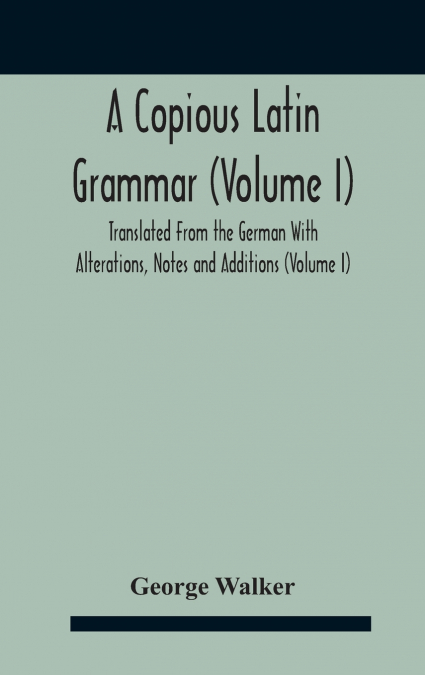
A Copious Latin Grammar returns the careful voice of nineteenth-century philology, methodical and exact, yet surprisingly readable. Language made precise and beautiful. Translated from the German and augmented by George Walker, Volume I acts as both a comprehensive latin manual and a practical latin grammar textbook: it sets out rules, exceptions and rationale with clarity, making latin syntax and usage intelligible without losing scholarly depth.Readers will find latin declensions explained with systematic paradigms and attentive commentary, treatments of moods and constructions that serve as an advanced latin grammar, and cross-references that reinforce learning. Its balance of explicit rules and illustrative examples lets beginners progress steadily while offering the granularity scholars expect. As a latin reference guide it balances formal rigour with pedagogical attention, so it is equally useful as a grammar for scholars, a tool for latin for students, and an academic language resource for tutors and researchers in classical language study and historical linguistics study. The arrangement favours quick consultation as well as sustained study, making it suitable for classroom use, private revision and curated collections. Careful paradigms and graded examples aid memorisation and review, and the exposition encourages comparative study of idiom and construction. Its measured tone and thoroughness make it especially valuable for advanced study and for researchers focused on historical linguistic change.Republished by Alpha Editions in a careful modern edition, this volume preserves the spirit of the original while making it effortless to enjoy today - a heritage title prepared for readers and collectors alike. More than a book of rules, it is a document of nineteenth century latin pedagogy and philological method: a reference that illuminates how generations learned and taught Latin. Casual readers curious about classical language study will find it approachable; classic-literature collectors and academic readers will prize it as both a working tool and a cultural treasure.