 Librería Samer Atenea
 Kálamo Books
 Librería Elías (Asturias)
 Librería Kolima (Madrid)
 Librería Proteo (Málaga)
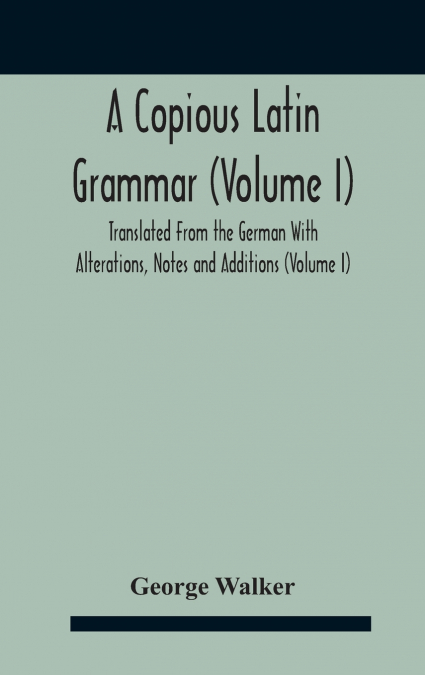
A handbook that defined nineteenth-century Latin study. Clear, rigorous, and elegantly delivered. George Walker’s A Copious Latin Grammar (Volume I), translated from the German with alterations, notes and additions, combines systematic explanation with the observational cast of Victorian era scholarship. Part practical manual, part comparative grammar resource, it organises paradigms and argument so that learners move from form to meaning with uncommon clarity. As a Latin grammar textbook and classical language reference it balances prescriptive guidance with lucid examples of Latin syntax and usage; students of classics and advanced Latin learners find here both immediate instruction and material for deeper historical linguistics study. The translator’s alterations and notes create a bridge between continental philology and English-speaking instruction, so readers encounter the German analytical tradition alongside practical guidance shaped for Anglophone learners.Readable enough for a curious amateur, robust enough for a tutor. Helpful for Latin language instruction at many levels. The volume functions as a comprehensive Latin guide for classroom use, private tuition or a homeschool Latin curriculum, and it rewards those seeking a rigorous study of syntax and nuance. Walker’s notes and alterations show engagement with contemporary German scholarship, making the work valuable for comparative study and for scholars tracing the development of nineteenth century education in classical subjects. Appeals to casual readers and classic-literature collectors, offering both reference utility and a window into a scholarly era. Republished by Alpha Editions in a careful modern edition, this volume preserves the spirit of the original while making it effortless to enjoy today - a heritage title prepared for readers and collectors alike. For the casual reader the volume offers rewarding passages of close analysis; for the collector it represents a tangible slice of Victorian-era scholarship and nineteenth-century education, an object of provenance and quiet admiration. Ideal for teachers designing curricula, scholars comparing grammars across languages, exam candidates sharpening parsing skills, and anyone curious about the techniques of nineteenth-century education, this edition dovetails practical instruction with historical perspective.