 Librería Samer Atenea
 Kálamo Books
 Librería Elías (Asturias)
 Librería Kolima (Madrid)
 Librería Proteo (Málaga)
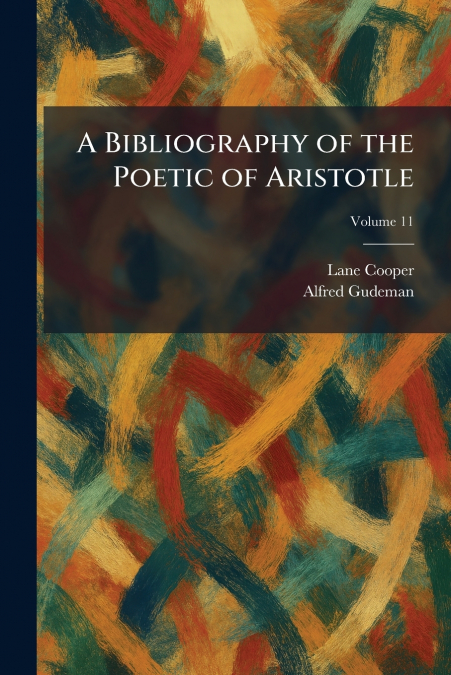
'A Bibliography of the Poetic of Aristotle' stands as an essential reference work for scholars of classical literature, philosophy, and literary theory. Compiled by Lane Cooper and Alfred Gudeman as part of the Cornell Studies in English series, this meticulous volume provides an exhaustive catalog of editions, translations, and critical commentaries concerning one of the most influential treatises in Western history: Aristotle’s 'Poetics'.The work organizes centuries of academic engagement with Aristotle’s theories on drama, mimesis, and catharsis, tracing the intellectual history and reception of the text from its early recovery through the early 20th century. By documenting a vast array of international scholarship, the bibliography serves as a vital tool for researchers seeking to understand the foundational principles of poetic art and the evolution of aesthetic criticism. This systematic collection remains an invaluable resource for anyone dedicated to the study of Greek literature, the history of rhetoric, and the enduring legacy of Aristotelian thought in the humanities.This work has been selected by scholars as being culturally important, and is part of the knowledge base of civilization as we know it. This work was reproduced from the original artifact, and remains as true to the original work as possible. Therefore, you may see the original copyright references, library stamps (as most of these works have been housed in our most important libraries around the world), and other notations in the work.This work is in the public domain in the United States of America, and possibly other nations. Within the United States, you may freely copy and distribute this work, as no entity (individual or corporate) has a copyright on the body of the work.As a reproduction of a historical artifact, this work may contain missing or blurred pages, poor pictures, errant marks, etc. Scholars believe, and we concur, that this work is important enough to be preserved, reproduced, and made generally available to the public. We appreciate your support of the preservation process, and thank you for being an important part of keeping this knowledge alive and relevant.