 Librería Samer Atenea
 Kálamo Books
 Librería Elías (Asturias)
 Librería Kolima (Madrid)
 Librería Proteo (Málaga)
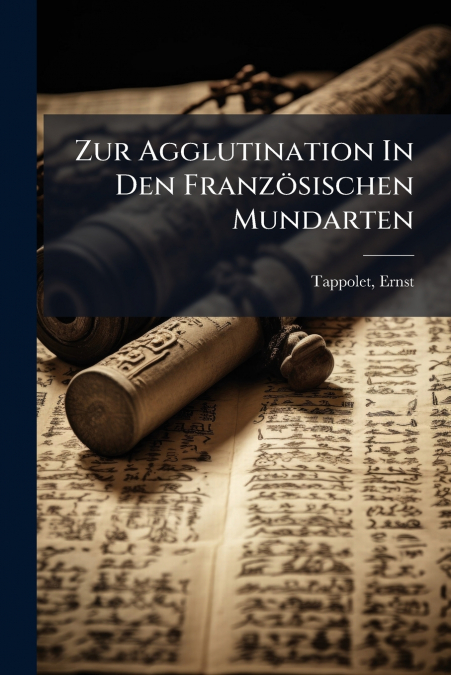
Zur Agglutination In Den Französischen Mundarten, by Ernst Tappolet, published in 1907, offers a detailed exploration of agglutination processes within French dialects. This study delves into the linguistic phenomena of word formation and structural changes observed across various regional dialects of French. Tappolet’s work provides valuable insights into the historical development and diversification of the French language, making it a significant resource for linguists and researchers interested in dialectology and historical linguistics.The book examines how different dialects employ agglutination-the process of combining morphemes to form words-and analyzes the resulting variations in grammar and vocabulary. This meticulous research contributes to a deeper understanding of the complexities inherent in linguistic evolution and the distinct characteristics of French regional languages. A key resource for scholars focusing on Romance languages and their historical transformations.This work has been selected by scholars as being culturally important, and is part of the knowledge base of civilization as we know it. This work was reproduced from the original artifact, and remains as true to the original work as possible. Therefore, you will see the original copyright references, library stamps (as most of these works have been housed in our most important libraries around the world), and other notations in the work.This work is in the public domain in the United States of America, and possibly other nations. Within the United States, you may freely copy and distribute this work, as no entity (individual or corporate) has a copyright on the body of the work.As a reproduction of a historical artifact, this work may contain missing or blurred pages, poor pictures, errant marks, etc. Scholars believe, and we concur, that this work is important enough to be preserved, reproduced, and made generally available to the public. We appreciate your support of the preservation process, and thank you for being an important part of keeping this knowledge alive and relevant.