 Librería Samer Atenea
 Kálamo Books
 Librería Elías (Asturias)
 Librería Kolima (Madrid)
 Librería Proteo (Málaga)
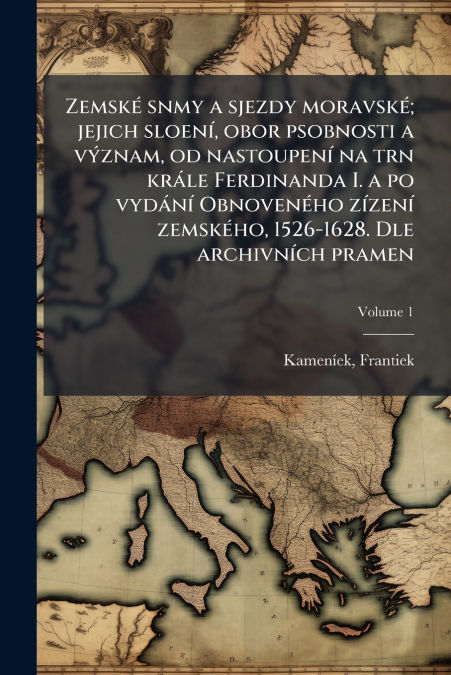
Zemské sněmy a sjezdy moravské; jejich složení, obor působnosti a význam, od nastoupení na trůn krále Ferdinanda I. a po vydání Obnoveného zřízení zemského, 1526-1628. Dle archivních pramenů, Volume 1, by František Kameníček, offers a detailed historical analysis of the Moravian diets and assemblies during a crucial period in Czech history. Covering the years 1526 to 1628, from the ascension of King Ferdinand I to the issuance of the Renewed Land Ordinance, this work explores the composition, scope, and significance of these regional bodies. Based on archival sources, Kameníček provides invaluable insights into the political and administrative structures of Moravia, shedding light on their role in the broader context of the Bohemian Revolt and the evolving relationship between the Czech lands and the Habsburg monarchy. This volume is an essential resource for scholars and historians interested in early modern Central European history and the development of regional governance.This work has been selected by scholars as being culturally important, and is part of the knowledge base of civilization as we know it. This work was reproduced from the original artifact, and remains as true to the original work as possible. Therefore, you will see the original copyright references, library stamps (as most of these works have been housed in our most important libraries around the world), and other notations in the work.This work is in the public domain in the United States of America, and possibly other nations. Within the United States, you may freely copy and distribute this work, as no entity (individual or corporate) has a copyright on the body of the work.As a reproduction of a historical artifact, this work may contain missing or blurred pages, poor pictures, errant marks, etc. Scholars believe, and we concur, that this work is important enough to be preserved, reproduced, and made generally available to the public. We appreciate your support of the preservation process, and thank you for being an important part of keeping this knowledge alive and relevant.