
Inicio > Derecho > Teoría general del derecho > YSEC Yearbook of Socio-Economic Constitutions 2023
YSEC Yearbook of Socio-Economic Constitutions 2023

YSEC Yearbook of Socio-Economic Constitutions 2023


218,28 €
IVA incluido
Consulta disponibilidad
Editorial:
Springer Nature B.V.
Año de edición:
2024
Materia
Teoría general del derecho
ISBN:
9783031558313

Selecciona una librería:

  • Librería Samer Atenea
  • Librería Aciertas (Toledo)
  • Kálamo Books
  • Librería Perelló (Valencia)
  • Librería Elías (Asturias)
  • Donde los libros
  • Librería Kolima (Madrid)
  • Librería Proteo (Málaga)

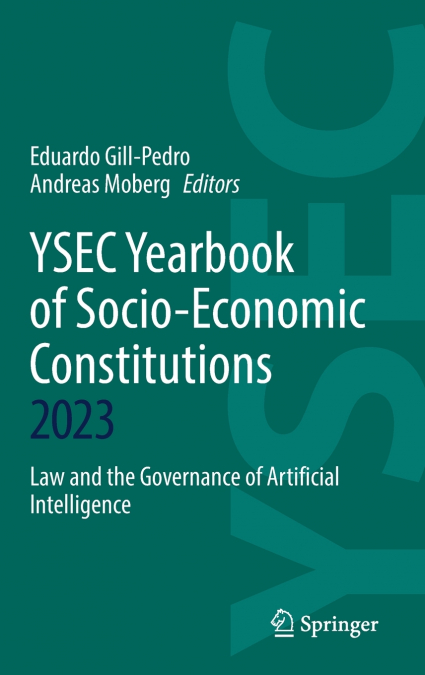
Artificial intelligence (AI) has the potential to radically transform our society. It may lead to a massive increase in the capabilities of humankind and allow us to address some of our most intractable challenges. It may also entail profound disruption to structures and processes that have sustained our society over centuries. These developments present a unique challenge to the socio-economic constitutional arrangements which govern our world at national, regional and international level. The deployment of increasingly powerful AI systems, able to function with increasing degree of autonomy, has led to concerns over loss of human control of important societal processes, over the disruption of existing economic, social and legal relationships, and over the empowerment of some societal actors at the expense of others, together with the entrenchment of situations of domination or discrimination. It has also made increasingly clear how tremendous the potential benefits, that these technologies may bring, are to those who successfully develop and deploy them. There is therefore great pressure on governments, international institutions, public authorities, civil society organisations, industry bodies and individual firms to introduce or adapt mechanisms and structures that will avoid the potentially negative outcomes of AI and achieve the positive ones. These mechanisms and structures, which have been given the umbrella term ’AI governance’, cover a wide range of approaches, from individual firms introducing ethical principles which they volunteer to abide by, to the European Union legislating an AI Act, which will prohibit certain types of AI applications and impose binding obligations on AI developers and deployers. The fast pace of innovation in the development of AI technologies is mirrored by the fast pace of development of the emerging field of AI governance, where traditional legislation by public bodies is complemented with more innovative approaches, such ashybrid and adaptive governance, ethical alignment, governance by design and the creation of regulatory sandboxes. The chapter 'AI and Sensitive Personal Data Under the Law Enforcement Directive: Between Operational Efficiency and Legal Necessity' is available open access under a Creative Commons Attribution 4.0 International License via link.springer.com. 

Artículos relacionados

  • EU General Data Protection Regulation (GDPR)
    IT Governance Privacy Team
    An in-depth guide to complying with the EU GDPR.Now in its second edition, EU GDPR – An Implementation and Compliance Guide is a clear and comprehensive guide to this new data protection law, providing a detailed commentary on the Regulation, and setting out the obligations of data  processors and controllers in clear and comprehensible terms.Read this book to learn: How the ...
    Disponible

    30,10 €

  • Banking Laws and Regulations in Nigeria
    Bello Mohammed Magaji
    Banking Law and Regulations in Nigeria: Selected Themes essentially deals with the laid down rules or code of conduct meant to control and set standards for banking business. Indeed, the main aim of the ongoing banking reforms in Nigeria, started in 2004, is to ensure banks’ conformity to the laid down banking rules and regulations. The eleven-chapter book contains vital and ri...
    Disponible

    41,17 €

  • States and the Interpretation of Treaties
    Dimitris Liakopoulos
    States and the Interpretation of Treaties opens with a provocative reconsideration of a debate on the subject of comparative international legal obligations by the United Nations’s International Law Commission. In this book, distinguished Tufts University legal scholar Dimitris Liakopoulos identifies and explores relevant considerations in the work of the Commission and offers ...
  • The role of customs in international treaties
    Dimitris Liakopoulos
    The Role of Customs in International Treaties concentrates on issues of friction between member states of the United Nations. In view of the role played by the United Nations in resolving international disputes, Dimitris Liakopoulos hypothesizes that 'practical guides' based on custom often catalyze the positions taken by states, courts, scholars, and other actors, constituting...
  • Debtor protection in American and European Union bankruptcy law
    Dimitris Liakopoulos
    In Debtor Protection in American and European Union Bankruptcy Law, international law scholar Dimitris Liakopulos raises a delicate issue at the foundations of the modern banking system by analyzing US bankruptcy law with a focus on the concept of automatic stay. His work identifies legal sources and authorities having repercussions in terms of operational protection. It then e...
  • Capital punishment in American courts
    James Biser Whisker / Kevin Spiker
    In the 400 years since the first known execution was carried out for treason in Virginia, American jurisdictions have debated both the appropriateness and methods of capital punishment. Over that time, courts have placed varying restrictions on its application, excluding categories of citizens (for example the insane or the underaged) and evaluating and excluding methods of exe...