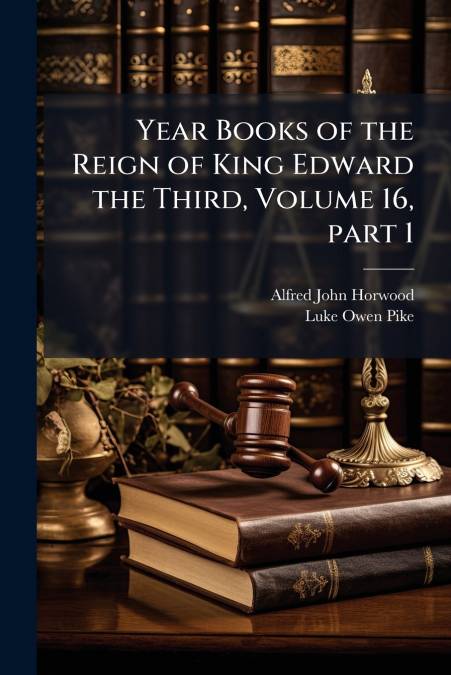
Alfred John Horwood / Luke Owen Pike
 Librería Samer Atenea
 Kálamo Books
 Librería Elías (Asturias)
 Librería Kolima (Madrid)
 Librería Proteo (Málaga)
This is a meticulously transcribed and edited volume from the Year Books of King Edward the Third’s reign, offering invaluable insight into the legal proceedings and judicial interpretations of 14th-century England. Compiled and translated by eminent legal historians Alfred John Horwood and Luke Owen Pike, this work provides a detailed record of court cases, arguments, and decisions that shaped the common law. Volume 16, part 2, presents a wealth of primary source material for legal scholars, historians, and anyone interested in the development of English jurisprudence. The 'Year Books' are essential for understanding the evolution of legal principles and the administration of justice during the medieval period. Discover the intricacies of property law, contract disputes, and criminal proceedings as they were argued and adjudicated in the courts of Edward III. This historical record offers a unique window into the past and remains a vital resource for legal research and historical study.This work has been selected by scholars as being culturally important, and is part of the knowledge base of civilization as we know it. This work was reproduced from the original artifact, and remains as true to the original work as possible. Therefore, you will see the original copyright references, library stamps (as most of these works have been housed in our most important libraries around the world), and other notations in the work.This work is in the public domain in the United States of America, and possibly other nations. Within the United States, you may freely copy and distribute this work, as no entity (individual or corporate) has a copyright on the body of the work.As a reproduction of a historical artifact, this work may contain missing or blurred pages, poor pictures, errant marks, etc. Scholars believe, and we concur, that this work is important enough to be preserved, reproduced, and made generally available to the public. We appreciate your support of the preservation process, and thank you for being an important part of keeping this knowledge alive and relevant.