
Inicio > > Ciencias de la computación > Windows® 64-bit Assembly Language Programming Quick Start
Windows® 64-bit Assembly Language Programming Quick Start

Windows® 64-bit Assembly Language Programming Quick Start

Windows® 64-bit Assembly Language Programming Quick Start

Robert Dunne

17,58 €
IVA incluido
Disponible
Editorial:
Gaul Communications
Año de edición:
2018
Materia
Ciencias de la computación
ISBN:
9780970112460
17,58 €
IVA incluido
Disponible

Selecciona una librería:

  • Librería Samer Atenea
  • Librería Aciertas (Toledo)
  • Kálamo Books
  • Librería Perelló (Valencia)
  • Librería Elías (Asturias)
  • Donde los libros
  • Librería Kolima (Madrid)
  • Librería Proteo (Málaga)

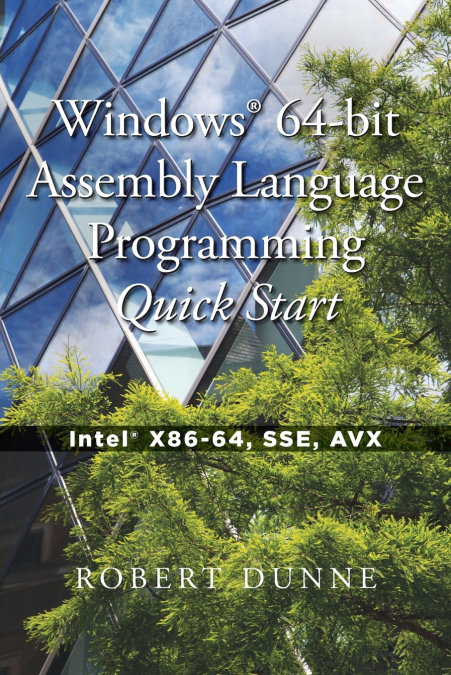
Windows® 64-bit Assembly Language Programming Quick Start is a complete tutorial using the free Community Edition of Microsoft® Visual Studio 17 to introduce the novice to the Intel® X86-64 architecture and the Windows X64 Calling Convention.

  • With Microsoft® Visual Studio 17, assembly language programs can be built using either its Integrated Development Environment (IDE) or using its ML64 assembler directly in a traditional command line approach. Both techniques are presented in this book, and each has its own merits for gaining a deeper understanding of computer software and hardware. The assistance provided by Visual Studio’s interactive debugger is immense not only for developing real programs but also learning how the CPU instructions work.
  • Programmers learn by example and develop their skills by examining and modifying working programs. Every sample program is complete, but leaves room for enhancements and experimentation encouraged by the questions at the end of each chapter. All are available for download through GitHub.
  • The sample programs, ranging from five to over one hundred lines of code, are extensively documented in both flowcharts and comments. Over seventy illustrations are included to explain programming techniques as well as X86, SSE, and AVX instructions. CPU instructions are introduced as needed to achieve programming goals as the projects in each chapter progress to the next.
  • This is not a book that has been modified or migrates from a 32-bit or 16-bit perspective, but starts right in with 64-bit programming and only refers to past approaches when necessary to explain seemingly unnatural conventions and names.
  • Topics like binary and hexadecimal are introduced through programming examples as well as appearing in appendices.
  • The examples in this book have been “classroom tested” with students having very little, if any, previous programming experience. The information is complete, allowing it to be used as an independent study.

Learning computer hardware and software architectures through hands-on assembly language programming experience helps develop well-rounded programmers and computer engineers.

Artículos relacionados

Otros libros del autor

  • Introduction to X86 Machine Code Assembly Language
    Robert Dunne
    Learn computer architecture and assembly language by building a working model of an 8086 processor from basic principles of computer architecture. Field Programmable Gate Arrays (FPGA) provide flexible digital electronics platforms that can be organized as a CPU, a neural net, or almost any other digital circuit.By working through the examples in this book and experimenting wit...
  • Computer Architecture Tutorial Using an FPGA
    Robert Dunne
    Learn computer architecture and get practical 'hands on' experience using an FPGA while studying at home. A working model of a 32-bit ARM processor is gradually built from basic principles of computer architecture. Field Programmable Gate Arrays (FPGA) provide flexible digital electronics platforms that can be organized as a CPU, a neural net, or almost any other digital circui...
  • Computers and the Law
    Robert Dunne
    ...