Will Palestine Go Extinct?

Will Palestine Go Extinct?

Naim Tahir Baig

39,99 €
IVA incluido
Disponible
Editorial:
Dr Naim Tahir Baig
Año de edición:
2025
Materia
Relaciones internacionales
ISBN:
9798231240395
39,99 €
IVA incluido
Disponible

Selecciona una librería:

  • Librería Samer Atenea

  • Kálamo Books
  • Librería Elías (Asturias)
  • Librería Kolima (Madrid)
  • Librería Proteo (Málaga)

BOOK DESCRIPTIONWill Palestine Go Extinct?A Comprehensive Examination of Palestinian Statehood, Identity, and Future SurvivalIn July 2024, the International Court of Justice delivered a landmark advisory opinion declaring Israel’s occupation of Palestinian territory-the West Bank, East Jerusalem, and Gaza-unlawful under international law. The Court mandated Israel to cease all settlement activities, evacuate settlers, and provide full reparations to Palestinian victims. Yet as this ruling was being delivered, the Palestinian population in Gaza was enduring what the United Nations has described as an unprecedented humanitarian catastrophe, with over 45,000 lives lost since October 2023 and 96% of the population facing acute food insecurity.Will Palestine Go Extinct? confronts one of the most pressing and provocative questions of our time: Can a nation survive without a state? At approximately 14.9 million people worldwide-with 5.5 million in the Palestinian territories, 1.8 million in Israel, and 7.6 million in diaspora-Palestinians constitute a demographically robust population. Yet they remain stateless, fragmented across continents, and subject to an occupation now entering its sixth decade. This meticulously researched work examines whether Palestinian national existence is threatened with extinction across multiple dimensions: territorial, political, cultural, and demographic.Drawing on data from the Palestinian Central Bureau of Statistics, UNRWA (which serves 5.9 million registered Palestinian refugees), the International Court of Justice, and leading human rights organizations including Amnesty International, Human Rights Watch, and B’Tselem, Dr. Baig presents a comprehensive analysis grounded in verifiable sources. The book examines the expansion of Israeli settlements-now exceeding 700,000 settlers in the West Bank and East Jerusalem-and the systematic fragmentation of Palestinian territory that has led major human rights organizations to designate the situation as one of apartheid.The work traces the historical trajectory from the Nakba of 1948, when 750,000 Palestinians became refugees, through the 1967 occupation, the Oslo Accords, and the current crisis. It analyzes the death of the two-state solution as settlement blocs have rendered territorial contiguity increasingly impossible, while also exploring alternative futures including confederation models, one democratic state scenarios, and the grim possibility of permanent occupation.Yet Will Palestine Go Extinct? is not merely a chronicle of dispossession. It documents Palestinian resilience-the concept of sumud (steadfastness)-that has preserved identity across generations and geography. It examines the growing international recognition of Palestine by over 146 countries, the impact of the BDS movement, and the shifting global opinion that has seen major powers including the United Kingdom, Canada, and Australia formally recognize Palestinian statehood in 2024-2025.Comparative analysis places the Palestinian case alongside other nations that survived existential threats-the Jewish people before 1948, the Kurds, the Armenians after genocide-as well as cautionary tales of national extinction from Native American nations to Tibet. This framework provides crucial context for assessing Palestinian futures.Written for general readers, policymakers, students, and scholars alike, Will Palestine Go Extinct? combines scholarly rigor with accessible prose. It presents multiple perspectives on contested issues while grounding analysis in international law, verifiable statistics, and documented facts. The conclusion is both sobering and significant: while the Palestinian people and their identity will almost certainly survive, Palestinian political sovereignty may never be achieved-and the next decade will be critical in determining which future prevails.
Artículos relacionados

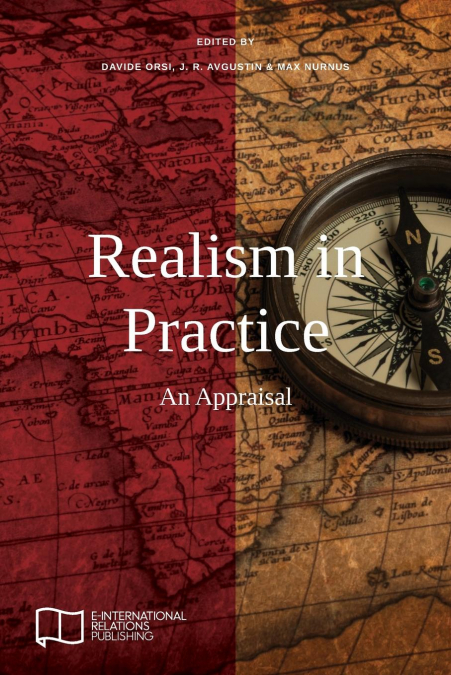
  • Realism in Practice
    The purpose of this book is to appraise the current relevance and validity of realism as an interpretative tool in contemporary International Relations. All chapters of the book are animated by a theoretical effort to define the conceptual aspects of realism and attempt to establish whether the tradition still provides the necessary conceptual tools to scholars.The chapters add...
    Disponible

    20,36 €

  • Predicting gender violence in India
    Shritha K Vasudevan
    In this provocative new book, Shritha Vasudevan argues that feminist international relations (IR) theory has inadvertently resulted in a biased worldview, the very opposite of what feminist IR set out to try to rectify. This book contests theoretical presumptions of Western feminist IR and attempts to reformulate it in contexts of non-Western cultures. Vasudevan deftly utilizes...
  • Contemporary security issues in Africa
    Isiaka Alani Badmus / Lere Amusan
    In volume, an emerging generation of African scholars examines specific states in Africa where instability is the order of the day. Considerations of African instability are highly relevant in today’s world, where one examines the types of regimes that were put in place after the Cold War and their effects on Africa. Multiparty systems introduced in Africa, rather than bringing...
  • Chronicles of the first and second chechen wars
    Ilya Milyukov
    Presented by Russian author and attorney Ilya Milyukov, Chronicles of the First and Second Chechen War presents the main events of the First (1994-1996) and Second (1999-2009) Wars in Chechnya, Russia’s deadliest conflicts since World War II. The First War began in December 1994 and lasted for one year and nine months, ending in August 1996. There were two major urban battles -...
  • Political instability in Africa
    Isiaka Alani Badmus / Lere Amusan
    This book offers broad-gauged analyses of the causes, nature, and changing patterns of armed conflict in Africa as well as the reasons for these patterns. It also situates conflicts that have been haunting the African continent since the time of decolonization within the various theoretical schools such as 'new war,' 'economic war,' 'neo-patrimonial,' and 'globalization.' It be...
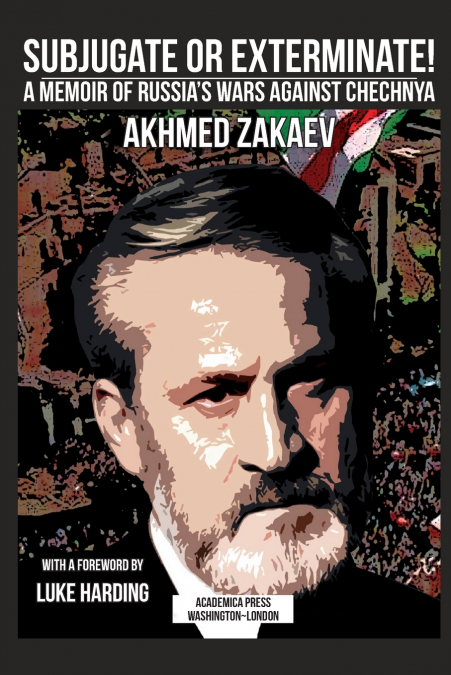
  • Subjugate or exterminate!
    Akhmed Zakaev / Arch Tait
    Foreword by Luke HardingAkhmed Zakaev is a symbol of the indomitable will of the Chechen nation. In this important memoir, he tells the story of the Chechen struggle as he experienced it, describing the conflict in human terms and providing a detailed documentary record of little known or badly understood events that will be of benefit to historians for generations to come.- Da...
    Disponible

    41,63 €

Otros libros del autor

  • The Perishable Advantage
    Naim Tahir Baig
    The Perishable Advantage: Pakistan, Hedging and the Multipolar Order after American Primacy, by Dr Naim Tahir Baig.When the world’s strongest power steps back, who steps forward, and what does it cost to stand there?In April 2026, American and Iranian negotiators sat down in Islamabad for the first direct talks between their governments since 1979. In the months that followed, ...
    Disponible

    55,74 €

  • The Orbit After Ambiguity
    Naim Tahir Baig
    SPACE SECURITY & ARMS CONTROLThe Orbit After AmbiguityHow the US Admitted It Has Weapons in SpaceThe first narrative account of what changed when the United States stopped keeping its space weapons secret.On September 14, 2026, the Secretary of the Air Force told a Washington audience that the United States 'has on-orbit space control weapons capable of defending the joint forc...
    Disponible

    73,95 €

  • The Stilwell Bypass
    Naim Tahir Baig
    In 1942 the United States Army pushed a road out of Ledo, in Assam, toward China. More than eighty years later, a question hangs over the same ground: could a different cargo travel part of that route, heavy rare earths dug from the clay hills of Kachin State in northern Myanmar and carried not east into China, as they are now, but west, toward India and toward separation plant...
    Disponible

    74,68 €

  • Extinction by Extraction?
    Naim Tahir Baig
    What we choose when we choose our mineralsEvery wind turbine, electric vehicle, guided missile and smartphone depends on a group of metals most people have never heard of. Rare earth elements make the modern world’s energy, defense and computing systems possible. They also come from some of the most toxic, concentrated and politically contested supply chains on Earth.Extinction...
    Disponible

    73,62 €

  • Theory in the Interregnum
    Naim Tahir Baig
    Theory in the InterregnumWhich International Relations Theory Explains What in a World of Fraying RulesBy Naim Tahir BaigThe liberal international order is fraying, and every school of International Relations claims to have seen it coming. Theory in the Interregnum asks a sharper question: which theory explains what? Dr Naim Tahir Baig argues that no new grand theory has displa...
    Disponible

    70,52 €

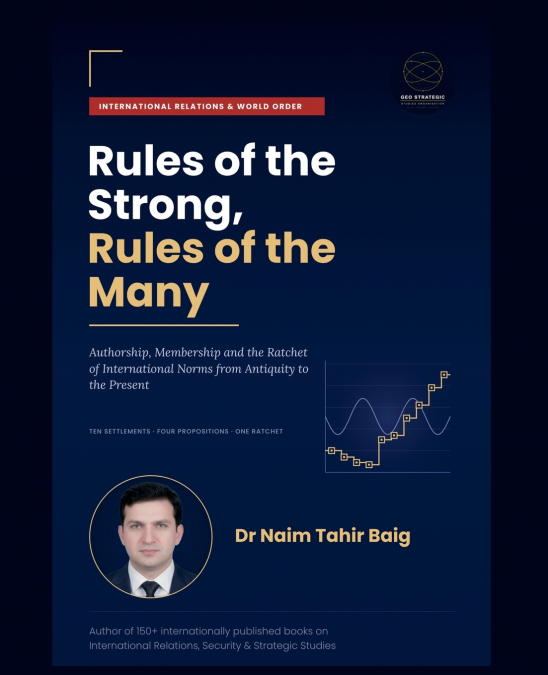
  • Rules of the Strong, Rules of the Many
    Naim Tahir Baig
    Rules of the Strong, Rules of the ManyAuthorship, Membership and the Ratchet of International Norms from Antiquity to the PresentBy Dr Naim Tahir BaigWho writes the rules of international order, and who do those rules protect? Rules of the Strong, Rules of the Many argues that international norms move in two rhythms at once. Authorship, meaning who writes and interprets the rul...
    Disponible

    75,59 €