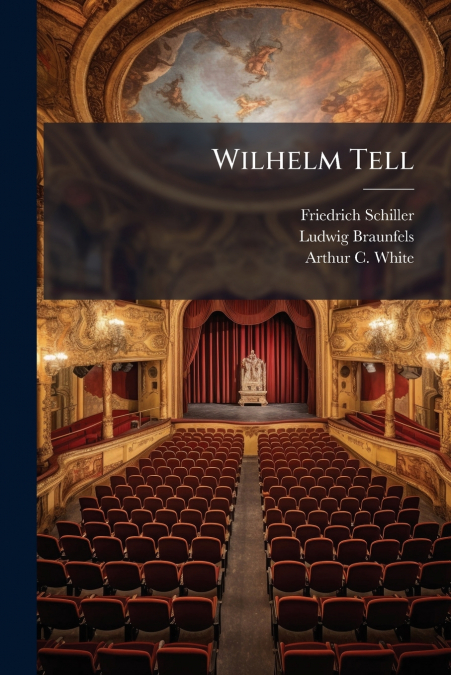
Friedrich Schiller / Ludwig Braunfels / Arthur C. White
 Librería Samer Atenea
 Kálamo Books
 Librería Elías (Asturias)
 Librería Kolima (Madrid)
 Librería Proteo (Málaga)
'Wilhelm Tell' ist ein dramatisches Werk des deutschen Dichters Friedrich Schiller, das die Geschichte des Schweizer Nationalhelden Wilhelm Tell erzählt. Das Stück spielt im frühen 14. Jahrhundert und thematisiert den Kampf der Schweizer Kantone gegen die habsburgische Herrschaft. Tell, ein einfacher, aber mutiger Mann, wird zum Symbol des Widerstands, als er sich weigert, vor dem Hut des Landvogts Gessler zu grüssen, und gezwungen wird, einen Apfel vom Kopf seines Sohnes zu schiessen. Schillers Drama ist ein Plädoyer für Freiheit und Gerechtigkeit und ein wichtiger Teil der deutschen Literaturgeschichte. Diese Ausgabe präsentiert Schillers Originaltext zusammen mit Anmerkungen und Erläuterungen von Ludwig Braunfels und Arthur C. White, die das Verständnis des historischen und literarischen Kontextes erleichtern. 'Wilhelm Tell' bleibt ein zeitloses Werk, das Leser und Zuschauer gleichermassen fesselt und zum Nachdenken über die Bedeutung von Mut, Widerstand und nationaler Identität anregt.This work has been selected by scholars as being culturally important, and is part of the knowledge base of civilization as we know it. This work was reproduced from the original artifact, and remains as true to the original work as possible. Therefore, you will see the original copyright references, library stamps (as most of these works have been housed in our most important libraries around the world), and other notations in the work.This work is in the public domain in the United States of America, and possibly other nations. Within the United States, you may freely copy and distribute this work, as no entity (individual or corporate) has a copyright on the body of the work.As a reproduction of a historical artifact, this work may contain missing or blurred pages, poor pictures, errant marks, etc. Scholars believe, and we concur, that this work is important enough to be preserved, reproduced, and made generally available to the public. We appreciate your support of the preservation process, and thank you for being an important part of keeping this knowledge alive and relevant.