
Inicio > Humanidades > Historia > Who Were the Shudras
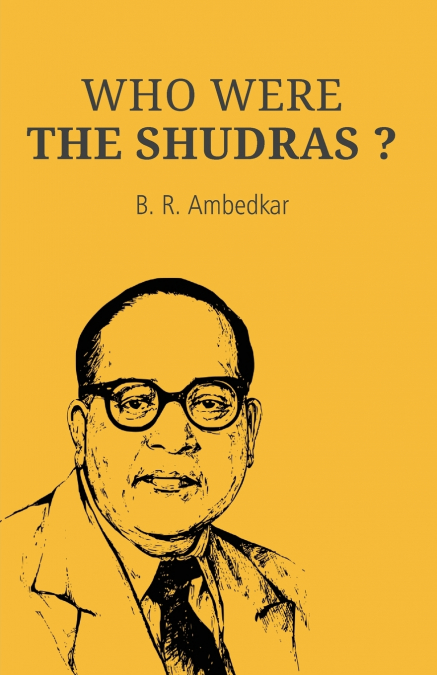
Who Were the Shudras

Who Were the Shudras

B.R. Ambedkar / B.RAmbedkar

18,60 €
IVA incluido
Disponible
Editorial:
Repro India Limited
Año de edición:
2021
Materia
Historia
ISBN:
9789388191814
18,60 €
IVA incluido
Disponible

Selecciona una librería:

  • Librería Samer Atenea
  • Librería Aciertas (Toledo)
  • Kálamo Books
  • Librería Perelló (Valencia)
  • Librería Elías (Asturias)
  • Donde los libros
  • Librería Kolima (Madrid)
  • Librería Proteo (Málaga)

In the present stage of the literature on the subject, a book on the Shudras cannot be regarded as a superfluity. Nor can it be said to deal with a trivial problem. The general proposition that the social organization of the Indo-Aryans was based on the theory of Chaturvarnya and that Chaturvarnya means division of society into four classes-Brahmins (priests), Kshatriyas (soldiers),Vaishyas (traders) and Shudras (menials) does not convey any idea of the real nature of the problem of the Shudras nor of its magnitude. Chaturvarnya would have been a very innocent principle if it meant no more than mere division of society into four classes. Unfortunately, more than this is involved in the theory of Chaturvarnya. Besides dividing society into four orders, the theory goes further and makes the principle of graded inequality. the basis for determining the terms of associated life as between the four Varnas. Again, the system of graded inequality is not merely notional. It is legal and penal. Under the system of Chaturvarnya, the Shudra is not only placed at the bottom of the gradation but he is subjected to inunumerable ignominies and disabilities so as to prevent him from rising above the condition fixed for him by law. Indeed until the fifth Varna of the Untouchables came into being, the Shudras were in the eyes of the Hindus the lowest of the low. This shows the nature of what might be called the problem of the Shudras. If people have no idea of the magnitude of the problem it is because they have not cared to know what the population of the Shudras is. Unfortunately, the census does not show their population separately. But there is no doubt that excluding the Untouchables the Shudras form about 75 to 80 per cent of the population of Hindus. A treatise which deals with so vast a population cannot be considered to be dealing with a trivial problem.


Artículos relacionados

  • Raising Freedom's Banner
    Paul Harris
    World wide history of peaceful street demonstrations from their earliest beginning in eighteenth century England to their use throughout the world in the twenty-first century. Describes why some demonstration movements succeeded and others failed. Contrasts demonstrations within the law with civil disobedience demonstrations. Describes Peterloo, the Chartists, the Suffragettes,...
    Disponible

    23,59 €

  • Waipi’o Valley
    Jeffrey L. Gross
    Waipi’o Valley: A Polynesian Journey from Eden to Eden recounts the remarkable migrations of the Polynesians across a third of the circumference of the earth. Their amazing journey began from Kalana i Hau’ola, the biblical “Garden of Eden” located along the shore of the Persian Gulf, extended to the Indus River Valley of ancient Vedic India, to Egypt where some ancestors of the...
  • Floralia
    June Rainsford Butler
    A century characterized by a growing interest in science, the opportunity for travel, and leisure for gardening furnishes the setting for Butler’s book. The rise of landscape gardening in England is traced, and the origin and history of its most famous gardens are given. The close relation between England and America in the field of horticulture is also discussed.Originally pub...
    Disponible

    61,20 €

  • President Wilson’s Addresses
    Woodrow Wilson
    'These addresses of President Woodrow Wilson are almost entirely concerned with political affairs, and more specifically with defining Americanism. Yet they also show that even as he moved from academia to the heights of politics, Wilson retained something of the teacher’s interest in showing the relation between specific instances and the general forms of thought or action of ...
  • The Story of my Life
    John Albert Macy
    The Story of My Life, is Helen Keller’s autobiography detailing her early life, especially her experiences with Anne Sullivan. The book is dedicated to inventor Alexander Graham Bell. The dedication reads, 'To ALEXANDER GRAHAM BELL Who has taught the deaf to speak and enabled the listening ear to hear speech from the Atlantic to the Rockies, I dedicate this Story of My Life.' ...
  • The Story of My Life Vol. 6 Spanish Passions
    Giacomo Casanova
    Casanova was an Italian adventurer and author from the Republic of Venice. His autobiography, Histoire de ma vie (Story of My Life), is regarded as one of the most authentic sources of the customs and norms of European social life during the 18th century. He has become so famous for his often complicated and elaborate affairs with women that his name is now synonymous with 'wom...

Otros libros del autor

  • Annihilation of Caste with a reply to Mahatma Gandhi
    B.R. Ambedkar / B.RAmbedkar
    The Second edition of this Essay appeared in 1937, and was exhausted within a very short period. A new edition has been in demand for a long time. It was my intention to recast the essay so as to incorporate into it another essay of mine called ' Castes in India, their Origin and their Mechanism ', which appeared in the issue of the Indian Antiquary Journal for May 1917. But as...
    Disponible

    14,49 €

  • Maharashtra as a Linguistic Province
    B.R. Ambedkar / B.RAmbedkar
    The figures quoted in this memorandum have been taken from various books and pamphlets written by various writers on the subject of reconstituting Maharashtra on a linguistic basis. I rely upon the writers for their accuracy. Similarly, the map of Maharashtra attached to this Memorandum need not be taken as accurate or complete. The idea is merely to give a picture of how the P...
    Disponible

    11,54 €

  • Mr Gandhi and Emancipation of the Untouchables
    B.R. Ambedkar / B.RAmbedkar
    In response to the invitation of the Chairman of the Indian section of the Institute of Pacific Relations, I wrote in August last year a Paper on the Problem of the Untouchables of India for the Session of the Conference which was due to be held on December 1942 at Mont’ Tramblant in Quebec in Canada. The Paper is printed in the proceedings of the Conference. Ever since it beca...
    Disponible

    11,39 €

  • The Buddha and His Dhamma
    B.R. Ambedkar / B.RAmbedkar
    Indications of a growth in the volume of interest in Buddhism are noticeable in some sections of the Indian people. Along with it there is naturally a growing demand for a clear and consistent statement of the life and teachings of the Buddha. Anyone who is not a Buddhist finds it extremely difficult to present the life and teachings of the Buddha in a manner which would make i...
    Disponible

    23,62 €

  • Small Holdings in India and their Remedies
    B.R. Ambedkar / B.RAmbedkar
    1. Importance of Agriculture, 2. Small Holdings in India, 3. Consolidation, 4. Enlargement, 5. Critique of The Remedies. ...
    Disponible

    11,45 €

  • Federation Versus Freedom
    B.R. Ambedkar / B.RAmbedkar
    A word or two as regards the origin of this tract and the motive which has led me to publish it at this time will, I think, not be out of place.Many in this country must be aware that there exists in Poona an institution which is called the GOKHALE INSTITUTE OF POLITICS AND ECONOMICS, WORKING under the direction of Dr. D. R. Gadgil.The Institute holds a function annually to cel...
    Disponible

    14,51 €