Whisk of the Red Broom

Whisk of the Red Broom

M. Andrew Holowchak

60,29 €
IVA incluido
Disponible
Editorial:
Vernon Art and Science
Año de edición:
2024
Materia
Historia de la economía
ISBN:
9798881901790
60,29 €
IVA incluido
Disponible

Selecciona una librería:

  • Librería Samer Atenea
  • Librería Aciertas (Toledo)
  • Kálamo Books
  • Librería Perelló (Valencia)
  • Librería Elías (Asturias)
  • Donde los libros
  • Librería Kolima (Madrid)
  • Librería Proteo (Málaga)

Once Joseph Stalin took the lead of the Soviet Bolshevists after the death of Vladimir Lenin, he quickly turned away from Lenin’s New Economic Policy, with its many concessions to capitalism, to a policy of one-country socialism, driven by his first Five Year Plan (1928) and a plan that other Bolsheviks like Lenin and Trotsky thought impossible. That shift, radical, forced Stalin to 'urbanize' the USSR’s vast rural areas-that is, to impose a factory-like model on the Soviet countryside to maximize its efficiency. That required collectivizing the numerous Soviet farms-making large farms of the numerous small farms. Ukraine was to be the model republic due to its vastness and black, fertile lands. Not only were the republics to be collectivized, they were also to be Russified for the sake of model efficiency and centralization of control. And so, while Stalin, early in his political life, preached respect for the cultural diversity of its many republics and the right of secession of any republic, the need to collectivize the Soviet farms for the sake of one-country socialism demanded compliance.Ukrainian peasant-farmers were non-compliant, for they readily saw that the State was asking them for everything and giving back nothing but the pledge of efficient farms to benefit the State, and non-compliance forced Stalin’s authoritarian hand. He imposed laws that brutally punished non-compliant peasants, called 'kulaks.' The plan was dekulakization. The intransigents were dispossessed of their property, alienated from other villagers, exiled, and exterminated. The result in Ukraine was the gross inefficiency of both collective and individual farms. That led to intolerance of Ukrainian culture and theft of Ukrainian grain, and even all other findable foodstuffs, to punish Ukrainians. The end was a great famine in 1932 and 1933 in which some four million Ukrainians died.Did Stalin believe that he could urbanize the Soviet countryside? Did Stalin think that socialism could take root in the backwater Soviet Union without the aid of Western succor? Did Stalin hate Ukrainians because many pressed for a cultural identity separate from that of Russia? Had Stalin’s plan of dekulakization from the beginning been a policy of political genocide? Those are some of the many questions I aim to answer in this book. I focus much on Stalin’s writings in the efforts to ascertain his mindset as a dictator.
Artículos relacionados

  • Foreign Banks and Global Finance in Modern China
    Ghassan Moazzin
    ...
    Disponible

    41,39 €

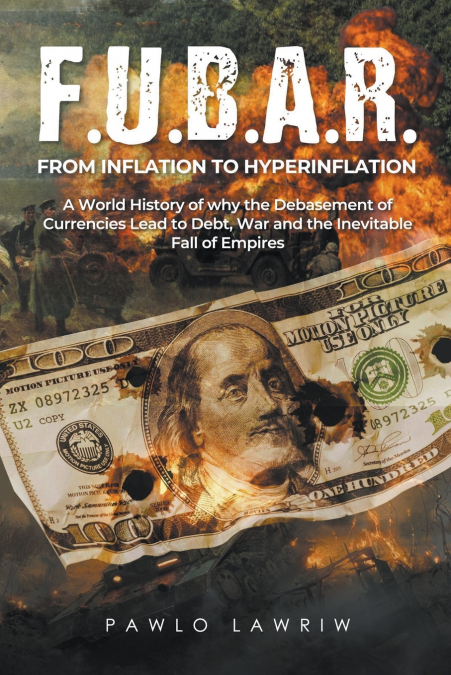
  • F.U.B.A.R. From Inflation to Hyperinflation
    Pawlo Lawriw
    Inflation and hyperinflation results in F.U.B.A.R on an epic scale. It can cause social and economic collapse and war and in short, change history- for the worse. If you are worried about inflation, who is not, then F.U.B.A.R. (F****d Up Beyond All Recognition) FROM INFLATION TO HYPERINFLATION is a work that you need to read.Some observers now wonder as society suffers from hig...
    Disponible

    18,47 €

  • Scarce and Valuable Economical Tracts
    John Ramsay McCulloch
    This volume, Scarce and Valuable Economical Tracts, was edited by John Ramsay McCulloch and originally published in 1859. It contains essays on political economy written by: Nicholas Barbon, Daniel Defoe, Henry Elking, Thomas Wise, Benjamin Franklin, Anne Robert Jacques Turgot, James Anderson, Alexander Schomberg, Joseph Townsend, Edmund Burke, and Archibald Bell.In her entry o...
    Disponible

    17,77 €

  • The Winding Road to the Welfare State
    George R. Boyer
    How did Britain transform itself from a nation of workhouses to one that became a model for the modern welfare state? The Winding Road to the Welfare State investigates the evolution of living standards and welfare policies in Britain from the 1830s to 1950 and provides insights into how British working-class households coped with economic insecurity. George Boyer examines the ...
    Disponible

    46,98 €

  • Joseph Alois Schumpeter
    Wolfgang F. Stolper
    In this major scholarly study of the life of Joseph A. Schumpeter, one of the great intellectual figures of the twentieth century, the distinguished economist Wolfgang Stolper delves into the mind of his former teacher, exploring the development of his ideas and, especially, their influence on politics and public policy. After reflecting briefly on Schumpeter the man, Stolper e...
    Disponible

    110,15 €

  • An Economic History of the Iberian Peninsula, 700-2000
    ...

Otros libros del autor

  • The Disease of Liberty
    M. Andrew Holowchak
    Liberty for Jefferson was ’the’ driving force of human history and a realizable state of the human organism and of a society of men. Study of history and anthropology showed that humans were moving from the barbaric independence suffered in primal hordes, which lived inefficiently on lands, to a more economical, human-friendly use of land in social settings, demanding laws for ...
    Disponible

    66,61 €

  • Thomas Jefferson on American Indians
    M. Andrew Holowchak
    Jefferson’s views on Indians were characterized by ambivalence. Jefferson both loved and hated Native Americans, because he loved Native Americans. Jefferson was, through his father Peter, exposed early on and directly, though likely infrequently, to mysterious but congenial Indigenes, and he came to respect profoundly their courage, physical endurance, artistry, integrity, and...
    Disponible

    67,79 €

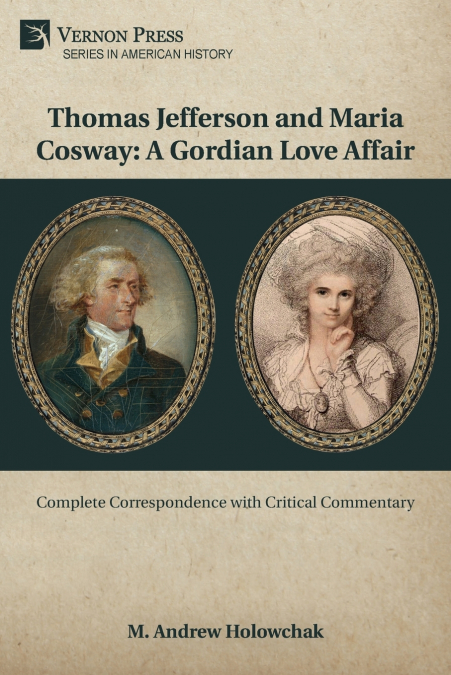
  • Thomas Jefferson and Maria Cosway
    M. Andrew Holowchak
    This is the only book to offer the complete correspondence between Thomas Jefferson and Maria Cosway, a talented artist for whom Jefferson fell while in France. There is agreement in the secondary literature that Jefferson’s affection for Hemings was reciprocated. This book shows that that cannot be believed. Holowchak also shows that Cosway, through letters late in life, much ...
    Disponible

    47,27 €

  • Thomas Jefferson’s ’Notes on the State of Virginia’
    M. Andrew Holowchak
    Why did Jefferson write ’Notes on the State of Virginia’? There are today two common theses. The first, the Alphabet-Soup Thesis, maintains that the book is more or less a loose collection of notes in answer to the 22 queries given by French diplomat François Barbé-Marbois. Jefferson’s altering the arrangement of his answers to the questions is a matter of allowing for a smooth...
    Disponible

    66,38 €

  • Thomas Jefferson on Taste and the Fine Arts
    M. Andrew Holowchak
    Jefferson tended to classify the books of his libraries under the Baconian headings of memory, reason, and imagination, which corresponded to history, philosophy, and the fine arts. Thus, education in the Fine Arts, which Jefferson listed as eight, was considered an indispensible part of the life of an educated person-especially a Virginian. An educated person needed knowledge ...
    Disponible

    59,28 €

  • Thomas Jefferson in Paris
    M. Andrew Holowchak
    Jefferson’s years in France as minister plenipotentiary were a time of large edification. He approached his ministry as a 'looker on': Jefferson, while in France, always kept a critical distance from events, so that he could measure and critically examine them from the perspective of a dispassionate natural philosopher. Being dispassionate, Jefferson was pulled into events only...
    Disponible

    62,73 €