
When the State Kills

When the State Kills

Austin Sarat

53,87 €
IVA incluido
Disponible
Editorial:
Princeton University Press
Año de edición:
2002
Materia
Teoría general del derecho
ISBN:
9780691102610
53,87 €
IVA incluido
Disponible

Selecciona una librería:

  • Librería Samer Atenea
  • Librería Aciertas (Toledo)
  • Kálamo Books
  • Librería Perelló (Valencia)
  • Librería Elías (Asturias)
  • Donde los libros
  • Librería Kolima (Madrid)
  • Librería Proteo (Málaga)

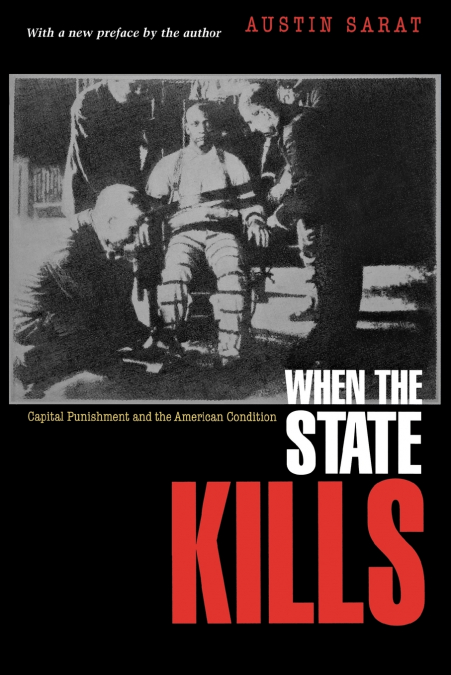
Is capital punishment just? Does it deter people from murder? What is the risk that we will execute innocent people? These are the usual questions at the heart of the increasingly heated debate about capital punishment in America. In this bold and impassioned book, Austin Sarat seeks to change the terms of that debate. Capital punishment must be stopped, Sarat argues, because it undermines our democratic society. Sarat unflinchingly exposes us to the realities of state killing. He examines its foundations in ideas about revenge and retribution. He takes us inside the courtroom of a capital trial, interviews jurors and lawyers who make decisions about life and death, and assesses the arguments swirling around Timothy McVeigh and his trial for the bombing in Oklahoma City. Aided by a series of unsettling color photographs, he traces Americans’ evolving quest for new methods of execution, and explores the place of capital punishment in popular culture by examining such films as Dead Man Walking, The Last Dance, and The Green Mile. Sarat argues that state executions, once used by monarchs as symbolic displays of power, gained acceptance among Americans as a sign of the people’s sovereignty. Yet today when the state kills, it does so in a bureaucratic procedure hidden from view and for which no one in particular takes responsibility. He uncovers the forces that sustain America’s killing culture, including overheated political rhetoric, racial prejudice, and the desire for a world without moral ambiguity. Capital punishment, Sarat shows, ultimately leaves Americans more divided, hostile, indifferent to life’s complexities, and much further from solving the nation’s ills. In short, it leaves us with an impoverished democracy. The book’s powerful and sobering conclusions point to a new abolitionist politics, in which capital punishment should be banned not only on ethical grounds but also for what it does to Americans and what we cherish.


Artículos relacionados

  • EU General Data Protection Regulation (GDPR)
    IT Governance Privacy Team
    An in-depth guide to complying with the EU GDPR.Now in its second edition, EU GDPR – An Implementation and Compliance Guide is a clear and comprehensive guide to this new data protection law, providing a detailed commentary on the Regulation, and setting out the obligations of data  processors and controllers in clear and comprehensible terms.Read this book to learn: How the ...
    Disponible

    30,10 €

  • Banking Laws and Regulations in Nigeria
    Bello Mohammed Magaji
    Banking Law and Regulations in Nigeria: Selected Themes essentially deals with the laid down rules or code of conduct meant to control and set standards for banking business. Indeed, the main aim of the ongoing banking reforms in Nigeria, started in 2004, is to ensure banks’ conformity to the laid down banking rules and regulations. The eleven-chapter book contains vital and ri...
    Disponible

    41,17 €

  • States and the Interpretation of Treaties
    Dimitris Liakopoulos
    States and the Interpretation of Treaties opens with a provocative reconsideration of a debate on the subject of comparative international legal obligations by the United Nations’s International Law Commission. In this book, distinguished Tufts University legal scholar Dimitris Liakopoulos identifies and explores relevant considerations in the work of the Commission and offers ...
  • The role of customs in international treaties
    Dimitris Liakopoulos
    The Role of Customs in International Treaties concentrates on issues of friction between member states of the United Nations. In view of the role played by the United Nations in resolving international disputes, Dimitris Liakopoulos hypothesizes that 'practical guides' based on custom often catalyze the positions taken by states, courts, scholars, and other actors, constituting...
  • Debtor protection in American and European Union bankruptcy law
    Dimitris Liakopoulos
    In Debtor Protection in American and European Union Bankruptcy Law, international law scholar Dimitris Liakopulos raises a delicate issue at the foundations of the modern banking system by analyzing US bankruptcy law with a focus on the concept of automatic stay. His work identifies legal sources and authorities having repercussions in terms of operational protection. It then e...
  • Capital punishment in American courts
    James Biser Whisker / Kevin Spiker
    In the 400 years since the first known execution was carried out for treason in Virginia, American jurisdictions have debated both the appropriateness and methods of capital punishment. Over that time, courts have placed varying restrictions on its application, excluding categories of citizens (for example the insane or the underaged) and evaluating and excluding methods of exe...

Otros libros del autor

  • Law, Politics and Family in ’The Americans’
    Austin Sarat
    Interpreting The Americans through a socially charged lens, this special issue offers a compelling insight into the legal and cultural undertones of family dynamics, as well as those at the heart of conservative American politics. ...
  • Human Dignity
    Austin Sarat
    This special issue investigates the meaning of justice and dignity and how they have changed over time. What do we mean by human dignity? How do we understand and interpret that meaning? How has it evolved? ...
  • Interrupting the Legal Person
    Austin Sarat
    This special issue is part one of a two-part edited collection on interrupting the legal person, and what this means. The chapters in this volume interrogate the role of the person and personhood in different contexts, jurisdictions, and legal traditions. ...
  • Interrupting the Legal Person
    Austin Sarat
    This special issue is part two of a two-part edited collection on interrupting the legal person, and what this means. Should we think of the legal person as a technical and grammatical question that varies across different legal traditions and jurisdictions? Does this cut across different ways of living and speaking law? ...
  • Privatisation of Migration Control
    Austin Sarat
    This special issue is the second of a two-part edited collection on the privatisation of migration. The central thrust of the special issue is a critical analysis of modern day manifestations of private participation in immigration control. ...
  • Studies in Law, Politics, and Society
    Austin Sarat
    This volume brings together an interdisciplinary collection of scholars to critically examine issues around hatred and the law. With chapters on different elements of the nexus between hatred and law, the volume makes a key contribution to the field and is essential reading for legal scholars. ...