 Librería Samer Atenea
 Kálamo Books
 Librería Elías (Asturias)
 Librería Kolima (Madrid)
 Librería Proteo (Málaga)
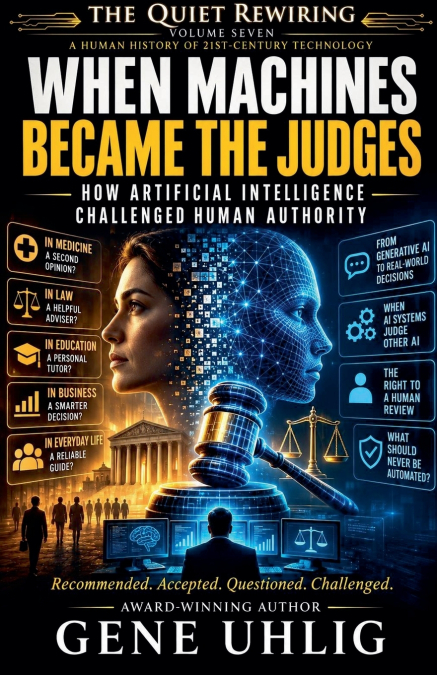
THE MACHINES HAVE LEARNED TO ANSWER. NOW WE MUST DECIDE HOW MUCH AUTHORITY TO GIVE THEM.For decades, computers helped human beings calculate, organize information, and predict outcomes. Then artificial intelligence began doing something extraordinary. It learned to communicate in ordinary language, explain complicated subjects, evaluate alternatives, and recommend what people should do next.The relationship between humans and machines was changing.A physician could consult an AI assistant about a difficult diagnosis. An attorney could request an analysis of legal arguments. A teacher could seek guidance about a struggling student. A business executive could ask a machine to evaluate competing strategies.The answers could be remarkably useful.They could also be dangerously convincing when they were wrong.In When Machines Became the Judges: How Artificial Intelligence Challenged Human Authority, award-winning author Gene Uhlig examines one of the most consequential technological transformations of the twenty-first century: the growing influence of artificial intelligence over human judgment.Through historical research, documented developments, and accessible illustrations, Uhlig explores how generative AI moved from experimental technology into professional workplaces, public institutions, and everyday life.Discover how:• Generative artificial intelligence transformed computers from information-processing tools into conversational advisers.• Physicians, attorneys, educators, and business professionals began incorporating AI recommendations into their work.• Artificial intelligence systems increasingly evaluated the conclusions and recommendations produced by other machines.• The growing dependence on automated recommendations raised questions about accountability, transparency, and meaningful human oversight.• Individuals and institutions confronted the question of whether certain decisions should always remain under human authority.The book examines both the extraordinary possibilities and the serious limitations of artificial intelligence, presenting a balanced historical account without technological sensationalism or political advocacy.When does helpful advice become unquestioned authority?Who is responsible when a machine’s recommendation leads to a consequential decision?And what should never be automated?Volume Seven of The Quiet Rewiring: A Human History of Technology in the Twenty-First Century continues the series’ exploration of the technologies that have quietly transformed modern society.Although connected to the preceding volumes, this book stands independently and requires no technical background.For readers interested in artificial intelligence, technology history, the future of work, professional responsibility, and the changing relationship between humans and machines, When Machines Became the Judges offers an engaging examination of a transformation already underway.The future of artificial intelligence will depend on more than what machines become capable of doing. It will also depend on what human beings decide they should be allowed to do.3. Draft2Digital Long Book DescriptionFor Draft2Digital, I recommend a slightly more concise description that works across Apple Books, Barnes & Noble, Kobo, and other ebook retailers.When artificial intelligence begins advising human beings, who is really making the decisions?